On this page
How to identify it
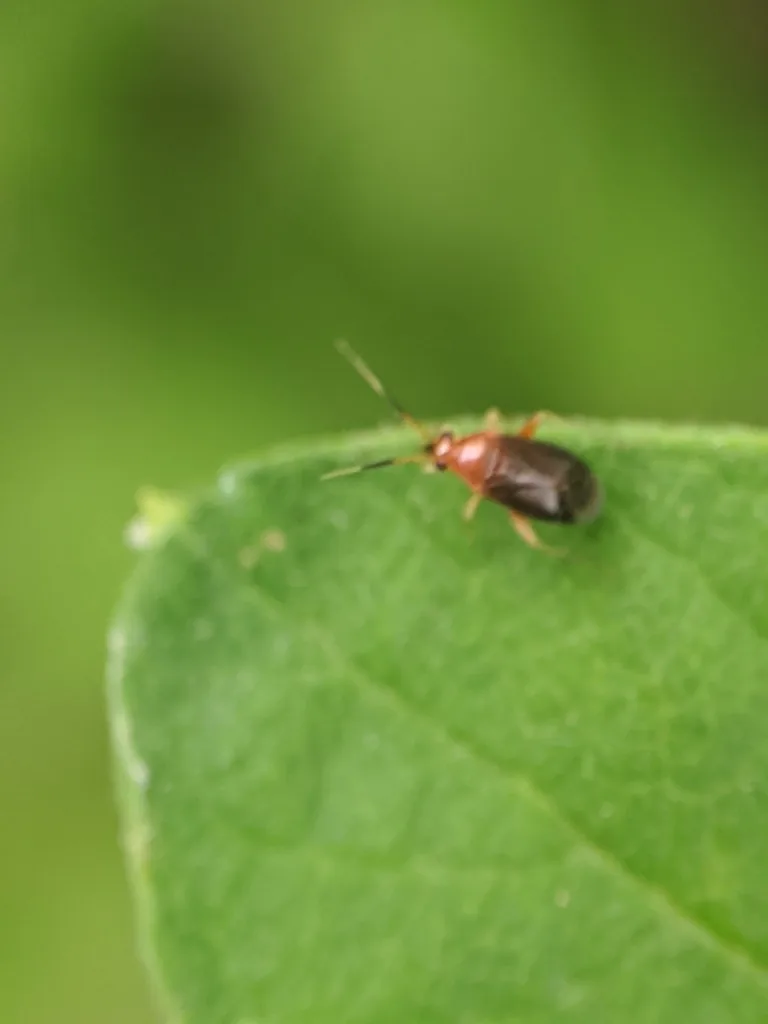
- Adults are about 1/8 inch (3.5 to 4 mm) long, shiny and oblong-oval, brown to dark brown or orange-winged on top and orange underneath with a black face.[1][2]
- Nymphs are bright red to vermilion with white antennae and feet, and are well camouflaged on red azaleas.[1][2]
- A beak for sucking juices separates it from similarly colored beetles; disturbed bugs dodge to the underside of the leaf.[2]
- Newly hatched nymphs are bright red and less than 1 mm long; later nymphs are 1.5 to 3.0 mm long, nearly vermilion, with somewhat darker wing pads. Adults' wings look orangeish in the field but turn dark brown to black in older specimens.[2]
Look-alikes
| Look-alike | How to tell them apart |
|---|---|
| Azalea lace bug | A more damaging azalea pest; the azalea plant bug does far less harm to the plant's looks.[1] |
Where it lives
Generally distributed from Ontario south to North Carolina and west to Missouri, according to Wheeler and Herring. GBIF occurrence records come from the United States and Canada, including states from Maine and Minnesota south to Texas, Alabama and South Carolina.[2][3]
Biology and life cycle
Eggs overwinter in azalea stems and hatch around bloom time, in early to mid-May near Harrisburg, Pennsylvania.[1][2]
There are five nymphal stages and one generation a year; adults appear in early June and are gone by mid-July, some moving to raspberries, spirea and plum.[1][2]
Timing shifts with latitude: development in northern Pennsylvania runs about two weeks behind Harrisburg, adults don't appear until late June or early July at Ithaca, New York, and near Washington, D.C. they may develop as early as mid-May.[2]
It breeds on native and cultivated azaleas, and is more common on deciduous kinds such as flame azalea; it also breeds to a lesser extent on raspberry.[2]
Damage and signs
Health risk
It often bites gardeners working in azaleas, leaving a painful, chigger-like welt.[1][2]
Control
Prevention
Usually no control is needed: it is far less damaging to the appearance of azaleas than the azalea lace bug, and control may become necessary mainly when large numbers turn up on azaleas grown for seed.[1][2]
Pesticides
If people object to being bitten, NC State Extension says a number of pesticides labeled for plant bug control should all work well. Sevin (carbaryl) is probably the most readily available, and home garden products containing pyrethrins or resmethrin should also work. Follow the label.[1]
Where sources disagree
Range: Wheeler and Herring describe it as distributed from Ontario to North Carolina and west to Missouri, while GBIF holds records farther south and west, including Texas and Alabama.[2][3]
Common questions
- What tiny red bug bit me while I trimmed my azaleas?
- Most likely an azalea plant bug nymph or adult, active around azalea bloom.[1][2]
- Does the azalea plant bug hurt my azaleas?
- Very little. It may slightly deform flowers and destroy pollen, which matters mainly on plants grown for seed, and it is much less damaging than the azalea lace bug.[2][1]
Sources
- NC State Extension, “Azalea Plant Bug (PDIC Factsheet).” content.ces.ncsu.edu/azalea-plant-bug (accessed 2026-11-12)
- American Rhododendron Society (Wheeler and Henry, Pennsylvania Department of Agriculture); Virginia Tech Libraries archive copy, “A Potential Insect Pest of Azaleas (Rhinocapsus vanduzeei), Quarterly Bulletin of the American Rhododendron Society 33(1).” scholar-dev.cloud.lib.vt.edu/ejournals/JARS/v33n1/v33n1-wheeler.html (accessed 2026-11-12)
- Global Biodiversity Information Facility (GBIF), “Rhinocapsus vanduzeei Uhler, 1890: occurrence records.” www.gbif.org/species/2008948 (accessed 2026-11-12)
- iNaturalist, “Rhinocapsus vanduzeei taxon page (order and family).” www.inaturalist.org/taxa/454095 (accessed 2026-11-12)