On this page
How to identify it
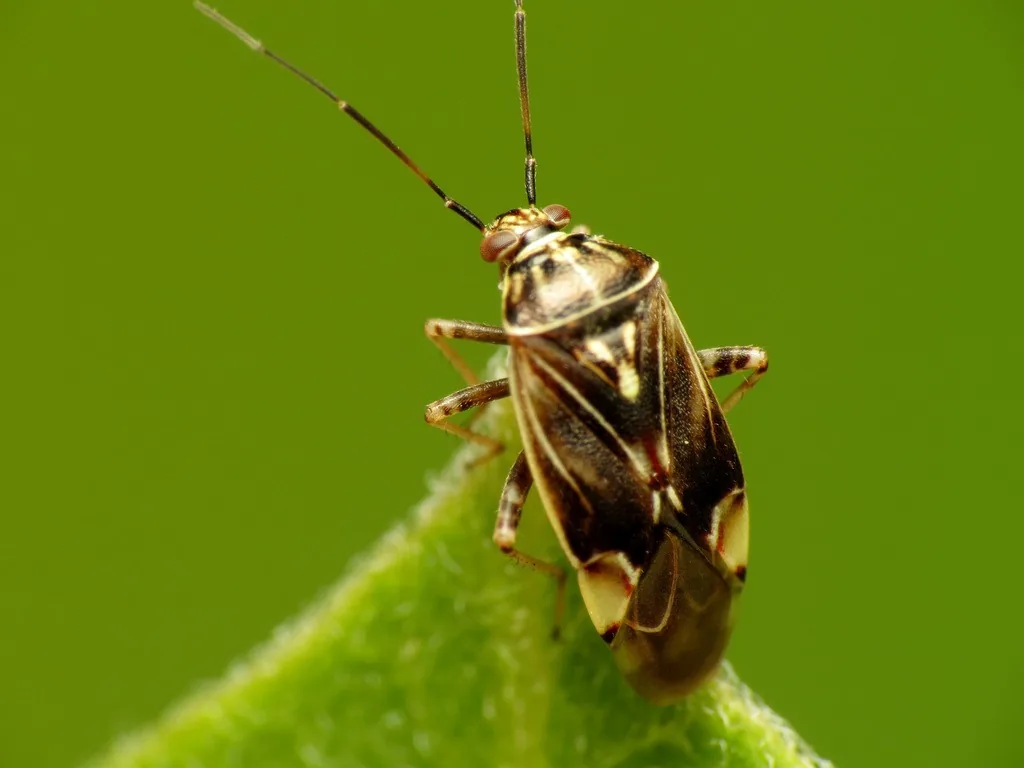
- Adults are about 1/4 inch (6 to 6.5 mm) long, oval and fragile-looking, bronze to dark brown or greenish brown with yellowish, white and black markings that give a brassy, tarnished look.[1][4][2][3]
- A yellow V- or Y-shaped mark sits on the wings, and the back third of the wings slants down toward the tip of the abdomen.[2][1]
- Nymphs are wingless, green to greenish yellow, with black dots on the back of older nymphs.[1][2]
- They are very active and take flight at the slightest disturbance.[4]
Look-alikes
| Look-alike | How to tell them apart |
|---|---|
| Stink bugs | Stink bugs are wider, shield-shaped bugs with a large triangle on the back, though their fruit damage can look almost identical to plant bug damage.[5] |
| Poor pollination (strawberries) | Small berries from poor pollination have hollow, hair-like projections instead of seeds; deformed berries with developed seeds point to plant bug injury.[4] |
Where it lives
Cornell says it's found throughout North America but is mainly a pest in temperate, non-desert areas; Virginia Tech describes it across the eastern half of the United States and west into the Great Plains.[3][2]
Biology and life cycle
It overwinters in leaf litter, under stones and in other protected places, becoming active on the first warm spring days. Penn State and Cornell say adults overwinter; Virginia Tech says adults and older nymphs.[1][2][3]
Females insert eggs into soft plant tissue such as buds, young stems or leaf veins. Hatch time varies by source: 5 to 7 days (Penn State), about a week (Cornell) or ten days (Virginia Tech). Insecticides have no effect on the eggs.[1][2][3]
Nymphs pass through five stages in about 12 to 40 days, depending on temperature. Cornell says there are two to five generations a year depending on location.[1][3]
It has been recorded on 385 plants, and populations often build up in flowering weeds such as daisy fleabane, ragweed and goldenrod.[1]
Damage and signs
- Penn State says it's believed to inject a toxic substance, possibly digestive enzymes, while feeding; the injury discolors, distorts and sometimes kills plant tissue.[1][2]
- Feeding on young fruit causes catfacing, with sunken, deformed or scarred areas; catfaced fruit is safe to eat but unsightly.[2]
- On strawberries, feeding on seeds of young berries causes small, seedy, woody button berries that fail to mature.[4][2]
- Feeding below flower buds can make flowers wilt and die, and attacks on shoot tips cause stunting, bud loss and tip die-back.[2][1]
- Hosts include strawberries, asparagus, celery, beans, potatoes, cauliflower, broccoli, peaches and carrots; Cornell says it damages more than fifty economically important plants, including most tree fruits grown in the United States.[1][3]
Health risk
It feeds on plant sap. Penn State, Virginia Tech and Cornell describe plant damage only and don't mention any risk to people or pets, and Virginia Tech says catfaced fruit is safe to eat.[1][2][3]
Control
Prevention
The bugs build up on flowering weeds before moving into crops, so weeds in and around the garden matter.[1][4][2]
Penn State says not to mow or cut nearby weeds while strawberries are blooming and setting fruit, because the bugs move into the patch when weeds are cut.[4]
Minor injury is tolerable; some varieties with very hairy fruit may resist damage.[2]
To monitor, use white sticky traps, which catch adults; Cornell uses unbaited white sticky boards hung low as a monitoring method.[1][3]
Biological control
Nabids, bigeyed bugs, lady beetles, spiders and parasitic wasps attack it, but Cornell says they can't control it effectively.[3]
Pesticides
Virginia Tech says sprays are often only partly effective because the bugs fly off and return, and they don't affect eggs inside plant tissue.[2][1]
Where the sources disagree
Mowing weeds: Penn State says not to cut weeds near strawberries during bloom and fruit set, because the bugs move into the crop. Virginia Tech says reducing or mowing weedy hosts around plantings may lower nearby populations.[4][2]
Range: Cornell says it occurs throughout North America; Virginia Tech gives the eastern half of the United States west to the Great Plains.[3][2]
Common questions
- Why are my strawberries small, hard and seedy?
- Tarnished plant bugs feeding on young berries cause button berries; if the deformed berry has developed seeds, plant bug injury is the likely cause.[4]
- Is catfaced fruit safe to eat?
- Yes. Fruit catfaced by tarnished plant bug feeding can be eaten safely, though it looks scarred and deformed.[2]
Sources
- Penn State Extension, “Tarnished Plant Bug (updated June 24, 2026).” extension.psu.edu/tarnished-plant-bug (accessed 2026-11-13)
- Virginia Cooperative Extension, Virginia Tech, “Tarnished Plant Bug, Publication 444-227 (ENTO-476NP), December 2021.” www.pubs.ext.vt.edu/444/444-227/tarnished-plant-bug.html (accessed 2026-11-13)
- Cornell University, New York State Integrated Pest Management, “Tarnished Plant Bug (Lygus lineolaris) Fruit Fact Sheet (last updated 2022).” cals.cornell.edu/integrated-pest-management/outreach-education/fact-sheets/tarnished-plant-bug-lygus-lineolaris-fruit-fact-sheet (accessed 2026-11-13)
- Penn State Extension, “Tarnished Plant Bug on Strawberries in Home Gardens (updated March 31, 2026).” extension.psu.edu/tarnished-plant-bug-on-strawberries-in-home-gardens (accessed 2026-11-13)
- University of California Statewide IPM Program, “Stink Bugs (Pest Notes, Home and Landscape).” ipm.ucanr.edu/home-and-landscape/stink-bugs/ (accessed 2026-11-13)
- Global Biodiversity Information Facility (GBIF), “Lygus lineolaris (Palisot de Beauvois, 1818) (GBIF Backbone Taxonomy).” api.gbif.org/v1/species/5152838 (accessed 2026-11-13)
- iNaturalist, “Lygus lineolaris taxon page (order and family).” www.inaturalist.org/taxa/84507 (accessed 2026-10-06)