On this page
How to identify it
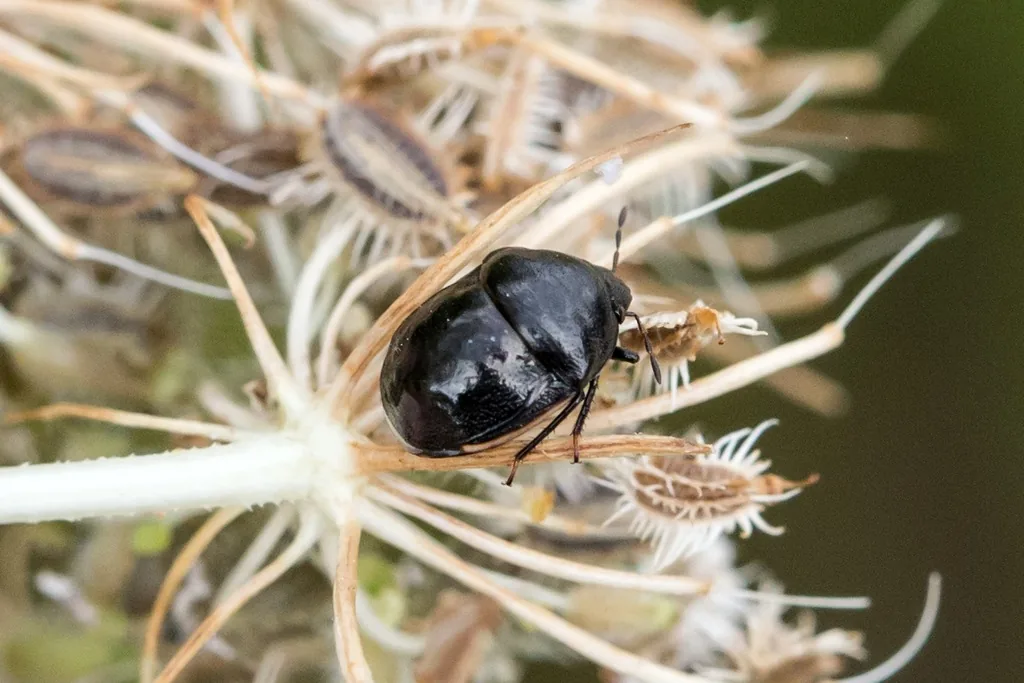
- Adults are less than 1/4 inch long, many only about 1/8 inch, with fat, almost round bodies.[1]
- They are usually shiny black, with an enlarged, shell-like plate (the scutellum) covering most or all of the abdomen and the wings, which makes them look like beetles.[1]
- Up close, the antennae have five segments, the straw-like beak has four, and the shins have no spines or only thin ones.[1]
- Corimelaena pulicaria has a row of bristles on the tibia of its legs, smells like almond extract when handled and can make a faint squeaking sound.[2]
Look-alikes
| Look-alike | How to tell them apart |
|---|---|
| Hister (clown) beetles | Tiny, black, rounded beetles whose hard covering is a pair of wing covers meeting in a straight line down the back; ebony bugs have one shield-like plate.[1] |
| Burrowing bugs, shield-backed bugs and stink bugs | Some relatives of ebony bugs are also tiny, rounded and black or blackish; the ebony bug family is told apart by body shape and size, five-segmented antennae, four-segmented beak and spineless or thin-spined shins.[1] |
Where it lives
More than 40 species in three genera (Corimelaena, Cydnoides and Galgupha) occur in North America north of Mexico, and they are found statewide in Missouri; the Connecticut station lists Corimelaena pulicaria among the insect problems of lobelia. GBIF holds about 900 U.S. records of the family since 1990 from 46 state-level areas, the most from New Mexico, Florida and Texas; about 90 of the U.S. records are Corimelaena pulicaria.[1][2][3][4]
Biology and life cycle
They feed by jabbing their straw-like beaks into flowers and developing seeds, especially of carrot-family plants such as Queen Anne's lace, rattlesnake master, fennel, dill and wild parsnip, and often occur by the dozens.[1]
They develop by simple metamorphosis, from egg through wingless nymphs to winged adults. The Missouri Department of Conservation says they probably overwinter as adults; the Connecticut station says Corimelaena pulicaria overwinters in the soil and becomes active in late April.[1][2]
A surprising find: males of a related species, Corimelaena extensa, release a newly identified pheromone that draws other bugs into feeding groups on wild tobacco. Researchers found the males released 40 times more of it on one tobacco species than on another, and that adults were more fertile on the first.[5]
Damage and signs
- Little is known about their effect on crops or landscape plants; the Missouri Department of Conservation says it is apparently rather mild. When Corimelaena pulicaria is abundant, its feeding causes injury similar to that of other plant bugs.[1][2]
- They must reduce seed production of their food plants somewhat, but given how many seeds those plants make, the Missouri Department of Conservation says the impact must not be drastic.[1]
Health risk
They feed on plants; the Missouri Department of Conservation and the Connecticut station mention no risk to people.[1][2]
Control
Prevention
Control is rarely needed: little is known about their effect on plants and it appears mild. Where they injure plants, the Connecticut station manages them like other plant bugs on perennials.[2][1]
Biological control
Leave them for wildlife: the Missouri Department of Conservation says they are a good source of protein for birds that visit flower heads and are eaten by many predatory insects.[1]
Where the sources disagree
Effect on plants: the Missouri Department of Conservation says little is known and the impact is apparently rather mild; the Connecticut station says Corimelaena pulicaria causes injury similar to other plant bugs and refers readers to plant bug control on perennials.[1][2]
Overwintering: the Missouri Department of Conservation says ebony bugs probably overwinter as adults; the Connecticut station says Corimelaena pulicaria overwinters in the soil and becomes active in late April.[1][2]
Common questions
- What are the tiny shiny black 'beetles' on my flowers?
- They may be ebony bugs, true bugs whose large back plate makes them look like tiny black beetles or seeds. Look for them on Queen Anne's lace, dill and fennel.[1]
- How can I tell an ebony bug from a beetle?
- A beetle's hard 'shell' is a pair of wing covers that meet in a straight line down the back; an ebony bug's shell is one plate, and it has a straw-like beak instead of chewing jaws.[1]
- Why does the little black bug I caught smell like almonds?
- Smelling like almond extract when handled is a known trait of Corimelaena pulicaria, an ebony bug the Connecticut station lists among the insect problems of lobelia.[2]
- Do I need to spray ebony bugs?
- Rarely. Their effect on plants appears mild; where they do injure perennials, treat them like other plant bugs.[1][2]
Sources
- Missouri Department of Conservation, “Ebony Bugs (Field Guide).” mdc.mo.gov/discover-nature/field-guide/ebony-bugs (accessed 2026-11-13)
- Connecticut Agricultural Experiment Station, “Plant Pest Handbook: Lobelia.” portal.ct.gov/caes/plant-pest-handbook/pphl/lobelia-lobelia (accessed 2026-11-13)
- Global Biodiversity Information Facility (GBIF), “Thyreocoridae: U.S. occurrence records since 1990 by state (GBIF occurrence search).” api.gbif.org/v1/occurrence/search?taxonKey=7898&country=US&hasGeospatialIssue=false&occurrenceStatus=PRESENT&year=1990%2C2026&facet=stateProvince&facetLimit=400&limit=0 (accessed 2026-11-13)
- Global Biodiversity Information Facility (GBIF), “Corimelaena pulicaria: U.S. occurrence records since 1990 by state (GBIF occurrence search).” api.gbif.org/v1/occurrence/search?taxonKey=2079425&country=US&hasGeospatialIssue=false&occurrenceStatus=PRESENT&year=1990%2C2026&facet=stateProvince&facetLimit=400&limit=0 (accessed 2026-11-13)
- New Phytol 2016;211(1):113-125, via PubMed, “Plant-mediated pheromone emission by a hemipteran seed feeder increases the apparency of an unreliable but rewarding host.” pubmed.ncbi.nlm.nih.gov/26915986/ (accessed 2026-11-13)
- Global Biodiversity Information Facility (GBIF), “Thyreocoridae Amyot & Serville, 1843 (GBIF Backbone Taxonomy).” api.gbif.org/v1/species/7898 (accessed 2026-11-13)
- Global Biodiversity Information Facility (GBIF), “Corimelaena pulicaria (Germar, 1839) (GBIF Backbone Taxonomy).” api.gbif.org/v1/species/2079425 (accessed 2026-11-13)
- iNaturalist, “Thyreocoridae taxon page (order and family).” www.inaturalist.org/taxa/133023 (accessed 2026-10-06)