On this page
How to identify it
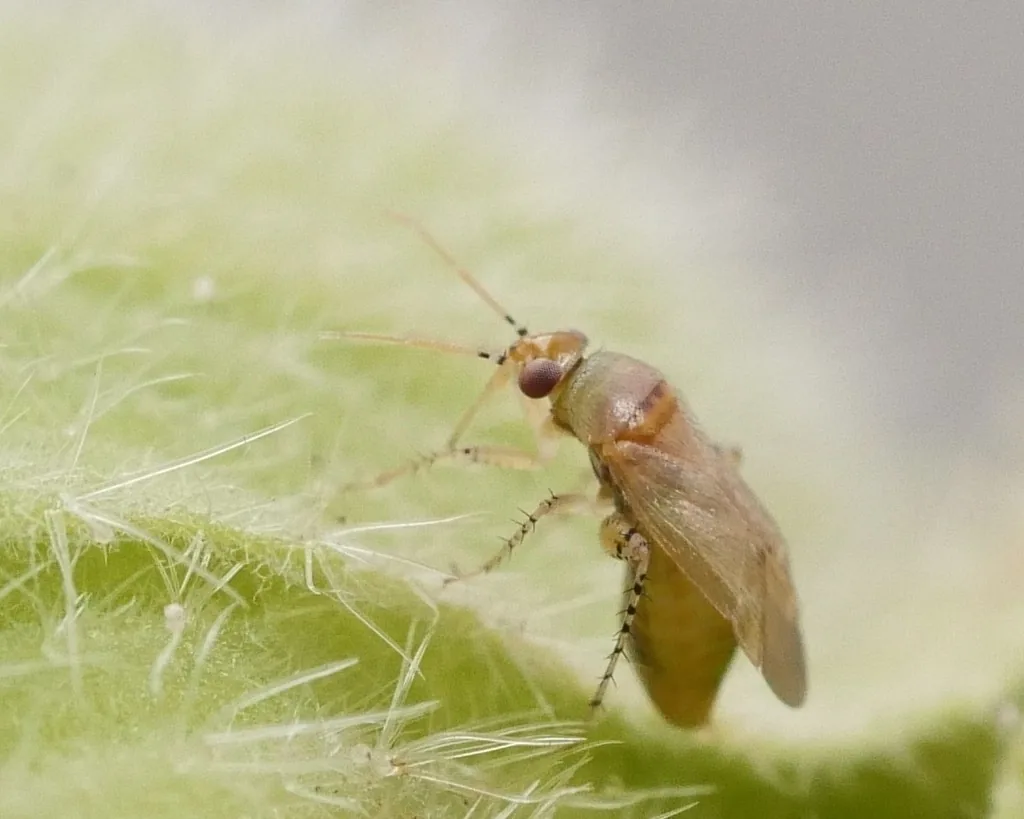
- Adults are only about 1/10 inch long, an elongated oval, greenish brown to grayish brown or brownish yellow, and very mobile and active. The PNW handbook notes a dark spot on the antennae and black spines on the legs.[1][2][4][3]
- Nymphs are oval, pale (translucent white per Utah State, green or pale green per the PNW handbook and Penn State) and fast moving; older ones develop black spines on the legs. Mature nymphs can pass for aphids, but they run instead of sitting still.[1][2][3]
- Nymphs can also be confused with white apple leafhopper nymphs; Penn State says the campylomma nymph has a stouter body and thicker, clearly segmented antennae with a dark stripe near the base.[3]
- Eggs are about 1/28 inch long and sac shaped, inserted into bark or under bud scales with only the lid exposed, so they are almost impossible to find.[1][3]
- The damage is easier to spot than the insect: a dark, raised, corky wart, often in a shallow depression, appearing on young apples shortly after petal fall, sometimes with dimpling or distortion of the fruit.[1][2][3]
Look-alikes
| Look-alike | How to tell them apart |
|---|---|
| Aphids | Mature campylomma nymphs resemble aphids in some ways but are far more active, scurrying away when the leaf is disturbed.[2][4] |
| White apple leafhopper | Its nymphs can be confused with campylomma nymphs; the campylomma nymph is stouter, with thicker, clearly segmented antennae that have a dark stripe near the base.[3] |
| Lygus bugs (tarnished plant bugs) | Lygus bugs are larger plant bugs that also cause dimpled, distorted fruit; the campylomma bug is about 1/10 inch long and its fruit injury is limited to the bloom-to-petal-fall window.[1][2] |
| Pear psylla | Pear psylla is one of the pests the campylomma bug eats; on pear the campylomma bug itself rarely damages fruit.[1][4][5] |
Where it lives
Not native to the United States, present since the late 1800s and of Asian or European origin. Utah State reports it in Utah apple orchards, the Pacific Northwest handbook covers it in apples and pears, Penn State calls it infrequent in Pennsylvania, and it is studied in Quebec orchards. GBIF holds 59 U.S. records since 1990 from 15 states, the most from New York (12) and Utah (10).[2][4][1][3][6][7]
Biology and life cycle
Tree hosts are apple, pear and other rosaceous plants, plus oak; the herbaceous hosts include common mullein (Verbascum thapsus), the weed the insect is named for, as well as potato, sugar beet, corn and small grains.[1][4][2]
It overwinters as eggs laid in young twigs and bark crevices of apple, pear and related trees. Eggs begin hatching before bloom, at about the pink stage (Utah State) or from tight cluster through petal fall (Penn State).[1][2][3]
In late spring part of the first-generation adults leave for herbaceous plants, especially mullein, where they feed on the plant and prey on aphids and thrips, although some stay in orchards all season. From late summer into fall adults move back into orchards to mate and lay the overwintering eggs. Utah State counts about three to four generations a year; Penn State says two to four, each lasting about 3 to 4 weeks.[1][2][3]
Late nymphs and adults prey on aphids, mites and pear psylla. Washington and Oregon pear researchers count it as a key natural enemy: when about 3 Campylomma immatures turn up per 30 beating trays, they suggest skipping an optional third-generation pear psylla spray.[1][5]
Damage and signs
- Only the young nymphs damage fruit, by feeding on blossom calyxes and developing fruitlets. The injury shows shortly after petal fall as small corky areas, alone or in a depression, with dimpling and deformity; severe injury can cat-face the fruit, and Penn State says many injured fruits drop in June. Apples are susceptible until they reach about half an inch in diameter.[1][2][3]
- Variety matters. Utah State and Penn State say Golden Delicious is more susceptible than Red Delicious and other dark-skinned apples, and early-blooming varieties are hit hardest. In Quebec tests, nymphs made more feeding punctures on Red Delicious than Honeycrisp, more on 7-9 mm than 18-20 mm Red Delicious fruitlets, and at harvest Red Delicious had more damage than Lobo and Marshall McIntosh.[1][3][2][6]
- Pear fruit is rarely damaged even when populations are high, and Penn State calls it an infrequent pest in Pennsylvania.[1][4][3]
Health risk
It feeds on fruit trees, weeds and small insects. Utah State, the PNW handbook and Penn State describe it only as a fruit pest and orchard predator and don't mention any risk to people or pets.[1][2][3]
Control
Prevention
Decide whether to treat by monitoring early: tap limbs over a tray from the pink stage through petal fall, or look closely at flowers and fruitlets, to count nymphs and adults. Bugs seen later in the season are not harmful to the crop, and Utah State says the adult is a beneficial predator, so do not control unless necessary.[2][3][1]
Traps and physical control
Damaged fruit can simply be thinned off.[2][4]
Biological control
No effective natural enemies of the campylomma bug have been found, and Utah State knows of no cultural tactics that work. The insect is itself a natural enemy of aphids, mites, thrips and psylla, which is why pear researchers count it before deciding on psylla sprays.[1][2][5]
Pesticides
The window is narrow: between egg hatch and the time nymphs scar the fruit. Utah State says bloom through petal fall is the most vulnerable stage and sprays by late bloom work best, while Penn State advises a petal-fall application only where fruit damage was heavy the year before; any spray must protect pollinators. Utah State lists acetamiprid, which it marks as available in homeowner products, and formetanate hydrochloride, which is toxic to bees and predatory mites, must be applied at night during bloom and must not be used after petal fall. The PNW handbook says no products are registered for home use against this pest on apple or pear (see where the sources disagree).[1][3][2][4]
When to call a professional
Commercial apple options in the PNW handbook include acetamiprid (not to be applied when bees are active), esfenvalerate and thiamethoxam (highly toxic to bees and not for use during bloom), each with seasonal limits; commercial pear orchards generally do not need treatment.[2][4]
Where the sources disagree
Egg hatch: Utah State says eggs begin hatching at about the pink stage; Penn State says hatch begins about tight cluster and finishes about petal fall; the PNW handbook says eggs begin to hatch before bloom.[1][3][2]
Generations: Utah State says about three to four a year; Penn State says two to four.[1][3]
Nymph color: Utah State says nymphs are translucent white; the PNW handbook and Penn State describe them as green.[1][2][3]
Summer: Utah State says campylomma can be found in apple and pear orchards throughout the growing season; Penn State says later generations move to weedy hosts, most notably mullein, for most of the summer.[1][3]
Home products: Utah State marks acetamiprid as available in homeowner products; the PNW handbook says no products are specifically registered for home use against campylomma bug on apple or pear.[1][2][4]
Common questions
- My young apples have little corky dimples. Is it too late to spray?
- Yes. The scars are made by nymphs feeding from bloom through petal fall, and once the fruit passes about half an inch in diameter the bug cannot damage it. Thin the worst fruit and plan to monitor at bloom next spring.[1][2]
- Should I kill the campylomma bugs I see in summer?
- No. Outside the bloom window they are not harmful to the crop, and the nymphs and adults eat aphids, mites, thrips and pear psylla.[3][1][2]
- Why is it called the mullein plant bug?
- Common mullein is one of its preferred herbaceous hosts. Part of the first generation leaves the orchard for mullein and other weeds in late spring and comes back in late summer and fall to lay eggs.[1][4][3]
- Is the campylomma bug harmful to people?
- Utah State and Penn State describe it only as a fruit pest around bloom and a predator of other insects the rest of the year, and don't mention any risk to people or pets.[1][3]
Sources
- Utah State University Extension, Integrated Pest Management Program, “Campylomma Bug (Utah Pests fact sheet).” extension.usu.edu/planthealth/ipm/notes_ag/fruit-campylomma-bug.php (accessed 2026-11-13)
- Pacific Northwest Pest Management Handbooks (Oregon State University, Washington State University and University of Idaho), “Apple: Campylomma bug, Pacific Northwest Insect Management Handbook.” pnwhandbooks.org/insect/tree-fruit/apple/apple-campylomma-bug (accessed 2026-11-13)
- Penn State Extension, “Tree Fruit Insect Pest - Mullein Plant Bug.” extension.psu.edu/tree-fruit-insect-pest-mullein-plant-bug (accessed 2026-11-13)
- Pacific Northwest Pest Management Handbooks (Oregon State University, Washington State University and University of Idaho), “Pear: Campylomma bug, Pacific Northwest Insect Management Handbook.” pnwhandbooks.org/insect/tree-fruit/pear/pear-campylomma-bug (accessed 2026-11-13)
- J Econ Entomol 2023;116(4):1249-1260, via PubMed, “Pear psylla and natural enemy thresholds for successful integrated pest management in pears.” pubmed.ncbi.nlm.nih.gov/37341151/ (accessed 2026-11-13)
- J Econ Entomol 2016;109(6):2463-2471, via PubMed, “Phytophagy by the Mullein Bug (Hemiptera: Miridae) on Apples: Feeding Behavior and Fruit Damage.” pubmed.ncbi.nlm.nih.gov/27694183/ (accessed 2026-11-13)
- Global Biodiversity Information Facility (GBIF), “Campylomma verbasci: U.S. occurrence records since 1990 by state (GBIF occurrence search).” api.gbif.org/v1/occurrence/search?taxonKey=2011329&country=US&hasGeospatialIssue=false&occurrenceStatus=PRESENT&year=1990%2C2026&facet=stateProvince&facetLimit=400&limit=0 (accessed 2026-11-13)
- Global Biodiversity Information Facility (GBIF), “Campylomma verbasci (Meyer-Dur, 1843) (GBIF Backbone Taxonomy).” api.gbif.org/v1/species/2011329 (accessed 2026-11-13)
- iNaturalist, “Campylomma verbasci taxon page (order and family).” www.inaturalist.org/taxa/748452 (accessed 2026-11-10)