On this page
How to identify it
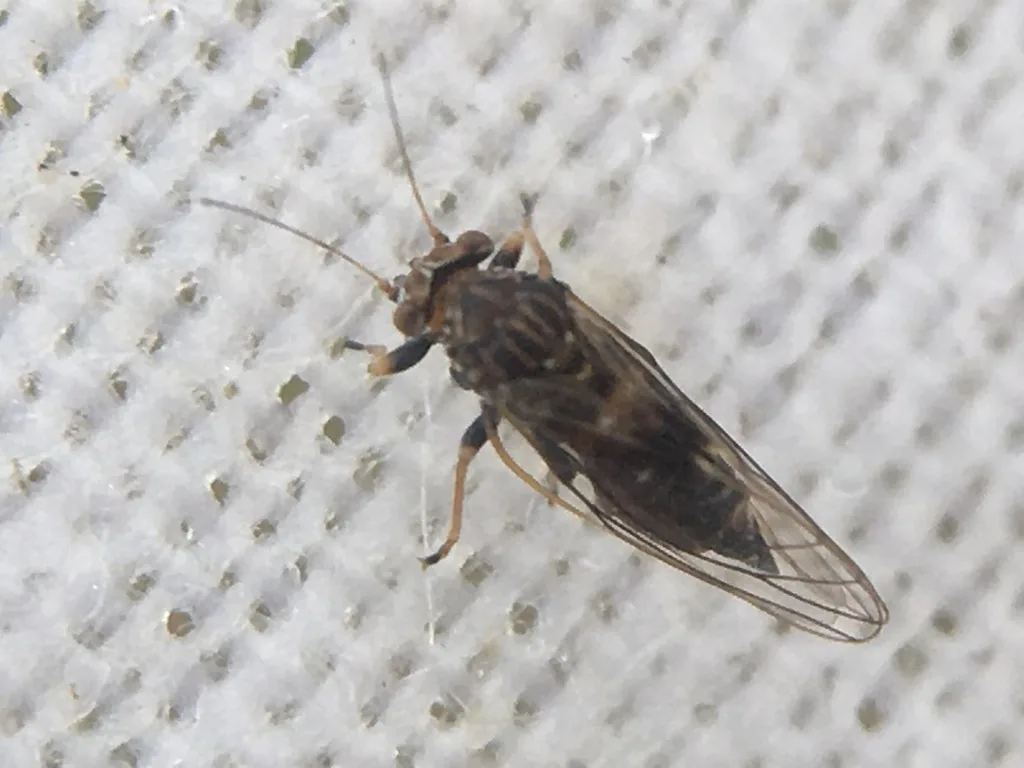
- Adults hold mostly clear wings rooflike over dark brown to reddish brown bodies, like tiny cicadas.[1]
- A dark spot on the top middle edge of each wing helps tell pear psylla from other psyllids.[1]
- Adults come in a smaller, lighter summer form and a larger, darker winter form. UC IPM gives about 1/12 inch for summer adults and 1/8 inch for overwintering adults; the PNW handbook gives 0.08 inch (light greenish to brown) and 0.1 inch (dark black and red).[1][2]
- Nymphs are flat and pass through five stages, from creamy yellow or translucent to dark green, brown or black with wing pads. All stages have red eyes, and the young ones are often almost covered in honeydew.[1][2]
- Eggs are tiny and elongate, like grains of rice, yellowish and turning yellow-orange as they mature.[1][2]
Where it lives
UC IPM and the Pacific Northwest handbooks cover it in California and the Northwest, and it's worse on European than Asian pear varieties. A 2026 study calls it a key pest of pears in the Pacific Northwest.[1][2][3]
Biology and life cycle
Sources differ on where adults spend the winter. UC IPM says in bark crevices, under bark scales or in litter near pear trees, where they sun themselves on days above 45°F. The PNW handbook says most leave the orchard for sites such as conifers and return to pears in early winter; a 2026 study likewise says winter-form adults recolonize orchards in late winter from habitat outside them.[1][2][3]
UC IPM says egg-laying starts in late January or early February on or near fruit spurs; the PNW handbook says around bud swell, at the base of buds. Later eggs go along leaf midribs and petioles and on blossom stems. Each female can lay several hundred eggs during a life of several weeks.[1][2]
There are about five generations a year in California (UC IPM) and three during the growing season in the Mid-Columbia region (PNW handbook). The last generation becomes the winter form.[1][2]
Damage and signs
- Honeydew grows black sooty mold that russets fruit skins. Toxic saliva blackens parts of leaves, which yellow and may drop early, and large numbers can stunt and defoliate trees and cause fruit drop.[1][2]
- Pear decline causes weak shoots, red upward-rolled leaves, small fruit and sometimes sudden tree collapse.[1]
Health risk
It feeds on pear trees, and no cited source describes any risk to people or pets.[1][2]
Control
Prevention
Keep trees growing well with appropriate irrigation and fertilization to lessen damage and pear decline (UC IPM), but don't push extra vigor with excess nitrogen (PNW handbook). Removing suckers from the tree's interior removes eggs and nymphs and improves spray coverage.[1][2]
To check for psylla, tap a limb over a white beating tray and look for adults, then check young shoots and leaves with a hand lens for eggs and nymphs.[2]
Kaolin clay, a particle film that repels adults, is recommended in orchards from late dormant through bloom. A 2026 orchard study found fall-sprayed kaolin partly stayed on branches through winter and often meant fewer adults and eggs the next spring.[3]
Biological control
Parasitic wasps, lady beetles, lacewing larvae, earwigs, predatory plant bugs, minute pirate bugs and yellow jackets all attack pear psylla, and the PNW handbook says conserving them can give significant control.[2]
Pesticides
Dormant oil timing depends on region. UC IPM says to apply horticultural oil at least once in the dormant season by the beginning of January, and again just before bloom if psylla was heavy. The PNW handbook says home dormant sprays can run from early February to late March depending on location, during the dormant or delayed-dormant period only.[1][2]
UC IPM lists imidacloprid as a soil drench during the growing season, but only after bloom, because it moves into nectar and pollen and can poison bees and natural enemies.[1]
For the growing season, the PNW handbook lists home options including insecticidal soap, kaolin clay and neem. It warns that neem products may injure some pear varieties, and many of the other listed insecticides are highly toxic to bees.[2]
Common questions
- Why are my pears dark and russeted?
- Pear psylla honeydew grows sooty mold that discolors the fruit skin.[1]
- When should I spray oil for pear psylla?
- At least once in the dormant season. In California UC IPM says by the beginning of January; the PNW handbook gives early February to late March depending on location.[1][2]
Sources
- University of California Statewide IPM Program, “Pear Psylla (Pests in Gardens and Landscapes).” ipm.ucanr.edu/PMG/GARDEN/FRUIT/PESTS/pearpsylla.html (accessed 2026-11-13)
- Pacific Northwest Pest Management Handbooks (OSU, WSU, University of Idaho), “Pear-Pear psylla.” pnwhandbooks.org/insect/tree-fruit/pear/pear-pear-psylla (accessed 2026-11-13)
- Journal of Economic Entomology (via PubMed), “Suppression of pear psylla, Cacopsylla pyricola, with fall applications of kaolin clay. Nottingham et al. 2026 (abstract).” pubmed.ncbi.nlm.nih.gov/41894607/ (accessed 2026-11-13)
- Global Biodiversity Information Facility (GBIF), “Cacopsylla pyricola (Foerster, 1848) (GBIF Backbone Taxonomy).” api.gbif.org/v1/species/2013085 (accessed 2026-11-13)