On this page
How to identify it
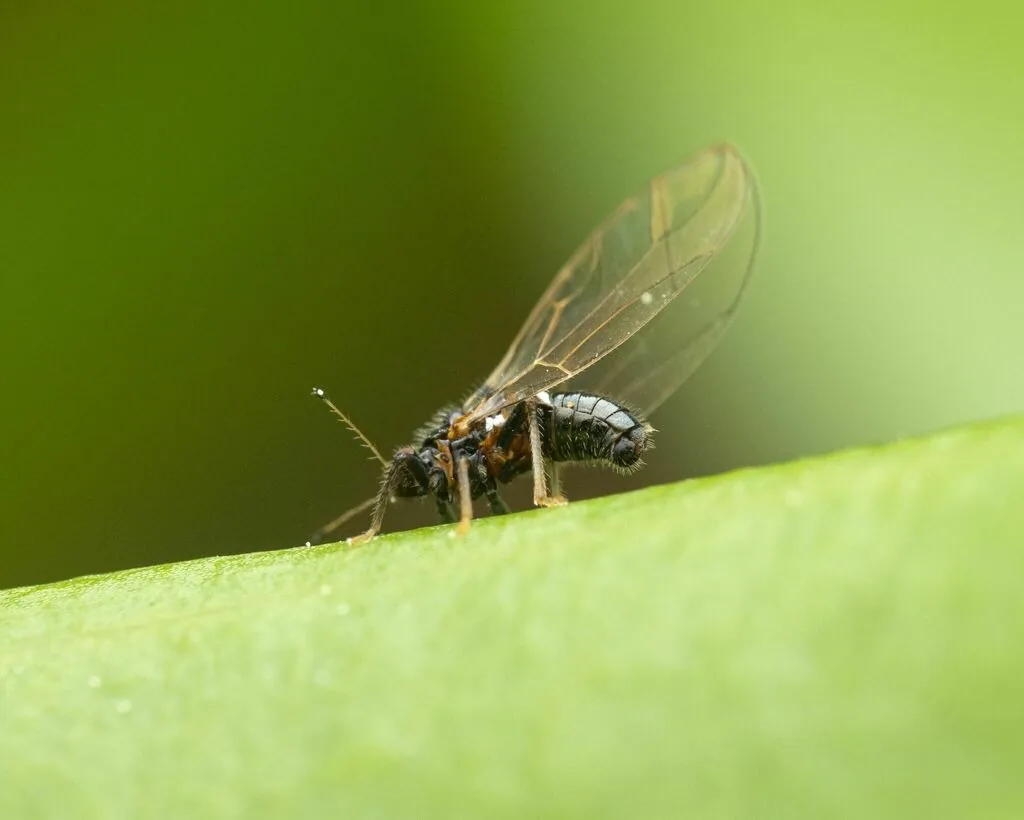
- Adults are 1/8 to 3/16 inch (3.5 to 4.5 mm), generally shining black, with the middle and hind tibiae, the feet and most of the antennae whitish; they hold their wings high over the body and jump readily.[1][2]
- Nymphs are flattened, covered with white powder or fluff, and older ones have a fringe of long hairs around the edge.[1][2]
- Key characters include hind tibiae with three inner spines at the tip, antennae distinctly longer than the head is wide, and sparse long hairs on top of the head and thorax. Nymphs are hard to identify without knowing the host plant.[4]
Look-alikes
Where it lives
Common and widely distributed in Florida and the southeastern United States, apparently throughout the range of native persimmon, which runs from southern Florida to Connecticut, west to Iowa and southwest to Texas. It has also been reported from Mexico. UF/IFAS's Featured Creatures reissue of the same circular calls it common in Florida and the southeastern United States, and possibly Mexico.[2][4]
Biology and life cycle
Females lay tiny, slender eggs along leaf margins; they hatch in five to six days, and the leaf curls over the young nymphs.[1][2]
Nymphs pass through about five stages; psyllids become abundant in spring when new growth appears, and hot weather can suppress them.[1]
Eggs are about 0.01 inch long and pale greenish, laid along the leaf margin and fastened to a thread-like gummy strip the female lays down first. When disturbed, nymphs give off large, watery droplets the color of milky water.[4]
Its recorded hosts are native persimmon (Diospyros virginiana) and Japanese persimmon (Diospyros kaki); it may also breed on Texas persimmon (D. texana) or other Diospyros species in Mexico.[4]
Precise data on the number of broods a year are lacking; UF/IFAS suggests the number is partly tied to flushes of new growth that provide tender leaves and shoots for the nymphs.[4]
Damage and signs
- Feeding makes leaves pucker, curl and become misshapen, and twists and galls the terminals; damage is occasionally moderate to severe.[1][2]
- Sticky honeydew grows sooty mold and can mess up plants or property below.[1]
- Nymphs inject toxins as they feed, so the leaf curls into a pocket around them, holding white waxy filaments, cast skins and honeydew that ants often feed on. A light infestation has little effect on tree vigor, and older trees are not plagued by it, perhaps because they have less succulent growth; it is generally detrimental to establishing young trees.[4]
Health risk
It feeds on persimmon sap, and no cited source describes any risk to people or pets.[1][2]
Control
Prevention
Avoid shearing persimmon terminals in the growing season, since new growth attracts psyllids; prune above crotches and nodes instead.[1]
Pesticides
Horticultural oils suppress adults and nymphs without leaving a residue that harms beneficial insects.[1]
Timing matters: the Florida circular says that once leaves are badly distorted it is too late, so sprays should target adults and early-stage nymphs. NC State says most insecticides labeled for residential landscape use will give adequate control, but pyrethroids are harsh on beneficial insects. UF/IFAS adds that conventional sprays should be timed to the bloom stage, aimed at adults to reduce egg laying and at early nymphs before the leaves are distinctly damaged.[2][1][4]
Where the sources disagree
Development time: NC State says development from egg to adult takes only a few weeks in spring, while the Florida circular says the young take four to five weeks to mature.[1][2]
Summer activity: NC State says hot weather can suppress populations, while the Florida circular says they breed through the summer, and Division of Plant Industry records list nymphs and adults in May, June and July, with nymphs also recorded in August and September.[1][2]
Mexico: the Florida circular reports that Russell had specimens from Mexico, while Caldwell did not collect it on two trips to Mexico.[2]
Common questions
- Why are the new leaves on my persimmon curled and fuzzy white inside?
- Persimmon psyllid nymphs feeding under the curled leaves are a likely cause.[1][2]
- Will persimmon psyllid hurt an older tree?
- Rarely. UF/IFAS says older trees are not plagued by it, perhaps because they have less succulent growth, and a light infestation has little effect on tree vigor; young trees being established are the ones it harms.[4]
Sources
- NC State Extension, “Persimmon Psyllid (PDIC Factsheet).” content.ces.ncsu.edu/persimmon-psyllid (accessed 2026-11-13)
- Florida Department of Agriculture, Division of Plant Industry, “Persimmon Psylla, Trioza diospyri (Ashmead), Entomology Circular No. 50 (F. W. Mead, July 1966).” ccmedia.fdacs.gov/content/download/4697/file/Persimmon%20Psylla.pdf (accessed 2026-11-13)
- Global Biodiversity Information Facility (GBIF), “Baeoalitriozus diospyri (Ashmead, 1881) (GBIF Backbone Taxonomy).” api.gbif.org/v1/species/8405561 (accessed 2026-11-13)
- University of Florida IFAS Extension, EDIS (Featured Creatures), “Persimmon Psylla, Trioza diospyri (Ashmead), EENY-390/IN700 (F. W. Mead; Featured Creatures reissue of DPI Entomology Circular 50; archival copy).” journals.flvc.org/edis/article/download/116483/114670/168191 (accessed 2026-11-14). Archival copy on the EDIS journal site; the current EDIS address, ask.ifas.ufl.edu/publication/IN700, returns 410 (withdrawn).