On this page
How to identify it
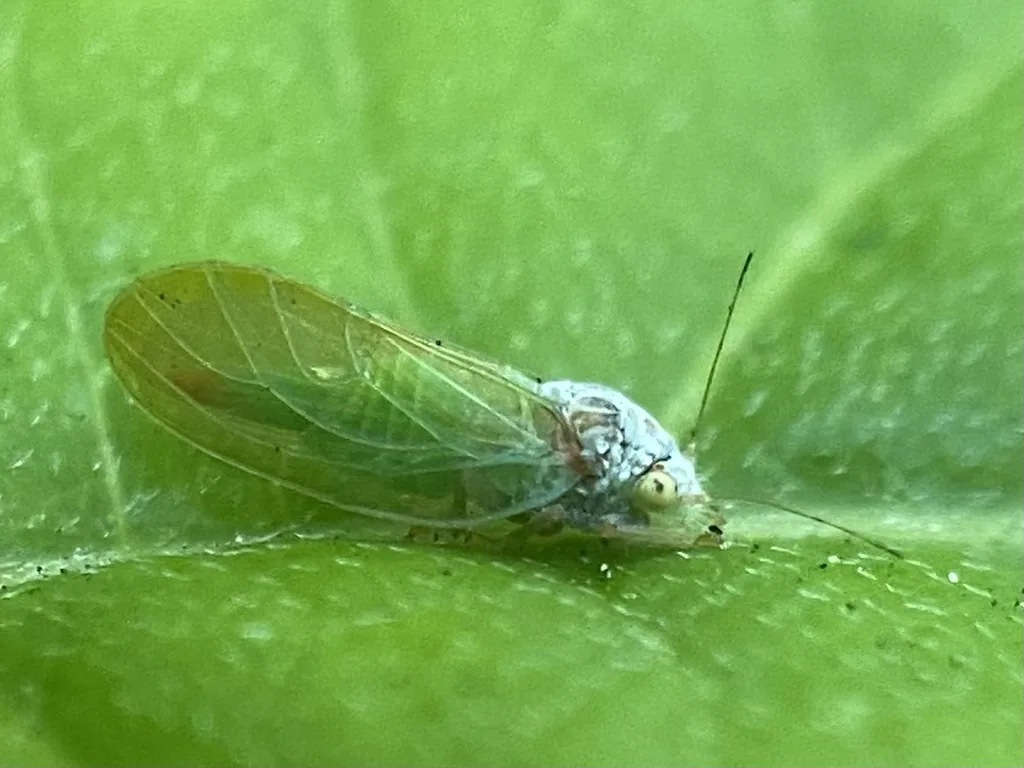
- Adults are light green, with clear wings and jumping legs, and look like tiny cicadas. Sizes vary by source: about 1/16 inch (Kentucky), about 3 mm (Penn State), up to 1/8 inch (NC State, Clemson), or about 0.125 inch with an orange tip on the abdomen (PNW).[1][2][4][7][3]
- Nymphs are light green, often with white waxy fluff, hidden inside cupped leaves.[1]
- Eggs are tiny, orange and spindle-shaped, tucked under the bud scales.[1][2][3][6]
Where it lives
It feeds only on boxwood (Buxus), including American and English boxwood, and seems to occur wherever boxwood is grown. American boxwood is more often and more severely infested than English boxwood.[1][5][6]
Biology and life cycle
Kentucky, Penn State and PNW say it spends the winter as eggs under bud scales. NC State and UMass say the first-stage nymph actually overwinters inside its eggshell, and Kentucky notes other states report this too. Either way, nymphs come out as boxwood buds open in spring.[1][2][3][4][6]
Nymphs become adults by late May or June. Kentucky and Penn State place egg-laying in early summer, after mating; NC State says females lay one to seven eggs under each bud scale in July or August. There is one generation a year.[1][2][4][5][3]
Damage and signs
- Nymph feeding in the newest growth at branch tips makes leaves curl and cup around them, often with honeydew inside. PNW notes that buds inside cupped leaves are often dead, and NC State says twig growth may be checked.[1][3][5]
- Because the single generation finishes early, plants tend to outgrow the injury by midsummer, according to NC State and Clemson. UMass says leaf symptoms can stay on the plant for up to two years.[5][7][6]
- UMass notes that damage from boxwood insects, the psyllid among them, is a main way many boxwood fungal diseases get into the plant.[6]
Health risk
No cited source describes any risk to people or pets; it is a sap-feeding plant pest.[1][2]
Control
Traps and physical control
Treatment usually isn't needed. Kentucky suggests pruning out cupped tips by mid-May, before the nymphs become adults, and destroying the clippings.[1]
Pesticides
Clemson advises insecticides only for heavy infestations. Where boxwoods must look their best, Kentucky lists insecticidal soap or summer horticultural oil on emerging buds in spring, and spinosad or pyrethroids such as permethrin and bifenthrin aimed at nymphs in early to mid-May or at egg-laying adults by early June. Penn State also times treatment to nymphs in early May. Follow the label.[7][1][2]
Kentucky says soil drenches of imidacloprid or dinotefuran must go on before damage shows, usually in April or early May, and warns that these neonicotinoids have been linked to spider mite outbreaks, so watch for mites afterward.[1]
Telling it apart, and its scientific name
Nymphs are covered in a white, waxy secretion that sets them apart from other boxwood pests; adults are light green and about 3 mm long.[2]
GBIF and UMass use the name Psylla buxi, as do PNW and NC State's boxwood pest guide. Penn State and NC State's psyllid fact sheet place it in the genus Cacopsylla instead.[8][6][3][5][2][4]
Common questions
- Why are my boxwood leaves cupped?
- Boxwood psyllids feeding in new growth make the leaves cup.[1]
- Do I need to spray boxwood psyllids?
- Usually not. Kentucky and UMass describe the damage as mostly cosmetic, and NC State and Clemson say plants tend to outgrow it by midsummer. Pruning out cupped tips by mid-May is often enough.[1][6][5][7]
- When should I prune out cupped boxwood tips?
- Kentucky says by mid-May, before the nymphs inside become adults, and to destroy the clippings.[1]
Sources
- University of Kentucky Entomology (ENTFACT), “Identifying Boxwood Psyllid (ENTFACT-454).” entomology.mgcafe.uky.edu/ef454 (accessed 2026-11-13)
- Penn State Extension, “Boxwood Psyllid.” extension.psu.edu/boxwood-psyllid (accessed 2026-11-13)
- Pacific Northwest Pest Management Handbooks (OSU, WSU, U of Idaho Extension), “Boxwood (Buxus)-Boxwood psyllid, PNW Insect Management Handbook.” pnwhandbooks.org/insect/hort/landscape/hosts-pests-landscape-plants/boxwood-buxus-boxwood-psyllid (accessed 2026-11-13)
- NC State Extension, “Boxwood Psyllid.” content.ces.ncsu.edu/boxwood-psyllid (accessed 2026-11-13)
- NC State Extension, “Pests of Boxwood.” content.ces.ncsu.edu/pests-of-boxwood (accessed 2026-11-13)
- UMass Amherst Center for Agriculture, Food, and the Environment, “Boxwood: Common Health Issues in the Landscape.” www.umass.edu/agriculture-food-environment/landscape/fact-sheets/boxwood-common-health-issues-in-landscape (accessed 2026-11-13)
- Clemson Cooperative Extension Home & Garden Information Center, “Boxwood Diseases and Insect Pests in South Carolina (HGIC).” hgic.clemson.edu/factsheet/boxwood-diseases-insect-pests/ (accessed 2026-11-13)
- Global Biodiversity Information Facility (GBIF), “Psylla buxi (Linnaeus, 1758) (GBIF Backbone Taxonomy).” api.gbif.org/v1/species/5153213 (accessed 2026-11-13)