On this page
How to identify it
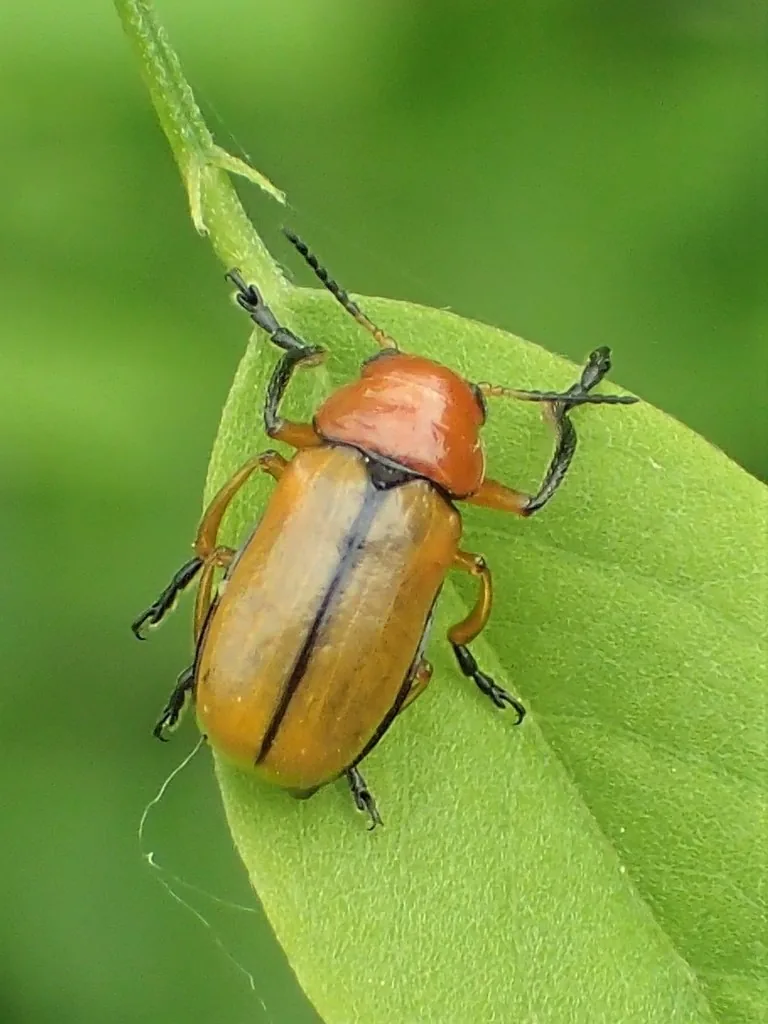
- Adults are about 3/8 inch long and brown to reddish brown.[1]
- A dark line runs down the inner and outer edges of each wing cover, so the beetle shows a black stripe down the middle of its back and one along each side.[1]
- The larvae are case-bearers: each wears a pouch made of its droppings and bits of leaves.[1]
Where it lives
NC State says it is found from the Great Plains eastward. The UWM Field Station describes its range as fields and prairies through most of the eastern United States and north into Canada.[1][3]
Biology and life cycle
Host plants vary by region. In North Carolina most records are from persimmon; elsewhere in the Southeast it has been found on azalea, oak, willow and wisteria; and in the Great Plains it seems to feed only on leadplant (Amorpha canescens).[1]
In southeastern Wisconsin, the UWM Field Station found the beetles all over leadplant, which blooms in midseason on the prairie. It says adults and larvae favor the leaves of legumes but also eat willow, oak, ragweed and persimmon.[3]
Females lay their eggs in cases of fecal material on the ground or on foliage.[1]
The larvae feed on leaves while living in their cases.[1]
NC State reports one generation a year.[1]
It does not spread quickly: NC State cites researchers who found that although it ranges from the Great Plains eastward, it does not disperse rapidly.[1]
The UWM Field Station says the larvae are myrmecophiles, animals that live in association with ants.[3]
Damage and signs
Health risk
It is a leaf-feeding beetle, and no cited source describes any risk to people or pets.[1][3]
Control
Pesticides
NC State says bifenthrin, permethrin or another pyrethroid labeled for landscapes should control it if needed. Pyrethroids also repel insects, so a treated tree becomes unattractive to other beetles and bees, and they are toxic to fish: keep them away from pools, ponds and streams.[1]
Where the sources disagree
Hosts: NC State lists persimmon, azalea, oak, willow and wisteria in the Southeast and only leadplant in the Great Plains, while the UWM Field Station says it favors legume leaves and also eats willow, oak, ragweed and persimmon.[1][3]
Range: NC State says it is found from the Great Plains eastward, while the UWM Field Station describes most of the eastern United States and north into Canada.[1][3]
Scientific name: NC State and the UWM Field Station use Anomoea laticlavia without comment, while the GBIF Backbone Taxonomy lists Anomoea laticlavia (Forster, 1771) but flags the name as doubtful.[1][3][2]
Common questions
- What is the small striped beetle on my persimmon tree?
- It may be the clay-colored leaf beetle, also called the persimmon leaf beetle: about 3/8 inch long, brown to reddish brown, with a black stripe down the back and one on each side. In North Carolina most records come from persimmon.[1]
- What are the little brown cases stuck to the leaves?
- Clay-colored leaf beetle larvae live inside cases made of their droppings and bits of leaves, and females lay their eggs in cases of fecal material on leaves or on the ground.[1]
Sources
- NC State Extension, “Claycolored Leaf Beetle (J. Baker; reviewed 2025).” content.ces.ncsu.edu/clay-colored-leaf-beetle (accessed 2026-11-13)
- Global Biodiversity Information Facility (GBIF), “Anomoea laticlavia (Forster, 1771) (GBIF Backbone Taxonomy).” api.gbif.org/v1/species/4990515 (accessed 2026-11-13)
- University of Wisconsin-Milwaukee Field Station, “Clay-colored Leaf Beetle (Family Chrysomelidae), Bug of the Week.” uwm.edu/field-station/bug-of-the-week/clay-colored-leaf-beetle/ (accessed 2026-11-13)