On this page
How to identify it
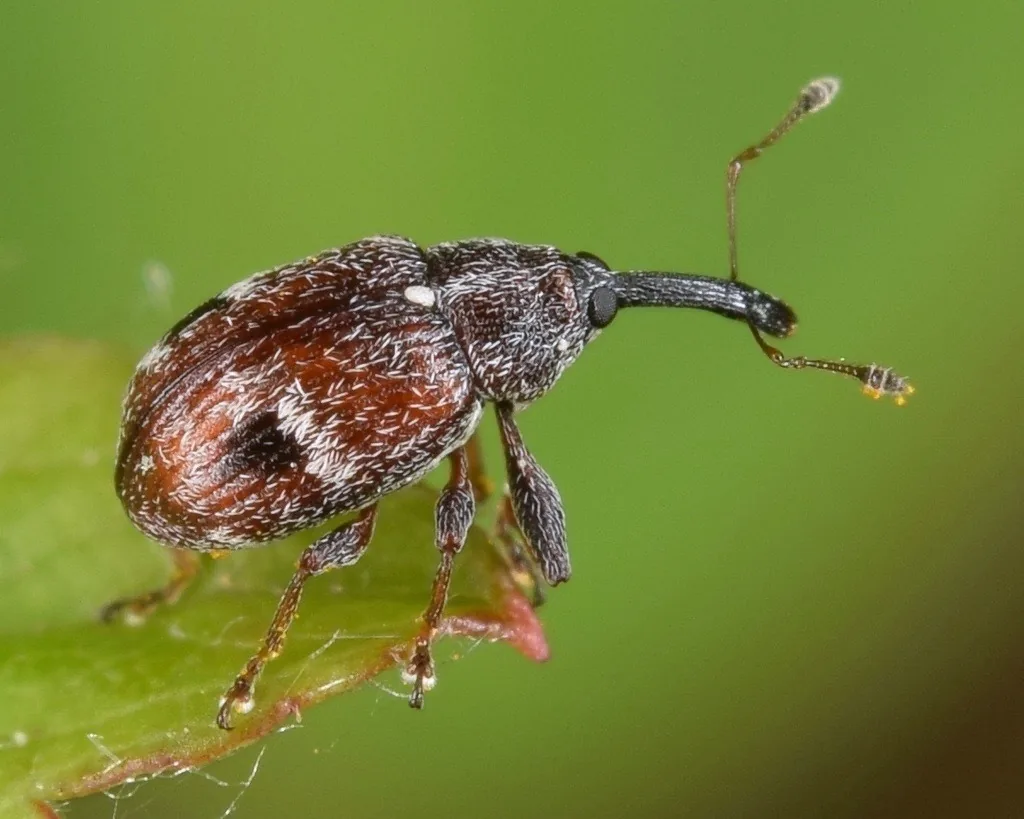
- A small weevil with a long snout, reddish or chestnut brown to nearly black, usually with a dark spot on each wing cover (EPPO says the spots may be absent). Sources differ on size: Virginia Tech says about 1/10 inch (3 mm), UNH less than 1/10 inch, EPPO about 2.5 mm and NC State about 1/4 inch.[1][2][3][4]
- Larvae are tiny white or cream-colored legless grubs inside the clipped buds.[1][2][3]
- The telltale sign is buds dangling from partly severed stems or lying on the ground.[1][2]
Look-alikes
| Look-alike | How to tell them apart |
|---|---|
| Strawberry root weevil | UNH warns not to confuse the two. Strawberry root weevil adults notch leaf edges at night and their larvae feed on roots; they don't clip flower buds.[3][5] |
Where it lives
Native to North America. EPPO lists it in every U.S. state east of the Mississippi and some to the west, east of the Rockies, and in all Canadian provinces; UNH says Texas to New England, and Virginia Tech says virtually all U.S. strawberry-growing regions.[4][3][2]
Biology and life cycle
There is one generation a year. Adults spend the winter in leaf litter and mulch, in wooded areas or in and around strawberry and bramble beds, and become active in spring around bloom; NC State and Virginia Tech say mid to late April in North Carolina and the Mid-Atlantic.[1][2][3][4]
Females puncture an unopened bud, lay a single egg, then girdle the bud's stem. UNH says each female lays 20 to 30 eggs, which hatch in 6 to 14 days; larvae develop in the clipped bud in three to four weeks, even after it falls.[1][2][3][4]
New adults appear in summer, feed briefly on pollen and then go dormant until the next spring.[1][2]
Besides strawberry, hosts include blackberry, raspberry, dewberry and redbud. EFSA notes reports on mint, catnip, rhododendron and goldenrod but says it's uncertain whether these are true hosts.[1][6][7]
Damage and signs
- Fields and rows nearest woods usually get the most clipped buds; UNH says problems are worst along field edges, especially those bordering woods.[1][3][2]
- Sources differ on how much it matters. Virginia Tech cites yield losses of 50 to 100 percent in some areas, and UNH says 50 to 75 percent of a crop can be destroyed. But a 2017 NC State study of five cultivars grown in annual plasticulture found no effect of bud removal on total yield, though harvest timing shifted in some, and New York work found plants made up for early bud loss.[2][3][6][1][4]
Health risk
It feeds on strawberry and bramble buds. NC State, Virginia Tech, UNH Extension and EPPO describe crop damage only and don't mention any risk to people or pets.[1][2][3][4]
Control
Prevention
Check for clipped buds, which NC State calls the only recommended way to sample. Suggested action levels differ: about 0.6 clipped buds per foot of row in Virginia and 2 per meter in New York, and EPPO notes research suggesting the New York threshold could be raised.[1][2][4]
Because plants can compensate for a good deal of bud loss, small numbers of clipped buds may not need treatment.[1][6]
Destroy nearby unmanaged brambles, which harbor the weevils, and remove weeds near strawberries, which UNH says give newly emerged adults pollen. Virginia Tech says varieties with only pistillate flowers are seldom attacked and early-fruiting varieties are more susceptible, and that plowing old beds right after harvest kills adults.[3][2]
Pesticides
If spraying is needed, NC State says most recommended insecticides are broad-spectrum and should go on in the evening after bees stop foraging, never while bees are working the bloom, and that no organic insecticide has been shown to work. Virginia Tech and EPPO cite New York research suggesting only rows near field edges or woods may need treatment.[1][2][4]
Quarantine status in Europe
It isn't known to occur in the European Union. EPPO lists it as an EU quarantine pest (Regulation (EU) 2019/2072, Annex II A), and EFSA's 2017 pest categorisation found it meets all the criteria for a Union quarantine pest, with trade in strawberry and Rubus plants for planting the likely pathway.[4][7]
Common questions
- Why are my strawberry flower buds hanging or falling off?
- Often the strawberry clipper, which lays an egg in the bud and then cuts its stem.[1][2]
- Will I lose my crop?
- Not necessarily. Plants often compensate for clipped buds, and a 2017 NC State study found no loss in total yield in five annual-plasticulture cultivars, though older reports cite heavy losses in some areas.[1][6][2]
- When does it show up?
- In spring around bloom; mid to late April in North Carolina and the Mid-Atlantic.[1][2][3]
Sources
- NC State Extension, “Strawberry Clipper Weevils in Strawberry (PDIC Factsheet).” content.ces.ncsu.edu/strawberry-clipper-weevils-in-strawberry (accessed 2026-11-13)
- Virginia Tech Department of Entomology (Virginia Fruit pages), “Strawberry bud weevil (Clipper), Anthonomus signatus.” www.virginiafruit.ento.vt.edu/StrwWeevil.html (accessed 2026-11-13)
- University of New Hampshire Extension, “Strawberry Weevil (Pest Fact Sheet; Alan T. Eaton).” extension.unh.edu/resource/strawberry-weevil-fact-sheet (accessed 2026-11-13)
- European and Mediterranean Plant Protection Organization (EPPO) Global Database, “Anthonomus signatus (ANTHSI) datasheet (last updated 2024-02-28).” gd.eppo.int/taxon/ANTHSI/datasheet (accessed 2026-11-13)
- Colorado State University Extension, “Root Weevils (Fact Sheet 5.551).” extension.colostate.edu/resource/root-weevils/ (accessed 2026-11-13)
- J Econ Entomol 2017;110(1):208-212, via PubMed, “Effect of simulated Anthonomus signatus (Coleoptera: Curculionidae) injury on strawberries (Fragaria x ananassa) grown in Southeastern plasticulture production (McPhie & Burrack).” pubmed.ncbi.nlm.nih.gov/28040738/ (accessed 2026-11-13)
- EFSA J 2017;15(7):e04882, via PubMed, “Pest categorisation of Anthonomus signatus (EFSA Panel on Plant Health).” pubmed.ncbi.nlm.nih.gov/32625547/ (accessed 2026-11-13)
- Global Biodiversity Information Facility (GBIF), “Anthonomus signatus Say, 1831 (GBIF Backbone Taxonomy).” api.gbif.org/v1/species/5013803 (accessed 2026-11-13)
- iNaturalist, “Anthonomus signatus taxon page (order and family).” www.inaturalist.org/taxa/213780 (accessed 2026-10-06)