On this page
How to identify it
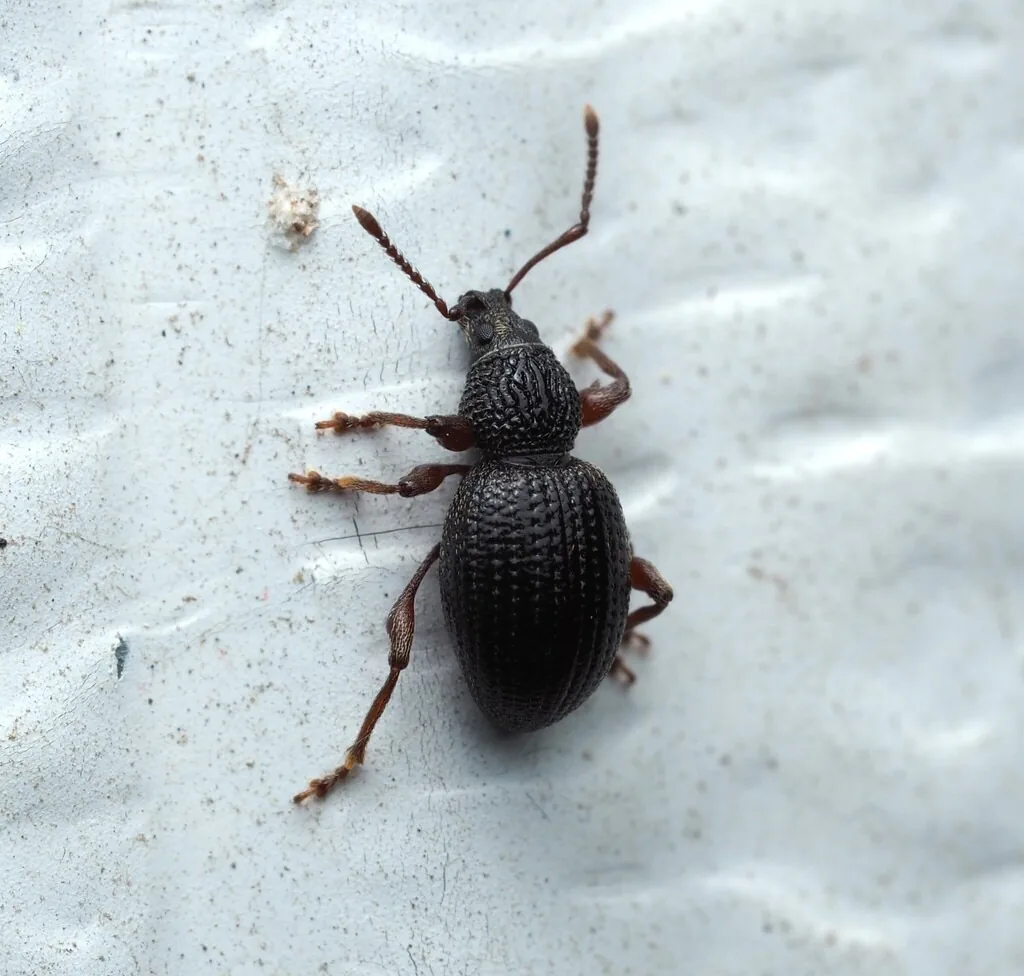
- Adults are shiny black or dark brown flightless snout beetles with elbowed antennae; UMN notes rows of pits along the back. Sizes vary by source: Iowa State says about 3/16 inch (5 mm), UMN about 1/4 inch and UMass 4 to 6 mm.[2][3][4][1]
- When disturbed they drop from plants and play dead.[1]
- Larvae are legless, curved, cream-colored grubs with a pale orange-brown head, up to about 1/4 inch long.[1][4]
Look-alikes
| Look-alike | How to tell them apart |
|---|---|
| Black vine weevil | A close relative that's larger, up to 10 mm (UMass), and more often seen indoors in late summer and fall.[1][4] |
| Lilac root weevil | Another relative, usually on lilac, privet, peony and euonymus.[1] |
| Ticks | UMN says people sometimes mistake strawberry root weevils for ticks, but weevils have six legs and ticks have eight.[3] |
Where it lives
It's one of the most common root weevils in Colorado, very common throughout Iowa and the most common home-invading weevil in Minnesota. UMass says it was first recorded in Massachusetts before 1852 and that the literature questions whether it originally came from Europe.[1][2][3][4]
Biology and life cycle
Only females are produced, and they reproduce without mating; there's one generation a year.[1][4]
Sources differ on timing. Colorado State says larvae overwinter in the soil and adults emerge in mid to late spring; UMass says several stages may overwinter depending on location, with adults emerging in May or June; UMN says adults start to emerge in early summer, and Iowa State says mid-summer. Adults can live a couple of months.[1][4][3][2]
UMass says each adult lays 150 to 200 eggs in soil near host plants, and the larvae hatch in about 10 days.[4]
Damage and signs
- Hosts include strawberry, raspberry, rhubarb, white clover, dandelion, dahlia and mint; larvae also feed on the roots of evergreens such as arborvitae, spruce, yew and hemlock.[1][3][4]
- Larvae on the roots do most of the harm, mainly to seedlings and transplants in nurseries, and the problem is often missed until the larvae are grown in spring. Iowa State says adult leaf feeding causes no significant damage, and Colorado State says severe root damage is rarely seen in landscapes.[4][2][1]
Health risk
Iowa State and UMN Extension say it doesn't harm people or pets, and Colorado State says it causes no injury to people or furnishings indoors.[2][3][1]
Control
Keep them out
To keep them out of homes, seal cracks and gaps around foundations, windows and doors, and vacuum or sweep up any that get in. Iowa State says household aerosol insecticides aren't very effective on weevils already inside, and UMN says shallow pans of water catch some but not enough to cut numbers.[3][2][1]
Traps and physical control
Search plants about an hour after sunset to confirm which weevil is feeding.[1]
Sticky bands around the base of plants with notched leaves can catch adults climbing up to feed; UMass says not to put the sticky material directly on bark.[4]
Biological control
Heterorhabditis nematodes applied as a soil drench control the larvae, and the soil should stay moist. Timing differs: Colorado State says mid-July to mid-September, after most eggs hatch, while UMass says once soil reaches 60 F, or in late June or early July.[1][4]
Pesticides
Pyrethroids sprayed on the lower trunk and plant base late in the day kill climbing adults; avoid spraying flowers bees visit.[1]
Sources differ on outdoor spraying. UMN says pesticides generally aren't required and those sold to the public aren't very effective against weevils, though a foundation treatment is an option when numbers are high. Iowa State says a residual spray along the foundation and where weevils are abundant may reduce the number wandering in, but may have to cover large areas and be reapplied often.[3][2]
More from Iowa State Extension
Adults are shiny black, about 3/16 inch long, with elbowed antennae; they are harmless indoors and don't damage the house, furnishings, people or pets.[2]
Common questions
- Why are small black weevils coming into my house in summer?
- Strawberry root weevils often wander indoors in hot, dry weather. Colorado State says late June and July, UMN from the end of June through August, and UMass particularly August.[1][3][4]
- Are root weevils harmful indoors?
- No. They don't harm people or pets, damage the house or infest food, and they won't breed indoors.[3][2][1]
Sources
- Colorado State University Extension, “Root Weevils (Fact Sheet 5.551).” extension.colostate.edu/resource/root-weevils/ (accessed 2026-11-13)
- Iowa State University Extension and Outreach, “Strawberry Root Weevil.” yardandgarden.extension.iastate.edu/encyclopedia/strawberry-root-weevil (accessed 2026-11-13)
- University of Minnesota Extension, “Home-invading weevils.” extension.umn.edu/garden-and-home/home-maintenance/household-insects/home-invading-weevils (accessed 2026-11-13)
- UMass Extension Landscape, Nursery and Urban Forestry Program, “Otiorhynchus ovatus (Insect & Mite Guide).” www.umass.edu/agriculture-food-environment/landscape/publications-resources/insect-mite-guide/otiorhynchus-ovatus (accessed 2026-11-13)
- Global Biodiversity Information Facility (GBIF), “Otiorhynchus ovatus (Linnaeus, 1758) (GBIF Backbone Taxonomy).” api.gbif.org/v1/species/1195043 (accessed 2026-11-13)
- iNaturalist, “Otiorhynchus ovatus taxon page (order and family).” www.inaturalist.org/taxa/200014 (accessed 2026-10-06)