On this page
How to identify it
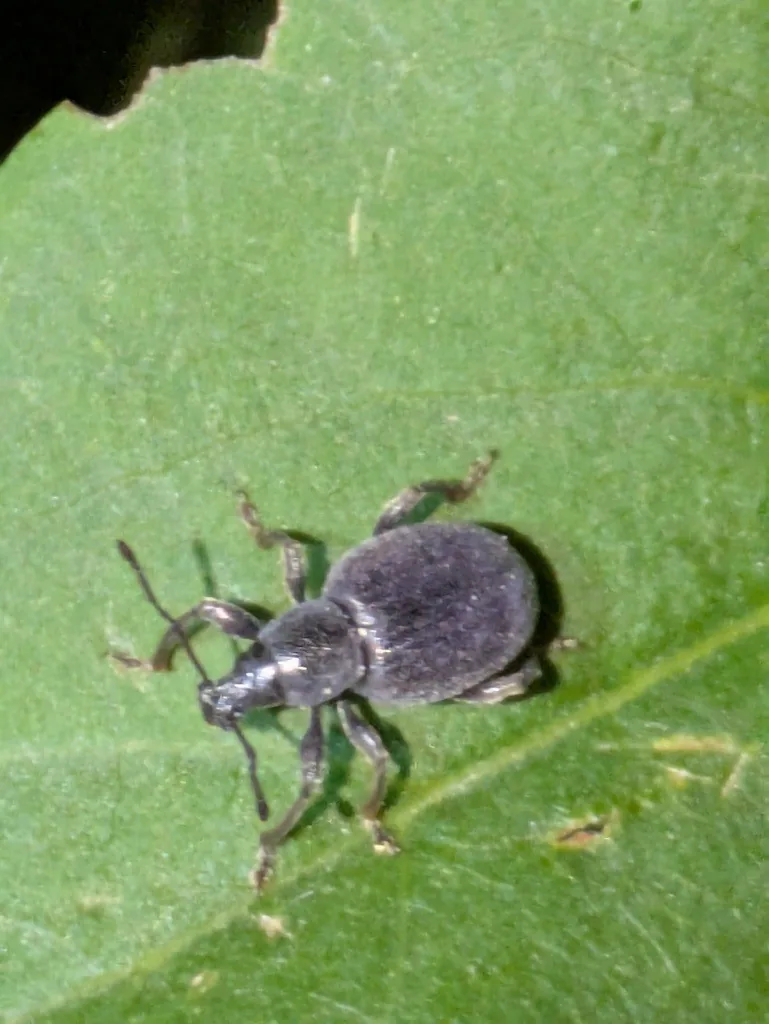
- Adults are flightless, night-active snout beetles, shiny black to brownish black, that hide by day in litter around the base of plants. Sizes vary by source: 0.2 to 0.25 inch (PNW handbook), 1/4 to 1/3 inch (Utah State fact sheet) or 1/4 to 1/2 inch (Utah State web page).[1][2][3][4]
- Leaf edges show regular U-shaped or angular notches. Larvae are cream-colored, legless grubs with a pale orange-brown to brown head, found on the roots.[1][4][2]
Look-alikes
| Look-alike | How to tell them apart |
|---|---|
| Strawberry root weevil | A relative with a much wider host range that often wanders indoors.[1] |
| Black vine weevil | Another relative, common on euonymus, heuchera, astilbe and hosta.[1] |
Where it lives
One of the most common root weevils in Colorado, and especially common east of the Cascades in the Pacific Northwest. Utah State says none of the 17 root weevil species in North America is native; they came from Europe, North Africa and northern Asia.[1][4][3]
Biology and life cycle
Unlike strawberry root weevil and black vine weevil, which are all female, lilac root weevil has both males and females, and the PNW handbook says pairs are often found together. There's one generation a year.[1][4]
Larvae overwinter in the soil. Colorado State says adults emerge in mid to late spring and lay eggs in soil cracks in late spring and early summer. Utah State's fact sheet puts pupation in late May or early June, adult emergence around mid-June, and egg-laying in late June and early July.[1][3]
Adults start feeding about an hour after sunset and drop and play dead when disturbed. They live a couple of months, some into autumn.[1]
Damage and signs
- Leaf notching is the only easily seen injury. Sources disagree on the roots: Colorado State says severe root pruning is rarely seen in landscapes, and the PNW handbook says larval feeding is rarely a problem in established landscapes, but Utah State says root feeding can cause canopy decline and plant death.[1][4][3]
Health risk
Utah State says root weevils that wander indoors won't harm people, pets or stored food, and Colorado State says they don't injure people or furnishings and don't breed indoors.[3][1]
Control
Keep them out
Indoors, vacuum them up or use sticky traps, and seal cracks around windows and doors. Colorado State and Utah State both say indoor insecticides aren't effective or needed; cutting back watering near the foundation and moving host plants away from the house helps.[2][1][3]
Traps and physical control
Check plants with a flashlight after dark to confirm which weevil is present, and dig around the roots in autumn or early spring to look for larvae.[1][3]
Before adults emerge (late May in northern Utah), wrap stems with a banding material and put the sticky barrier on the wrap, not on the plant. Prune so branches don't touch anything weevils could climb.[3]
Biological control
Insect-parasitic nematodes in moist soil control the larvae. Colorado State recommends Heterorhabditis bacteriophora from mid-July to mid-September, after eggs hatch; Utah State names Heterorhabditis or Steinernema once soil reaches 60°F in spring, or in late June and early July.[1][3]
Pesticides
Pyrethroids on the lower trunk and base of plants kill climbing adults. Don't spray leaves or flowers while plants are blooming, and spray late in the day.[1][3]
Common questions
- What's notching my lilac leaves?
- Lilac root weevil adults feeding at night cut regular notches in leaf edges.[1][4]
- Can lilac root weevils fly?
- No; root weevils can't fly and crawl up plants after dark.[1]
- Why are small black weevils in my house in the fall?
- Root weevils, including the lilac root weevil, often wander indoors from midsummer through fall. They won't harm people, pets or furnishings and don't breed indoors; vacuum them up and seal gaps.[3][1][2]
Sources
- Colorado State University Extension, “Root Weevils (Fact Sheet 5.551).” extension.colostate.edu/resource/root-weevils/ (accessed 2026-11-13)
- Utah State University Extension, “Root Weevils, Otiorhynchus spp. (IPM nuisance pest fact sheet).” extension.usu.edu/planthealth/ipm/notes_nuisance/root-weevils.php (accessed 2026-11-13)
- Utah State University Extension, “Root Weevils (fact sheet, May 2018).” extension.usu.edu/planthealth/research/root-weevil.pdf (accessed 2026-11-13)
- Pacific Northwest Pest Management Handbooks (Oregon State University, Washington State University, University of Idaho), “Lilac (Syringa)-Root weevil (Pacific Northwest Insect Management Handbook).” pnwhandbooks.org/node/17786/print (accessed 2026-11-13)
- Global Biodiversity Information Facility (GBIF), “Otiorhynchus meridionalis Gyllenhal, 1834 (GBIF Backbone Taxonomy).” api.gbif.org/v1/species/1194885 (accessed 2026-11-13)