On this page
How to identify it
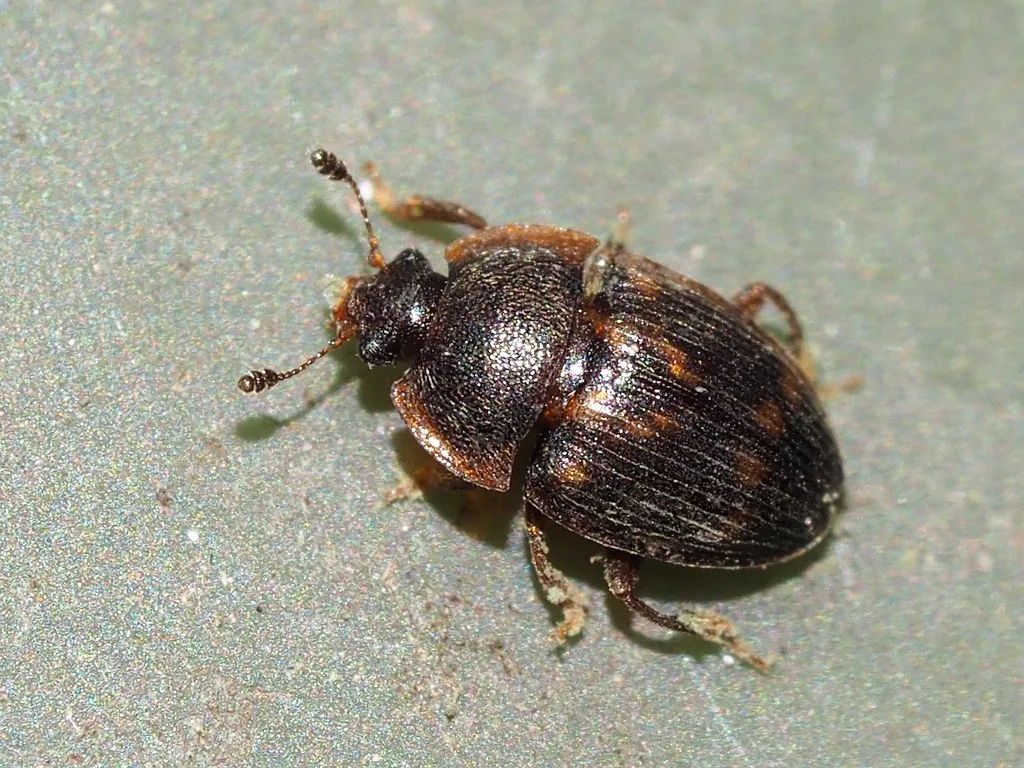
- Adults are small, oval, brown and slightly mottled, less than 1/8 inch long. Minnesota Extension says they are the smallest of the common sap beetles there and have no clear markings on the wings.[1][3]
- Like other sap beetles they have knobbed antennae, which set them apart from other small beetles.[2]
- Minnesota Extension describes sap beetle larvae as small (less than 1/4 inch), white turning pale yellow when mature, with a light brown head. NC State adds three distinct pairs of legs, bristles along the body and two projections at the tip of the abdomen.[3][2]
- Sap beetle eggs are milky white, about 1/25 inch long, and hard to see because they are laid within plant matter.[3][4]
Look-alikes
| Look-alike | How to tell them apart |
|---|---|
| Picnic beetle and other sap beetles | The picnic beetle, another sap beetle found in very overripe berries, is larger and has four orange blotches on its back. NC State names the dusky sap beetle and the fourspotted sap beetle, along with the strawberry sap beetle, among the sap beetles present in North Carolina.[1][2] |
Where it lives
NC State lists it among at least three sap beetle species present in North Carolina, and Minnesota Extension among the most common sap beetles in Minnesota. Penn State and the University of Wisconsin fruit program also cover it as a strawberry pest.[2][3][1][4]
Biology and life cycle
Adults spend the winter outside the planting. NC State says sap beetles frequently overwinter in wooded areas, and the University of Wisconsin says overwintering strawberry sap beetles fly into strawberry plantings from wooded areas.[2][4][3]
They move into strawberry fields around the time the fruit ripens, drawn by the odor of rotting fruit; Penn State says berries begin to ripen in May and June.[2][1][4]
NC State says females lay eggs in debris near rotting fruit; the University of Wisconsin says strawberry sap beetle females lay eggs on injured fruit.[2][4]
Larvae feed inside the fruit, for about three weeks by Minnesota's account, then pupate in the soil nearby. Minnesota Extension says sap beetles take about 30 to 35 days from egg to adult, and new adults emerge in late June or early July.[2][3][4]
Minnesota Extension and the University of Wisconsin say sap beetles generally have one generation a year.[3][4]
Damage and signs
- Feeding is mostly in rotting, damaged or overripe fruit, but sound fruit is occasionally attacked, and the University of Wisconsin says adults sometimes feed in groups. Minnesota Extension says they can leave deep cavities in berries, similar to slug damage.[2][4][3]
- On sound berries the beetles usually get in from underneath, eating a hole straight into the fruit, most often where it rests on soil or mulch. The hole shows once the berry is picked but is not conspicuous unless several beetles have been feeding.[1]
- The beetles spread rot organisms from berry to berry and bring in fungi that make fruit ferment. Any other injury near harvest, from insects or handling, may draw in more sap beetles.[1][2]
- Trouble builds when overripe berries accumulate, as when rain interrupts harvest or pick-your-own customers leave fruit behind. Then adults and larvae can also attack sound, marketable berries.[1][2]
- Larval damage is much less obvious than the adults' cavities, because except in very serious infestations the fruit has usually decomposed by the time the larvae are present.[1]
Health risk
It is a fruit-feeding beetle. NC State, Penn State, Minnesota Extension and the University of Wisconsin describe it only as a pest of berries and other produce; none of them mentions bites, stings or any effect on people or pets.[2][1][3][4]
Control
Sanitation
Pick often and remove rotten, overripe, damaged and diseased fruit from the planting. NC State calls this the most important control and says it is often enough on its own to prevent damage.[2][1][3]
Traps and physical control
To monitor, NC State suggests sinking buckets baited with rotten fruit or whole wheat bread dough into the ground along the field edges, checking them and replacing the bait at least weekly, and disposing of old bait away from the field. For trapping, Minnesota and Wisconsin put baited traps outside the planting (Wisconsin: near woodland edges as the crop begins to ripen) and empty and rebait them every 3 to 4 days.[2][3][4]
Pesticides
If sanitation is not enough, NC State says foliar sprays can be applied and refers growers to the North Carolina Agricultural Chemicals Manual and the Southern Region Small Fruit Consortium Strawberry IPM Guide; the University of Wisconsin points to the Midwest Fruit Pest Management Guide and says sprays must penetrate the canopy and respect preharvest intervals, since the beetles are present while fruit is ripe. For home gardens, Minnesota Extension says pesticides are not very effective and does not recommend using them on the crop.[2][4][3]
Where the sources disagree
Where eggs go: NC State says females lay eggs in debris near rotting fruit; the University of Wisconsin says on injured fruit; Minnesota Extension says near fermenting and decaying plant material.[2][4][3]
Sprays: NC State and the University of Wisconsin treat foliar insecticides as an option when sanitation falls short; Minnesota Extension says pesticides are not very effective and are not recommended on the crop in home gardens.[2][4][3]
Timing: Penn State says the beetles arrive as berries ripen in May and June; Minnesota Extension tells gardeners to watch from early July, when new adults first emerge.[1][3]
Common questions
- What are the tiny brown beetles in the holes in my strawberries?
- Brown, slightly mottled beetles less than 1/8 inch long that drop and scurry away when you pick the berry fit the strawberry sap beetle. A larger beetle with four orange blotches is the picnic beetle, another sap beetle.[1][3]
- Is there an organic way to control strawberry sap beetles?
- NC State considers good field sanitation the only effective organically acceptable method at present: keep fruit picked and remove overripe and rotting berries.[2][1]
- Will spraying stop them?
- Not reliably. Minnesota Extension says pesticides are not very effective against sap beetles in home gardens and should not be used on ripe fruit; NC State and the University of Wisconsin treat foliar sprays as a backup when sanitation is not enough, with attention to preharvest intervals.[3][2][4]
Sources
- Penn State Extension, “Strawberry Sap Beetle.” extension.psu.edu/strawberry-sap-beetle (accessed 2026-11-13)
- NC State Extension, “Sap Beetles in Strawberries (L. Lopez, H. Burrack and A. Toennisson).” content.ces.ncsu.edu/sap-beetles-in-strawberries (accessed 2026-11-13)
- University of Minnesota Extension, “Sap beetles in home gardens (S. Wold-Burkness and J. Hahn, reviewed 2021).” extension.umn.edu/yard-and-garden-insects/sap-beetles (accessed 2026-11-13)
- University of Wisconsin-Madison Division of Extension, Wisconsin Fruit, “Picnic/sap beetles.” fruit.wisc.edu/?p=7180 (accessed 2026-11-13)
- Global Biodiversity Information Facility (GBIF), “Stelidota geminata (Say, 1825) (GBIF Backbone Taxonomy).” api.gbif.org/v1/species/1043978 (accessed 2026-11-13)
- iNaturalist, “Stelidota geminata taxon page (order and family).” www.inaturalist.org/taxa/231503 (accessed 2026-11-08)