On this page
How to identify it
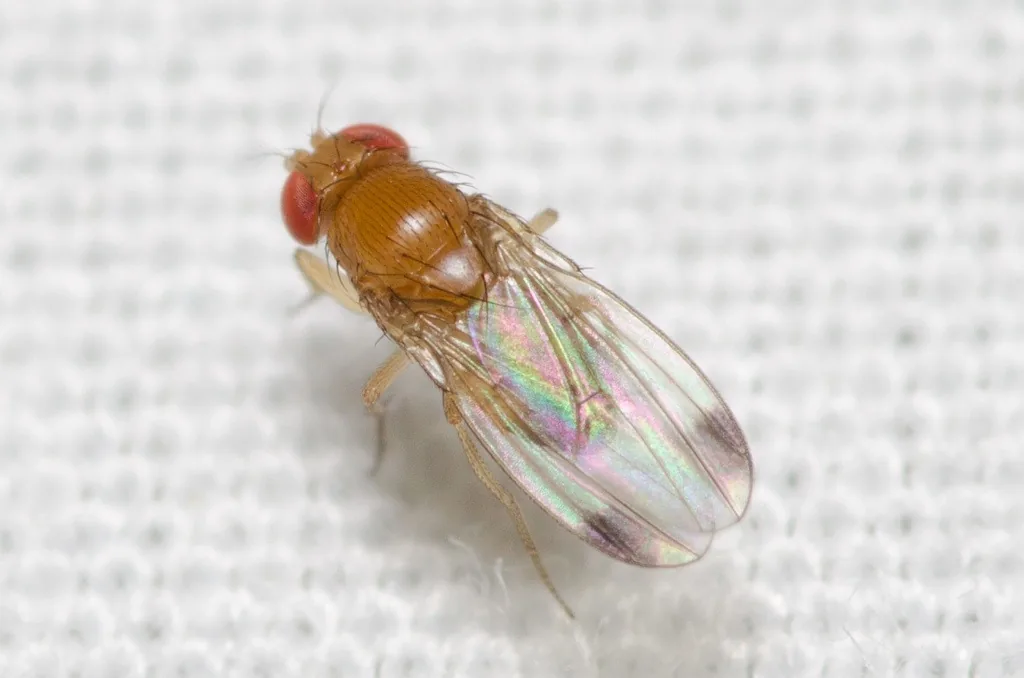
- Adults are tiny: about 1/16 to 1/8 inch per UC IPM, or 1/12 to 1/8 inch (2 to 3 mm) per UMN. They're pale yellowish brown with red eyes and dark stripes on the abdomen.[1][2]
- Males are the easiest to recognize: each clear wing has a dark spot near the tip.[1][2]
- Females have unspotted wings and a large, saw-toothed egg-laying tube, but seeing those teeth takes strong magnification.[2][1]
- Larvae are tiny white maggots, about 1/8 inch when full grown, with no legs or visible head; one to several may feed inside a single berry.[2][1]
Look-alikes
| Look-alike | How to tell them apart |
|---|---|
| Common fruit fly (vinegar fly) | Looks very similar, but common vinegar flies mainly lay eggs in rotting, fermenting or already damaged fruit, while spotted-wing drosophila attacks sound, ripening fruit.[1] |
| Western cherry fruit fly | A larger fly, about 3/16 inch long, with dark bands across the wings instead of a single spot at each wing tip. UC IPM notes it's a quarantine pest not established in California.[1] |
Where it lives
Native to Asia, it reached Hawaii in the 1980s and was detected in the continental U.S. in California in 2008, possibly arriving in imported fruit, according to the USDA National Invasive Species Information Center.[3][1]
Biology and life cycle
The life cycle can take as little as about a week in warm weather, and there can be up to 10 generations a year.[2][1]
Females can begin laying eggs one day after they emerge, so numbers build quickly once flies show up.[2]
Each egg-laying puncture, or sting, holds one to three eggs; mature larvae leave the fruit, partly or completely, to pupate.[1][2]
In Minnesota flies appear in late June or early July and peak in August and September; most arrive from farther south.[2]
In California's inland valleys they are most active in spring and fall, when highs run between 60 and 80 degrees F; heat above 86 degrees F slows them.[1]
It survives winter as an adult fly.[2]
Damage and signs
- Larvae feed inside the fruit, turning the flesh brown and soft with sunken spots that may leak juice on cherries and blueberries.[1][2]
- Damage often isn't noticed until harvest; berries that looked fine can turn soft and wormy a day or two later on the counter.[1][2]
- Infested fruit often smells sour or fermented, and the wounds let rot fungi, bacteria and other insects move in.[2][1]
- Raspberries are especially susceptible; it also attacks blackberries, blueberries, strawberries, grapes, plums and cherries.[1][2]
- It doesn't attack healthy apples, pears or cherry tomatoes, though it can infest them once they are damaged.[2]
Health risk
The FDA's Food Defect Levels Handbook sets limits for insects and Drosophila eggs and maggots in some processed berry and tomato products and lists their significance as aesthetic. It says these action levels cover natural or unavoidable defects that pose no inherent hazard to health. The harm is to the fruit crop.[5][1]
Control
Keep them out
Cover berries or small trees with very fine insect netting before fruit begins to ripen, sealing the edges. UC IPM suggests no-see-um mesh; in a 2015 Minnesota raspberry study described by UMN, 35% of berries were infested in netted tunnels, 2% in plastic-covered tunnels, 60% in insecticide-treated open plots and 81% in untreated plots.[1][2]
Sanitation
Pick ripe fruit often, and gather fallen or infested fruit into a sealed plastic bag for the trash.[1][2]
Don't compost or bury infested fruit: UC IPM says neither is reliable, and UMN says the flies can survive burial up to 18 inches deep. UMN says sealed clear bags left in the sun kill them, and UC IPM calls solarizing promising.[1][2]
Traps and physical control
Hang a vinegar trap in the shade near your fruit before it ripens. UC IPM suggests a lidded quart container with 10 to 16 small holes and 1 to 2 inches of apple cider vinegar plus a drop of soap, hung by early May; UMN uses a 32-ounce cup with about an inch of vinegar and a yellow sticky card.[1][2]
Check the trap weekly for small flies with dark wing-tip spots, and check ripening fruit for tiny stings that leak juice when gently squeezed.[1]
Biological control
USDA has permitted release of the parasitic wasp Ganaspis brasiliensis against spotted-wing drosophila, and Oregon State University began releases in June 2022. Washington State University researchers had confirmed the wasp in the United States in 2021.[3]
Pesticides
Sprays only kill adults before they lay eggs and won't help fruit that is already infested, so confirm the pest first and spray as fruit begins to color.[1][2]
UC IPM names spinosad (e.g. Monterey Garden Insect Spray) as effective with the least environmental impact, and warns that malathion is very toxic to bees and natural enemies and can injure cherry. UMN lists carbaryl, malathion, spinosad and pyrethrin for home use, but notes the Midwest commercial guide rates pyrethrins poor and names spinosad (Entrust) the most effective organic option.[1][2]
Spray in the evening to protect pollinators, rotate insecticide classes, and observe the label's waiting period before harvest.[2][1]
Regulatory status
The USDA National Invasive Species Information Center lists spotted-wing drosophila as an invasive species in the United States.[3]
The European and Mediterranean Plant Protection Organization (EPPO) has listed it on its A2 list of pests recommended for regulation since 2011. EPPO records it as a quarantine pest in Mexico and Morocco (2018) and Tunisia (2012), and on the A1 lists of Jordan, Kazakhstan, Armenia, Azerbaijan, Türkiye and the Eurasian Economic Union.[4]
Common questions
- Why are my raspberries turning mushy with tiny worms inside?
- Spotted-wing drosophila is a likely cause: the females lay eggs in ripening berries, and small white maggots soften the fruit from inside.[1][2]
- Is it safe to eat berries that might have spotted-wing drosophila?
- The FDA treats insects and fly eggs and maggots in processed berries and tomato products as an aesthetic defect that poses no inherent health hazard. UMN says refrigerating fruit you suspect is infested slows or stops larval growth.[5][2]
- Will a vinegar trap get rid of spotted-wing drosophila?
- No. Traps tell you the flies are present and when to act, but trapping hasn't been shown to reduce backyard populations.[1]
- Is spotted-wing drosophila regulated?
- It's listed as invasive by the USDA National Invasive Species Information Center, and EPPO recommends it for regulation in Europe and the Mediterranean; several countries, including Mexico and Morocco, list it as a quarantine pest.[3][4]
Sources
- University of California Statewide IPM Program, “Spotted-Wing Drosophila (Pest Notes, Home and Landscape).” ipm.ucanr.edu/home-and-landscape/spotted-wing-drosophila/ (accessed 2026-11-13)
- University of Minnesota Extension, “Spotted Wing Drosophila (Yard and Garden Insects).” extension.umn.edu/garden-and-home/yard-and-garden/yard-and-garden-insects/spotted-wing-drosophila (accessed 2026-11-13)
- USDA National Agricultural Library, National Invasive Species Information Center, “Spotted Wing Drosophila (Terrestrial Invertebrates).” www.invasivespeciesinfo.gov/terrestrial/invertebrates/spotted-wing-drosophila (accessed 2026-11-13)
- European and Mediterranean Plant Protection Organization (EPPO Global Database), “Drosophila suzukii (DROSSU): Categorization.” gd.eppo.int/taxon/DROSSU/categorization (accessed 2026-11-13)
- U.S. Food and Drug Administration, “Food Defect Levels Handbook.” www.fda.gov/food/current-good-manufacturing-practices-cgmps-food-and-dietary-supplements/food-defect-levels-handbook (accessed 2026-11-13)
- Global Biodiversity Information Facility (GBIF), “Drosophila suzukii (Matsumura, 1931) (GBIF Backbone Taxonomy).” api.gbif.org/v1/species/5073820 (accessed 2026-11-13)