On this page
How to identify it
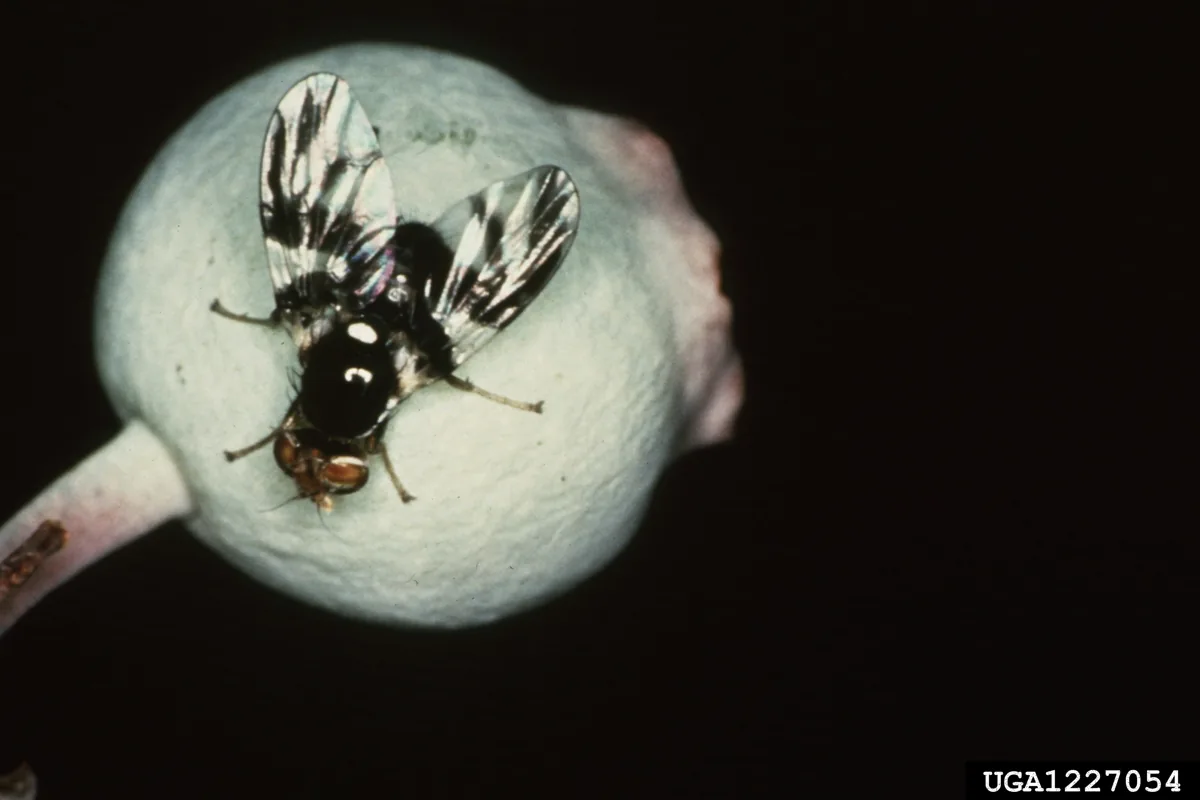
- Adults are about 1/8 inch long (Virginia Tech gives 3/16 inch for females), black with a prominent white spot at the rear of the thorax and white bands on the abdomen, four on females and three on males, and black zigzag bands across the wings. UF/IFAS gives a body length of 3 to 4 mm (about 1/8 to 3/16 inch) and says reliable ID of adults needs careful measurement of wing bands and other features.[1][2][3]
- Larvae are white, legless maggots found in ripe berries; pupae are oval, hard and tan. UF/IFAS describes them as creamy white, reaching 5 to 6 mm (about 3/16 to 1/4 inch), with a tapered front end bearing fine black mouthhooks.[1][3]
- It is nearly identical to the apple maggot but slightly smaller; it was once considered a race of the apple maggot. UF/IFAS says no known features separate its larvae from those of the apple maggot or the dogwood berry maggot.[1][2][3]
Look-alikes
| Look-alike | How to tell them apart |
|---|---|
| Apple maggot | A close relative that looks almost the same; apple maggots do not attack blueberries and blueberry maggots do not attack apples.[1][2] |
| Spotted-wing drosophila | Another fly whose larvae infest soft berries; a 2025 study found blueberry maggot activity shifting about three weeks earlier, when spotted-wing drosophila activity is still low.[4][1] |
| Black walnut fruit fly | A fruit fly that develops in black walnut and can land in the same traps; its outermost black wing band reaches the wing edge, while the blueberry maggot's leaves a clear margin.[2] |
Where it lives
Native to eastern North America. UF/IFAS says it was first reported in 1914 in Maine and New Hampshire and has mainly damaged crops in the northeastern and north central United States and Canada; it was found at high levels in northeast Georgia in 1991 and in far southern Alabama in 1992. UF/IFAS lists it from Alabama, Connecticut, Delaware, Florida, Georgia, Maine, Maryland, Massachusetts, Michigan, New Hampshire, New Jersey, New York, North Carolina, Pennsylvania, Rhode Island, Tennessee, Virginia and West Virginia, and in Canada from New Brunswick, Nova Scotia, Ontario and Prince Edward Island. Long common in Canadian lowbush blueberries, it spread south through the mid-Atlantic from the 1960s and is common in the Southeast. California and Washington quarantine blueberries from all states from the Dakotas and Texas eastward; that quarantine area is a regulatory boundary, not a record of where the fly lives.[3][4][2][5][6][1]
Biology and life cycle
It overwinters as a pupa in the soil under the bushes and has one generation a year. About 85% emerge the next summer; some wait a year longer, and a few emerge in the third or fourth year.[1][2]
Adults emerge as the first berries ripen: usually the last week of May or first week of June in North Carolina, and around June 30 in New Hampshire, where adults peak July 1 to 15. In Florida and Georgia, UF/IFAS says adults appear about late May and persist until late July, while the native host deerberry is fruiting.[2][1][3]
After about a week, or 7 to 10 days, of feeding and mating, females lay single eggs under the skin of ripening berries, one egg per berry; a 2025 study found they can also lay in green fruit. UF/IFAS says each female lays 25 to 100 eggs over 15 to 30 days.[1][2][4][3]
Eggs hatch in about 5 days and the maggot feeds in the pulp for about two weeks, then drops to the soil to pupate. UF/IFAS gives 3 to 10 days for eggs to hatch and 17 to 22 days of larval feeding, during which the pulp may be eaten completely.[2][1][3]
Populations run highest where the soil stays moist all summer (irrigation, high organic matter, shading bushes), which keeps pupae from drying out.[2]
Damage and signs
- Hosts are highbush and lowbush blueberries, huckleberries and, in the Southeast, deerberry. UF/IFAS adds sourtop and hillside blueberry, lingonberry, black huckleberry, dangleberry and dwarf huckleberry. Flies in sparkleberry in the Southeast, which fruits from August to November, are currently called blueberry maggots but may be a separate, undescribed species.[2][5][3]
- Unmanaged plantings can build very high populations and lose the whole crop; lowbush fields often suffer more, while well-picked highbush plantings usually have few problems.[1]
- A 2025 study found more maggots in later-ripening blueberry varieties than earlier ones.[4]
Health risk
A fruit pest; none of the sources describes any risk to people or pets.[1][2]
Control
Prevention
Hang red sticky spheres or yellow sticky traps (Virginia Tech baits them with ammonium acetate or protein hydrolysate) in the upper half of the canopy; first catches come before the first berries turn blue. Virginia Tech uses an action threshold of 3 adults per week (or 5 per field per week). UF/IFAS describes yellow sticky boards baited with ammonium carbonate, placed near fruit in a shady part of the bush between knee and waist height, and gives the same threshold of three adults per trap per week or five per field. Traps only show egg-laying is possible: once flies are caught, cut open several hundred ripening berries to look for maggots.[1][2][3]
Don't carry or ship fresh blueberries from eastern states into California or Washington without checking their rules: both quarantine them.[5][6]
Sanitation
Keep bushes picked clean so ripe berries don't remain for the flies, and harvest ripe fruit before any spray.[1][2]
Pesticides
Many insecticides are registered, including organic ones; once a field passes the threshold, sprays are repeated until unharvested fruit has dropped. Ask your county extension office for current choices and read the label every time. UF/IFAS says spraying as soon as flies are caught is only for plantings damaged the previous year, and a short-residual product should be used during harvest.[1][2][3]
Quarantines on eastern blueberries
California's quarantine covers all states east of and including North Dakota, South Dakota, Nebraska, Kansas, Oklahoma and Texas. Fresh fruit of blueberries, huckleberries and other listed hosts, and the soil under fruiting plants, are barred unless they meet the rule's conditions, in most cases a certificate from the shipping state's agricultural official.[5]
Washington prohibits fresh blueberries from the same eastern area except under the conditions in its rule, to protect its blueberry crop.[6]
Where sources disagree
Pupation depth: UNH says 1 to 2 inches; Virginia Tech cites 2.5 to 15 cm (about 1 to 6 inches).[1][2]
Adult size: UNH says 1/8 inch; Virginia Tech gives 4.75 mm (3/16 inch) for females.[1][2]
Trap height: Virginia Tech says the upper half of the canopy; UF/IFAS says a shady spot between knee and waist height.[2][3]
Delayed emergence: UNH says a few pupae emerge in the third or fourth year; UF/IFAS says in northern states some can stay in the soil up to five years.[1][3]
Egg and larval timing: Virginia Tech gives about 5 days to hatch and about two weeks of feeding; UF/IFAS gives 3 to 10 days and 17 to 22 days.[2][3]
Common questions
- What are the little white worms in my blueberries?
- Often blueberry maggots, the larvae of the blueberry fruit fly; spotted-wing drosophila larvae are the other common cause.[1][4]
- Will they move to my apple trees?
- No; blueberry and apple maggots don't cross hosts.[1]
- How can I prevent them?
- Pick bushes clean and put out sticky traps before berries turn blue so you know when the flies arrive.[1][2]
- Is the blueberry maggot the same as the apple maggot?
- They are separate but very close species. UF/IFAS places them in one species group with the dogwood berry maggot and snowberry maggot, and genetic studies have confirmed they are distinct.[3]
Sources
- UNH Cooperative Extension, “Blueberry Fruit Fly (Pest Fact Sheet 22).” extension.unh.edu/resource/blueberry-fruit-fly-fact-sheet (accessed 2026-11-14)
- Virginia Tech Department of Entomology (Virginia Fruit pages), “Blueberry maggot, Rhagoletis mendax Curran.” www.virginiafruit.ento.vt.edu/BlueberryMaggot.html (accessed 2026-11-14)
- University of Florida/IFAS Extension (Featured Creatures), “Blueberry Maggot, Rhagoletis mendax Curran, EENY-041/IN198.” ask.ifas.ufl.edu/publication/IN198 (accessed 2026-11-14)
- Journal of Economic Entomology, via PubMed, “Sampling highbush blueberries for Rhagoletis mendax reveals shifting activity timing and cultivar susceptibility (Van Timmeren and Isaacs 2025).” pubmed.ncbi.nlm.nih.gov/40971815/ (accessed 2026-11-14)
- California Department of Food and Agriculture, “Plant Quarantine Manual 3266: Plum Curculio and Blueberry Maggot.” pi.cdfa.ca.gov/pqm/manual/htm/314.htm (accessed 2026-11-14)
- Washington State Department of Agriculture rule (Washington State Legislature), “Chapter 16-488 WAC: Fresh Fruit of Blueberry Quarantine.” lawfilesext.leg.wa.gov/Law/WACArchive/2024/pdf/WAC%20%2016%20-488%20%20CHAPTER/WAC%20%2016%20-488%20%20COMBINEDCHAPTER.pdf (accessed 2026-11-14)
- iNaturalist, “Rhagoletis mendax taxon page (order and family).” www.inaturalist.org/taxa/52205 (accessed 2026-11-14)