On this page
How to identify it
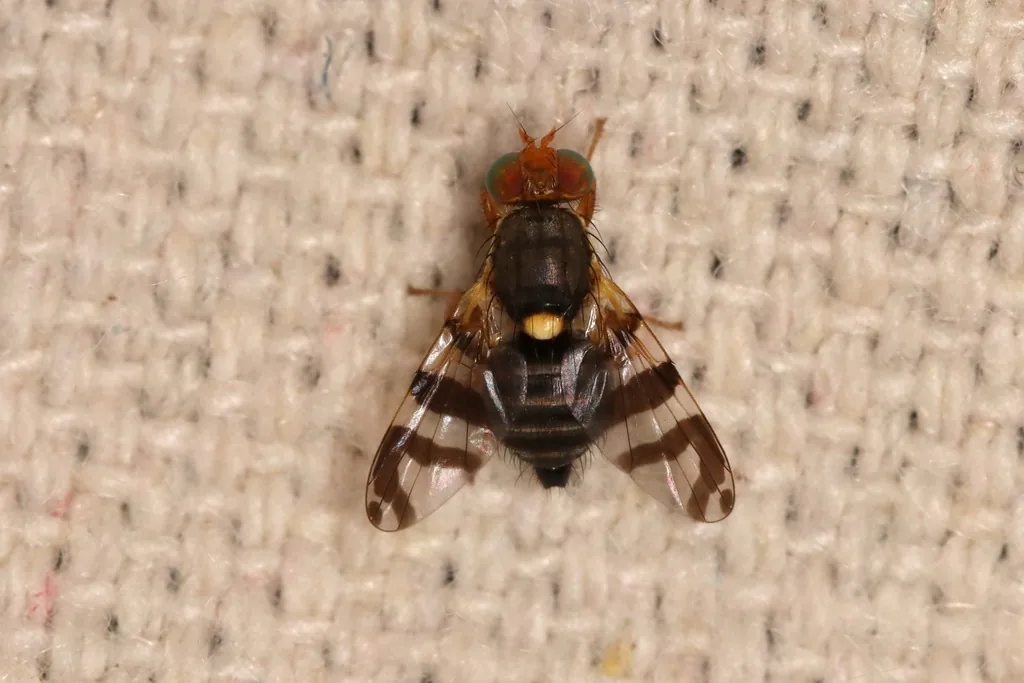
- Adults are black flies with yellow heads, a bit smaller than house flies, with a white or cream dot between the wings.[1]
- The cherry fruit fly's abdomen has four white crossbands; the black cherry fruit fly's is entirely black.[1]
- The dark bands on the wings are distinctive, and Kentucky suggests using the wing banding to tell the two cherry fruit flies apart on sticky cards.[1]
- The larvae are harder to separate. EFSA notes that cherry fruit fly and western cherry fruit fly adults look different, but their larvae are similar and both attack cherries.[3]
- UF/IFAS gives adults as 4 to 5 mm long, generally black with yellow edges on the thorax, a white scutellum, yellowish lower legs, and transverse and oblique blackish wing markings.[4]
- UF/IFAS says the maggots in the fruit are yellowish white, up to 1/4 inch long and pointed at the head end.[4]
Look-alikes
| Look-alike | How to tell them apart |
|---|---|
| Black cherry fruit fly | Its abdomen is entirely black, without the four white crossbands, and its wing markings differ. It usually starts emerging about ten to fourteen days earlier and has a more northern range, reaching only as far south as Pennsylvania, in both eastern and western North America. UF/IFAS adds that its wing bands are more pronounced and that it mainly attacks sour cherries.[1][2][4] |
| Western cherry fruit fly | A western relative and the only other crop pest in the cherry fruit fly's group of five North American species. Adults look different, but the larvae are similar.[3] |
| European cherry fruit fly | An invasive species native to Europe and parts of Asia that was found in southern Ontario in 2016 and in western New York in 2017.[2] |
| Plum curculio larvae | These weevil grubs also turn up in cherries and plums. UF/IFAS says they have heavy chewing jaws and a bluntly rounded head, while fruit fly maggots have sharp, downward-curved mouth hooks and a pointed head.[4] |
| Apple maggot | UF/IFAS says this third Rhagoletis closely resembles the two cherry fruit flies; all three have banded wings.[4] |
Where it lives
Native to eastern North America; see where the sources disagree on how far it reaches. GBIF holds about 230 U.S. records since 1990, the most from New York, Massachusetts and Pennsylvania. It has also been introduced to Europe. UF/IFAS says only this species, not the black cherry fruit fly, occurs in Florida, where it attacks wild cherries and is of little economic importance.[2][3][5][6][4]
Biology and life cycle
Flies spend ten months in the soil; adults emerge late May to early July, usually after rain wets the topsoil.[1]
Adults feed on aphid honeydew and other foods for about 10 days before laying eggs under the fruit skin. The eggs hatch in about 4 days to one week.[1]
Maggots feed about two weeks, then pupate 1 to 2 inches deep; there's one generation a year.[1]
Timing varies with habitat. In Michigan, flies flew early (June-July) in neglected orchards, peaked just after harvest (June-August) in managed orchards and flew through most of the season (June-September) around wild black cherry, the fly's ancestral host. Females in unsprayed orchards also became ready to lay eggs earlier than those in sprayed orchards or black cherry stands.[7][8]
Adults are weak fliers, so the fly spreads mainly as larvae in traded fruit and as pupae in soil.[3]
UF/IFAS says each female may lay 300 to 400 eggs, but only one larva matures in a fruit. The eggs hatch in five to eight days, and larvae tunnel straight to the seed and pass through three instars in an average of 11 days at 77°F.[4]
UF/IFAS says a few flies emerge in August and September as a second generation, but about 99% take a year to complete the life cycle.[4]
Damage and signs
- Infested fruit looks normal at first, then develops sunken, shriveled areas near ripening. UF/IFAS says infested cherries don't fall at first, and by harvest as many as 75% may be infested. Larvae in early varieties can pass undetected at harvest and be shipped elsewhere.[1][4]
- Kentucky lists sweet and sour cherries, pear, plum and wild cherry as hosts, and females can blemish fruit with egg-laying punctures near the bottom. EFSA says late-maturing varieties, especially sour cherries, suffer most.[1][3]
- Even small infestations cause losses for growers who sell fruit: EU marketing rules set a threshold below 4% for worm-eaten cherries.[3]
Health risk
Kentucky's ENTFACT describes a fruit pest and doesn't mention any risk to people or pets.[1]
Control
Keep them out
Besides sprays timed to kill adults, EFSA lists netting and trapping among the few cultural options.[3]
Traps and physical control
Hang yellow sticky cards in trees in late May and check them twice a week.[1]
Pesticides
Eggs and larvae inside fruit are protected, so sprays must target adults before they lay eggs. UF/IFAS says the few days new adults spend feeding on leaf and fruit surfaces before laying eggs are the most vulnerable stage and the best time for control.[1][4]
Kentucky says adults should be controlled 5 to 6 days after they emerge, before egg laying begins. Read and follow the label.[1]
In Michigan State lab and field trials, chlorantraniliprole killed cherry fruit fly adults and protected fruit about as well as standard broad-spectrum insecticides.[9]
Spread to Europe
The cherry fruit fly is one of two North American Rhagoletis flies now in Europe, along with the walnut husk fly, joining the European cherry fruit fly, a much older resident there.[6]
By 2014 it was present in eight EU member states, and EU plant-health rules regulate it, with restrictions on host plants and soil entering or moving within the EU. GBIF now holds hundreds of records from the Netherlands and Belgium.[3][10]
Where the sources disagree
Hosts: Kentucky lists sweet and sour cherries, pear, plum and wild cherry; EFSA says it attacks cultivated and wild cherries, with late-maturing varieties, especially sour cherries, suffering most. UF/IFAS lists sweet, sour, mahaleb and wild (Prunus serotina) cherries as primary hosts and says it has also been reared from plum, fringe tree and wild olive.[1][3][4]
When adults fly: Kentucky gives late May to early July; Michigan studies found flight in June and July in neglected orchards, June to August in managed orchards and June to September around wild black cherry.[1][7]
Range: New York State IPM says its range includes most of eastern North America; EFSA describes it as present from Canada to Mexico. UF/IFAS gives Michigan to New Hampshire and south to Florida, across the middle and eastern U.S. and into southeastern and south-central Canada.[2][3][4]
Generations: Kentucky says there is one generation a year, while UF/IFAS says a few flies emerge in August and September as a partial second generation.[1][4]
Egg hatch and pupation depth: Kentucky gives about 4 days to one week and 1 to 2 inches deep; UF/IFAS gives five to eight days and one to three inches.[1][4]
Black cherry fruit fly range: New York State IPM says it reaches only as far south as Pennsylvania, while UF/IFAS says it occurs across southern Canada south to New York in the east and to California on the west coast.[2][4]
Common questions
- Why are there worms in my cherries?
- Usually cherry fruit fly maggots, which feed inside ripening fruit.[1]
- Can I spray once I see maggots?
- Too late; sprays must target adult flies before egg laying.[1]
- Is the black cherry fruit fly the same thing?
- No. It is a separate native species with an all-black abdomen that emerges ten to fourteen days earlier and lives farther north; both can attack the same cherries.[1][2]
- Is the cherry fruit fly a problem in Florida?
- Rarely. UF/IFAS says it is the only one of the cherry fruit flies found in Florida, where it attacks wild cherries and is of little economic importance.[4]
Sources
- University of Kentucky Entomology (ENTFACT), “Cherry Fruit Flies (ENTFACT-217).” entomology.mgcafe.uky.edu/ef217 (accessed 2026-11-13)
- New York State Integrated Pest Management Program (Cornell University), “Cherry Fruit Flies (Fruits IPM Fact Sheet, A. Agnello, 2021; eCommons record abstract).” hdl.handle.net/1813/43083.2 (accessed 2026-11-13). The fact-sheet PDF download returned HTTP 405 to a scripted request and was not worked around; only the record's published abstract is cited.
- EFSA Journal, via PubMed, “Scientific Opinion on the pest categorisation of Rhagoletis cingulata (EFSA Panel on Plant Health 2014).” pubmed.ncbi.nlm.nih.gov/42087931/ (accessed 2026-11-13)
- University of Florida IFAS Extension (EDIS), “Cherry Fruit Fly, Rhagoletis cingulata (Loew), EENY-203/IN360 (Featured Creatures; H. V. Weems Jr.).” ask.ifas.ufl.edu/publication/IN360 (accessed 2026-11-14)
- Global Biodiversity Information Facility (GBIF), “Rhagoletis cingulata: U.S. occurrence records since 1990 by state (GBIF occurrence search).” api.gbif.org/v1/occurrence/search?taxonKey=1622599&country=US&hasGeospatialIssue=false&occurrenceStatus=PRESENT&year=1990%2C2026&facet=stateProvince&facetLimit=400&limit=0 (accessed 2026-11-13). Exact count at access: 227 U.S. records since 1990 (New York 26; Massachusetts 24; Pennsylvania 15; Wisconsin 10).
- Bulletin of Entomological Research, via PubMed, “Old residents and new arrivals of Rhagoletis species in Europe (Augustinos et al. 2019).” pubmed.ncbi.nlm.nih.gov/30744707/ (accessed 2026-11-13)
- Environmental Entomology, via PubMed, “Habitat-specific flight period in the cherry fruit fly Rhagoletis cingulata (Teixeira et al. 2007, Michigan State University).” pubmed.ncbi.nlm.nih.gov/18284761/ (accessed 2026-11-13)
- Environmental Entomology, via PubMed, “Reproductive maturity of cherry fruit fly in managed and natural habitats (Teixeira et al. 2009).” pubmed.ncbi.nlm.nih.gov/19689872/ (accessed 2026-11-13)
- Pest Management Science, via PubMed, “Lethal and sublethal effects of chlorantraniliprole on three species of Rhagoletis fruit flies (Teixeira et al. 2009).” pubmed.ncbi.nlm.nih.gov/18937218/ (accessed 2026-11-13)
- Global Biodiversity Information Facility (GBIF), “Rhagoletis cingulata: occurrence records since 1990 by country (GBIF occurrence search).” api.gbif.org/v1/occurrence/search?taxonKey=1622599&hasGeospatialIssue=false&occurrenceStatus=PRESENT&year=1990%2C2026&facet=country&limit=0 (accessed 2026-11-13). Exact counts at access: 734 records since 1990; Netherlands 237, United States 227, Belgium 182, Canada 35, Germany 22, Costa Rica 13, France 5.
- Global Biodiversity Information Facility (GBIF), “Rhagoletis cingulata (Loew, 1862) (GBIF Backbone Taxonomy).” api.gbif.org/v1/species/1622599 (accessed 2026-11-13)
- iNaturalist, “Rhagoletis cingulata taxon page (order and family).” www.inaturalist.org/taxa/497933 (accessed 2026-10-06)