On this page
How to identify it
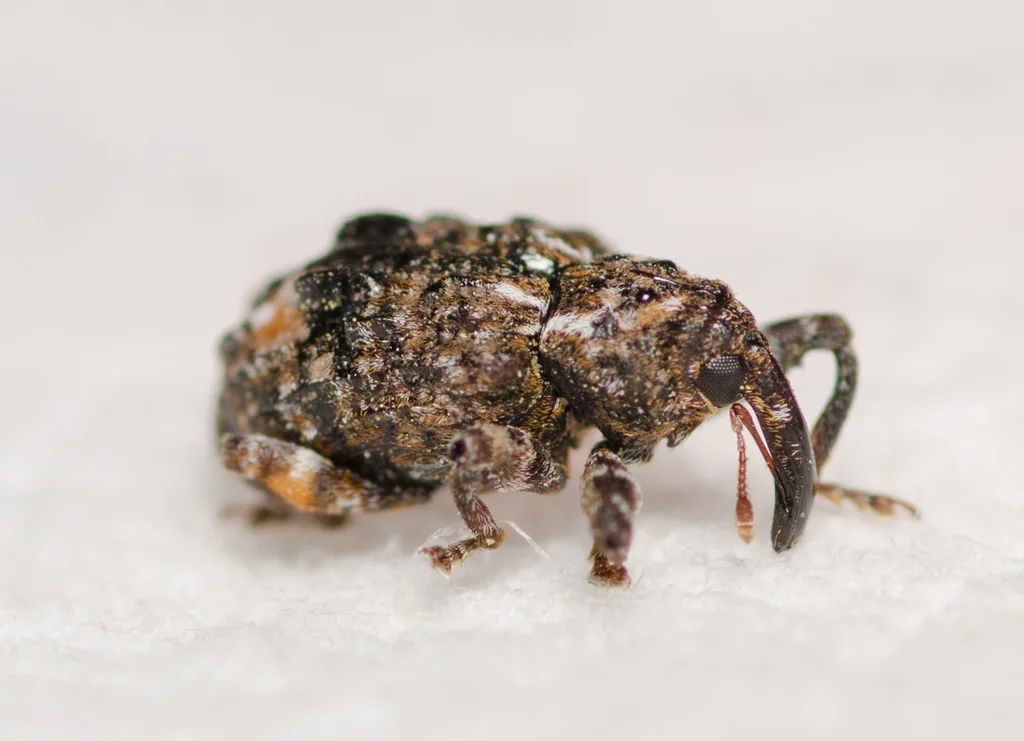
- Adults are dark brown to nearly black snout beetles mottled with gray, brown and black, about 3/16 to 1/4 inch (5 to 6 mm) long, with a curved snout about one-third the length of the body.[1][2][5][3][4]
- The wing covers have four humps and grayish-white patches; Wisconsin notes that only one pair of these ridges is readily apparent.[1][2][5][4]
- Larvae are legless, C-shaped, cream to grayish-white grubs with a small brown head, 1/4 to 1/3 inch long when grown, found inside fruit.[1][2][4][5]
- Eggs are tiny (about 1/50 inch), white and oval, laid one at a time under the fruit skin.[4][5][6]
- The telltale sign is a crescent-shaped cut partly surrounding a sunken egg puncture on young fruit. Adult feeding leaves small round holes.[5][2][3][6]
Look-alikes
| Look-alike | How to tell them apart |
|---|---|
| Codling moth larva | Codling moth larvae are white to light pink caterpillars with a dark brown head that tunnel to the core and leave reddish-brown frass, unlike the legless curculio grub.[7][1] |
| Apple curculio | Reddish-brown, with a longer protruding snout and two sets of knobs on the wing covers. It seals its egg puncture with frass instead of cutting a crescent, and seldom attacks stone fruit other than tart cherries.[8] |
Where it lives
Native to eastern North America and found in most states east of the Rocky Mountains and in Canada. The only population west of the Rockies, in Box Elder County, Utah, was detected in the early 1980s; the beetle is a quarantine pest in western North America and, for the European Union, where it is not known to occur.[1][4][6][9]
Biology and life cycle
Adults spend the winter under leaf litter in woods, hedgerows, fence rows, ditch banks and compost piles near orchards; Wisconsin says they spend about 300 days a year there.[1][2][6][4]
They become active after the mean temperature tops 50 °F for at least 3 days and reach fruit trees around bloom, walking in and climbing trunks below 70 °F and flying when it is warmer.[6][4][5]
A female chews a small cavity, lays one egg in it and cuts a crescent-shaped slit beside it; the flap shields the egg as the fruit grows. Egg-laying runs for 3 to 5 weeks after bloom.[2][6][4]
Eggs hatch in 2 to 12 days, typically in about a week.[1][6][5][4]
Grubs feed inside the fruit through four stages for about 16 days (8 to 22 days in Utah), then leave it and pupate 1 to 3 inches down in the soil.[2][5][4][6]
In apples and pears the firm, growing flesh kills most larvae, so they mainly survive in fruit that drops. In stone fruit they can finish developing in fruit still on the tree.[4][6][5]
Northern populations have one generation a year and a southern strain has two. Illinois has two, mid-Atlantic trap studies found two-generation populations, and Penn State reports a partial second generation in southern Pennsylvania in some years.[3][2][10][5]
New adults come out of the soil about a month after pupating, mostly in August, feed on fruit for a while and head for winter shelter in late summer or early fall.[1][4][2][5]
Damage and signs
- Infested young fruit usually falls around the time of the natural June drop.[1][2][3][6]
- When an egg fails to hatch, the crescent scar stays on the fruit, grows with it into a half-moon lesion and lowers its quality at harvest. On plums and apricots a drop of clear to amber sap may weep from the scar.[1][2][4][5]
- Adults also feed on fruit in spring and late summer. Feeding on flower bases before egg-laying can leave lumpy, misshapen fruit, and feeding wounds can let in brown rot.[3][4][6]
- Hosts include apples, peaches, nectarines, plums, cherries, pears, apricots and quince, along with wild plum, crabapple and hawthorn.[1][2][5][4][6]
- Trees next to woods, fence rows and weedy fields are hit first and hardest. A study in a peach orchard during 2025 found feeding, egg scars and larvae concentrated along the edges, with yield falling toward the edge.[2][5][11]
Health risk
The harm is to the crop: both adults and grubs injure fruit, and infested fruit is unfit to eat or sell.[3][6]
Control
Prevention
Watch young fruit from bloom until about two weeks after petal fall for fresh crescent scars, especially on edge trees; attacks on apple begin once fruit reaches about 1/4 inch. The key period is the first warm, humid days after petal fall, near 70 °F.[1][5][4]
In commercial apple orchards, a lure-baited 'trap tree' at the edge concentrates attacks and shows whether border sprays are needed after petal fall; a 2023 study found methyl salicylate can replace the costlier benzaldehyde lure.[2][12]
Sanitation
Pick up dropped fruit all season and throw it away or bury it to kill grubs before they pupate; composting does not kill them.[2][3][4]
Remove wild or neglected fruit trees nearby, and prune in the dormant season to open the canopy. Wisconsin cautions that beetles can travel more than 1/4 mile, so removing hosts may not be enough where populations are high.[2][4]
Traps and physical control
On small trees, spread a white sheet underneath and tap each branch early in the morning, when beetles drop instead of flying, then kill them. It has to be repeated almost daily for about 4 weeks from bloom.[4][6]
Fruit sealed in plastic bags tied at the stem is protected until harvest, but the beetles often strike before fruit is big enough to bag.[4]
Pesticides
Kaolin clay sprayed from petal fall forms a white film that deters egg-laying and is accepted for organic growing. It must be renewed weekly and after rain as the fruit grows.[2][1][4]
Never spray insecticides during bloom; start after it is completely finished, repeat about every 7 to 10 days for a few weeks, rotate IRAC groups, and follow your state's tree fruit guide and the label. Wisconsin warns that carbaryl used within a month of bloom can make healthy fruit drop.[2][1][4]
Where sources disagree
Eggs per female: an average of 150 to 200 (UNH, Utah State), 100 to 500 (Wisconsin) or 400 to 500 (Illinois).[1][6][4][3]
Traps: Illinois describes beating sheets and benzaldehyde-baited trunk traps for monitoring, but mid-Atlantic trials found baited traps catch more beetles without reliably showing when or whether to spray, and Wisconsin calls branch-tapping unreliable unless paired with checking fruit for scars.[3][10][4]
Adult size: 3/16 inch (UNH), 1/4 inch (UMass, Penn State, Utah State) or 1/6 to 1/4 inch (Wisconsin).[1][2][5][6][4]
Apples: most extension guides list apple as a main host, but Utah State reports no economic damage to apples or pears in Utah, where larvae do not survive in those fruits.[1][4][6]
Common questions
- What are the half-moon scars on my apples?
- They are plum curculio egg-laying scars. The female cuts a small crescent-shaped flap in the skin and lays an egg beside it; the scar grows with the fruit.[2][3][4]
- Why are my small apples or peaches falling off early?
- Plum curculio grubs feeding inside young fruit make it drop, usually around the time of the June drop. Pick up and destroy the dropped fruit.[1][2][3]
- Can I spray during bloom?
- No. Wait until bloom is completely finished to protect pollinators.[2][4]
- Can I compost the dropped fruit?
- No. Composting doesn't kill the grubs inside; throw the fruit away or bury it.[4]
Sources
- University of New Hampshire Extension, “Plum Curculio [fact sheet].” extension.unh.edu/resource/plum-curculio-fact-sheet (accessed 2026-11-11)
- UMass Amherst Extension Fruit Program, “Apple IPM: Plum Curculio (March 2020).” www.umass.edu/agriculture-food-environment/fruit/fact-sheets/apple-ipm-plum-curculio (accessed 2026-11-11)
- University of Illinois Extension, “Life Cycle and Biology of Plum Curculio (2023).” extension.illinois.edu/sites/default/files/plum_curcurlio_insect_fact_sheet_nov._23.pdf (accessed 2026-11-11)
- University of Wisconsin-Madison Extension (Wisconsin Horticulture), “Plum Curculio.” hort.extension.wisc.edu/articles/plum-curculio/ (accessed 2026-11-11)
- Penn State Extension, “Tree Fruit Insect Pest - Plum Curculio.” extension.psu.edu/tree-fruit-insect-pest-plum-curculio (accessed 2026-11-11)
- Utah State University Extension, “Plum Curculio (December 2023).” extension.usu.edu/planthealth/research/plum-curculio (accessed 2026-11-11)
- University of California Statewide IPM Program, “Codling Moth (Pest Notes, Home and Landscape).” ipm.ucanr.edu/home-and-landscape/codling-moth/ (accessed 2026-11-11)
- University of Minnesota Extension Fruit and Vegetable IPM blog, “Apple curculio: A lesser-known orchard pest (Aug. 2024).” blog-fruit-vegetable-ipm.extension.umn.edu/2024/08/apple-curculio-lesser-known-orchard-pest.html (accessed 2026-11-11)
- EFSA Journal, via PubMed, “EFSA Panel on Plant Health (2018), Pest categorisation of Conotrachelus nenuphar.” pubmed.ncbi.nlm.nih.gov/32625717/ (accessed 2026-11-11)
- Journal of Economic Entomology, via PubMed, “Leskey and Wright (2004), Monitoring plum curculio populations in apple and peach orchards in the mid-Atlantic.” pubmed.ncbi.nlm.nih.gov/14998130/ (accessed 2026-11-11)
- Environmental Entomology, via PubMed, “Barrett, McFarland, Esposito and Nielsen (2026), Edge effects concentrate Conotrachelus nenuphar oviposition with consequences for larval performance and fruit yield.” pubmed.ncbi.nlm.nih.gov/42746851/ (accessed 2026-11-11)
- Journal of Economic Entomology, via PubMed, “Regmi, Leskey and Pinero (2023), Methyl salicylate improves the effectiveness of the odor-baited trap tree approach for adult plum curculio.” pubmed.ncbi.nlm.nih.gov/37318334/ (accessed 2026-11-11)
- iNaturalist, “Conotrachelus nenuphar taxon page (order and family).” www.inaturalist.org/taxa/217517 (accessed 2026-10-06)