On this page
How to identify it
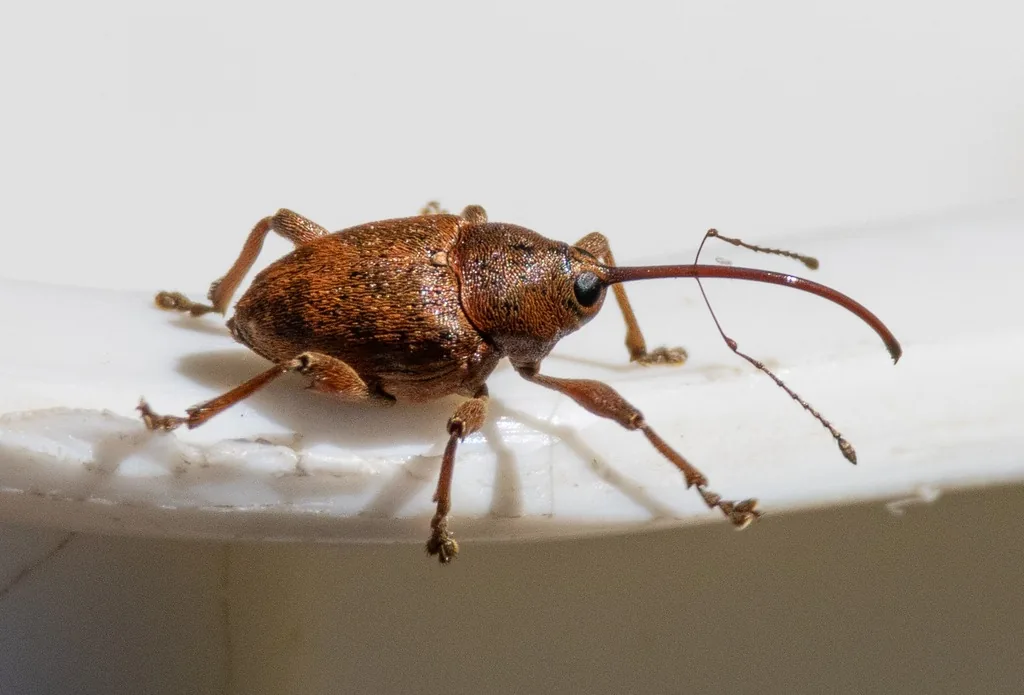
- Adults are about 3/8 inch long, brown, tan or gray and often mottled, with a very long, thin snout. Females have longer snouts than males, and the Missouri Department of Conservation says in some species the female's snout is longer than the rest of her body.[1][2][3]
- Grubs are creamy white, legless and curved, fattest in the middle, with brown heads. NC State says they grow to about 3/8 inch; Iowa State says 1/4 to 3/8 inch.[1][2]
- Infested acorns show a perfectly round hole about 1/8 inch across where the grub chewed its way out.[1][2]
Look-alikes
| Look-alike | How to tell them apart |
|---|---|
| Pecan weevil | Another Curculio nut weevil; about 30 species of the genus live in North America.[3] |
| Plum curculio | Called a curculio, but in a different genus; it attacks stone fruits.[3] |
| Chestnut weevils | NC State says the grubs of the many Curculio species look remarkably alike, and that a very similar chestnut weevil is a serious pest of Chinese chestnuts.[1] |
Where it lives
The Missouri Department of Conservation says about 30 Curculio species live in North America north of Mexico, and a published study describes the acorn weevil Curculio glandium as widespread in eastern North America.[3][4]
Biology and life cycle
In summer, females use the chewing mouthparts at the tip of the snout to bore into developing acorns on the tree and lay eggs inside. NC State says one or more eggs go in each acorn; the Missouri Department of Conservation says the female bores a separate hole for each egg.[1][2][3]
Grubs feed inside the nut until fall, chew out of fallen acorns in late fall or early winter and tunnel into the soil, where NC State and Iowa State say they stay one to two years before becoming adults.[1][2]
A study of Curculio glandium larvae from Pelee Island in southwestern Ontario found they overwinter in the soil and avoid freezing; the authors suggest colder soil farther north or in years with little snow cover could kill some.[4]
Sources differ on when adults appear: the Missouri Department of Conservation says they emerge from the soil in spring, while NC State says they emerge throughout the summer.[3][1]
Damage and signs
- Grubs eat out the inside of the acorn, killing it as seed, but they don't otherwise harm the tree. Sources differ on hickory nuts: Iowa State says the larvae also eat hickory nuts and the Missouri Department of Conservation lists hickory and other nuts for the genus, while NC State says it's unclear whether the acorn weevil itself infests hickory nuts.[1][2][3]
- Squirrels leave infested nuts behind, so it can look as though nearly all acorns are infested.[1][2]
Health risk
It feeds on nuts, and no cited source describes any risk to people or pets.[1][2][3]
Control
Sanitation
To save acorns for planting, NC State says to collect them as soon as they fall and refrigerate them to slow the grubs, then freeze them to kill the grubs, or soak them 20 minutes in 120°F water. It says hotter water can be used if the acorns aren't meant for seed.[1]
Pesticides
Insecticide control in backyard oaks and hickories isn't practical. NC State says that's because adults emerge from the soil all summer; Iowa State says nut growers spray to stop egg-laying, but that's prohibitively costly for homeowners.[1][2]
Common questions
- Why do my acorns have little holes?
- The holes are exit holes chewed by acorn weevil grubs leaving the nut.[1][2]
- Will acorn weevils hurt my oak tree?
- No. NC State and Iowa State say the grubs kill the acorn as seed but don't otherwise damage the tree.[1][2]
- Do acorn weevils also get into hickory nuts?
- Sources differ. Iowa State says the larvae eat acorns or hickory nuts, and the Missouri Department of Conservation says nut weevils use acorns, hickory and other nuts, but NC State says it's unclear whether the acorn weevil itself infests hickory nuts.[2][3][1]
Sources
- NC State Extension, “Acorn Weevil (PDIC Factsheet).” content.ces.ncsu.edu/acorn-weevil (accessed 2026-11-13)
- Iowa State University Extension and Outreach (Yard and Garden), “Acorn and Nut Weevils (Yard and Garden encyclopedia).” yardandgarden.extension.iastate.edu/encyclopedia/acorn-and-nut-weevils (accessed 2026-11-13)
- Missouri Department of Conservation, “Nut Weevils (Acorn Weevils) (Field Guide).” mdc.mo.gov/discover-nature/field-guide/nut-weevils-acorn-weevils (accessed 2026-11-13)
- Journal of Thermal Biology (via PubMed), “The overwintering biology of the acorn weevil, Curculio glandium in southwestern Ontario. Udaka & Sinclair 2014 (abstract).” pubmed.ncbi.nlm.nih.gov/25086980/ (accessed 2026-11-13)
- Global Biodiversity Information Facility (GBIF), “Curculio Linnaeus, 1758 (GBIF Backbone Taxonomy).” api.gbif.org/v1/species/10656453 (accessed 2026-11-13)