On this page
How to identify it
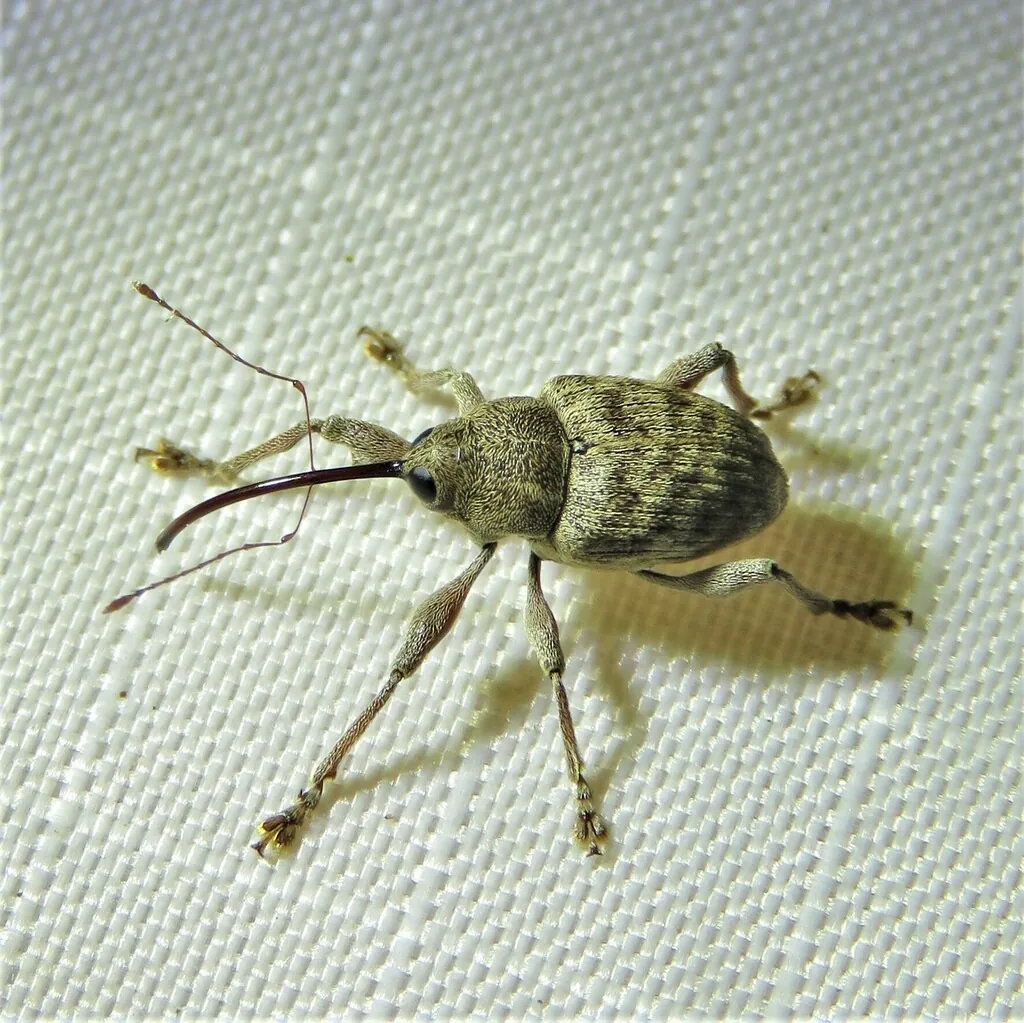
- Adults are reddish brown to grayish, with olive-brown hairs and scales. Kentucky and Texas A&M put them at about 3/8 inch not counting the snout; Missouri says about 1/2 inch.[1][3][2]
- The female's snout is as long as her body, or slightly longer according to Missouri; the male's is about half that.[1][2]
- Grubs are cream colored with reddish-brown heads. Kentucky and Texas A&M say they reach 3/5 inch; Missouri says about 1/2 inch.[1][3][2]
- Adult feeding leaves a pin-size puncture on the nut, which Texas A&M says is ringed by a circle of tracks. Inside, Missouri describes a tiny dark spot and a tobacco-like stain on the kernel.[3][2]
Look-alikes
| Look-alike | How to tell them apart |
|---|---|
| Hickory shuckworm and nut curculio | A grub inside a pecan before the shell hardens is usually a nut curculio or hickory shuckworm. Missouri Extension says pecan weevil grubs aren't found in nuts with soft shells.[2] |
Where it lives
Texas A&M gives a range from New York to Iowa, south to Oklahoma, and from Florida to West Texas, with recent finds in eastern New Mexico. It feeds on all North American hickories and on English walnut.[3]
Biology and life cycle
Adults leave the soil from late July into fall, often two or three days after a heavy rain. Missouri gives July 25 as the earliest; Kentucky says late August through September. Texas A&M says about 80 percent come out between August 20 and September 10 when soil moisture is normal, but drought or clay soil can delay them a month or more.[2][1][3]
In Texas A&M's account, 77 percent of adults fly to the trunk and land 6 to 8 feet up, 15 percent fly straight into the canopy and 5 percent walk.[3]
Females start laying about five days after emerging, once the nuts reach the gel stage, and keep going until the shucks split. They put 2 to 4 eggs in each nut; Texas A&M says a female lays about 75 eggs in roughly 30 nuts over a life of three to four weeks.[3][2]
Grubs feed for about a month, chew a round 1/8-inch hole and leave the nuts from late September into December. They dig 4 to 12 inches into the soil.[2][1][3]
Grubs stay in the soil one or two years, then pupate in early autumn and become adults that wait underground until the next August. Texas A&M says about 90 percent finish in two years and 10 percent take three.[2][1][3]
Damage and signs
- Adults feeding before the gel stage make young nuts shrivel, blacken and drop early. Later, grubs eat the kernel; damaged mature nuts don't bleed or drop, so the loss shows up at cracking. Kentucky notes grubs sometimes turn up where nuts are stored.[2][3][1]
- Some trees are infested year after year while their neighbors aren't. Kentucky says trees in low areas or near hickories, and early-maturing varieties, are hit hardest.[2][1]
Health risk
It feeds on nuts. Kentucky, Missouri and Texas A&M Extension describe crop damage only and don't mention any risk to people or pets.[1][2][3]
Control
Prevention
Traps help time control. Missouri calls cone-shaped emergence traps under the canopy the best detector, and Texas A&M also describes Tedders and circle traps on trunks plus kernel checks. Texas A&M says the commercial lure is unreliable and not recommended.[2][3]
Don't move infested nuts. Texas A&M says weevils spread on their own only about a mile, and people carrying infested nuts move them farther.[3]
Traps and physical control
Jarring limbs over a sheet shows when weevils are active. Kentucky also offers it as a non-spray control: shake weevils onto a harvesting sheet and destroy them, starting with the first heavy rain in early August and continuing through mid-September or until none are caught.[1]
Spread and the Texas quarantine
Texas A&M says pecan weevil is a Texas Department of Agriculture quarantined pest, and every Texas county is under quarantine except El Paso, Hudspeth, Culberson, Presidio and Jeff Davis. In-shell pecans shipped to New Mexico, Arizona, California or abroad must meet a quarantine treatment.[3]
Texas A&M asks anyone who sees pecan weevil activity in a county not on its infestation map to report it to the county Extension agent, with damaged nuts and location details if possible.[3]
In 2010, Texas A&M researchers used DNA to confirm pecan weevil larvae in a Carpathian (English) walnut growing among infested pecans in Missouri. They called it the first DNA confirmation of this host and said the infestation was established.[4]
Common questions
- What made the round holes in my pecans?
- Mature pecan weevil grubs chew a round 1/8-inch exit hole when they leave the nut, from late September on.[1][2]
- Do the same trees get hit every year?
- Often. Missouri and Kentucky say certain trees are infested year after year while neighbors aren't, and Texas A&M says weevils spread only about a mile on their own.[2][1][3]
- Why are green pecans dropping in August?
- Pecan weevil is one possible cause. Adults feeding before the gel stage make young nuts shrivel and fall. Look for a tiny dark puncture on the nut.[2][3]
Sources
- University of Kentucky Entomology (ENTFACT), “Nut Weevils (ENTFACT-206).” entomology.mgcafe.uky.edu/ef206 (accessed 2026-11-13)
- University of Missouri Extension, “Pecan Pest Management: Insects and Diseases (MP711).” extension.missouri.edu/publications/mp711 (accessed 2026-11-13)
- Texas A&M AgriLife Extension, “Controlling the Pecan Weevil (ENTO-089, Ree, Knutson & Harris, 7/19).” extensionentomology.tamu.edu/wp-content/uploads/2025/03/controlling-the-pecan-weevil.pdf (accessed 2026-11-13)
- J Econ Entomol 2010;103(4):1312-4, via PubMed, “DNA identification confirms pecan weevil (Coleoptera: Curculionidae) infestation of Carpathian walnut (Harris, Hunt & Cognato, 2010).” pubmed.ncbi.nlm.nih.gov/20857742/ (accessed 2026-11-13)
- Global Biodiversity Information Facility (GBIF), “Curculio caryae (G.H. Horn, 1873) (GBIF Backbone Taxonomy).” api.gbif.org/v1/species/5011873 (accessed 2026-11-13)
- iNaturalist, “Curculio caryae taxon page (order and family).” www.inaturalist.org/taxa/217926 (accessed 2026-10-06)