On this page
How to identify it
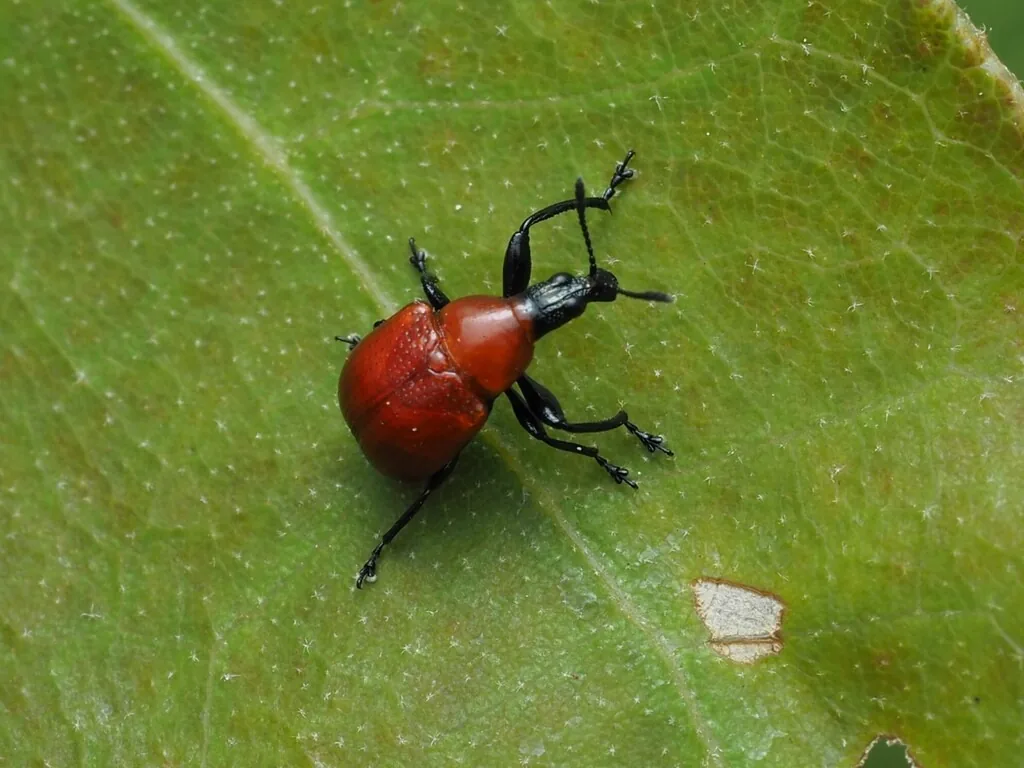
- The oak leaf-rolling weevil, Homoeolabus analis, is less than 1/4 inch long, shiny and chunky, and burnt orange except for its black head and legs. UF/IFAS gives adults as approximately 6 mm long, red with a black head and legs, with rows of small pits on the wing covers and clubbed antennae; the male's head is longer than the female's.[1][3]
- A very similar species, Attelabus bipustulatus, is shiny black with two bright red spots, one on each wing cover. UF/IFAS says it shares much of the oak leaf-rolling weevil's range but lives slightly farther north and is not found in Florida.[1][3]
- The egg is tiny and shaped like a rugby ball. Grubs are legless, curved and plump with brown heads. UF/IFAS describes the pupa as yellowish with reddish-brown eyes and sparse hairs.[1][3]
Look-alikes
| Look-alike | How to tell them apart |
|---|---|
| Thief weevil (Pterocolus ovatus) | Dark metallic blue and much smaller than the oak leaf-rolling weevil. It doesn't roll leaves; it enters finished rolls to eat the egg inside.[3] |
Where it lives
GBIF has 1990-2026 records of Homoeolabus analis from 30 states, from Florida and Texas (the most records) north to Massachusetts, New York, Michigan and Wisconsin, plus records from Canada. NC State notes it is more common near the coast in North Carolina. UF/IFAS adds that a similar weevil in Louisiana west of the Mississippi River and into Texas uses only live oak as a host.[4][1][3]
Biology and life cycle
The female chews slits on either side of the leaf midrib, lays an egg near the tip, then folds the leaf along the midrib and rolls it into a neat bundle called a nidus, with the egg near the center. UF/IFAS, drawing on a film of the process, says the female bites notches along the midrib and side veins so the leaf will fold, stops about every two turns to bite wedges that keep the roll from unwinding, and tucks in the flaps at the end; the whole job takes about two hours.[1][3]
The grub feeds on the leaf tissue inside the roll and pupates there; a new generation of adults emerges later, and there may be more than one generation a year. UF/IFAS says it overwinters as a prepupa and pupates in spring, and the pupal stage lasts about a week.[1][3]
Cutting and rolling host leaves is a family trait: attelabid weevils cut shoots, cut leaves, roll leaves or build wrapped leaf rolls in ways specific to each species, presumably to protect their eggs or larvae, and leaf-rolling arose more than once in the family.[2]
Each female may lay approximately 30 eggs in her lifetime, usually one per roll, though UF/IFAS says more than one egg may go into a roll when tender leaves are scarce.[3]
Around Gainesville, Florida, UF/IFAS says leaf rolling starts once new spring leaves have expanded and runs through summer, peaking while spring leaves are still soft and again with the new flush that follows the June and July rains. Sand live oak is a favorite host in Florida.[3]
North of Florida the female normally cuts the finished roll off and drops it, while in Florida it is usually left hanging; around Gainesville rolls are often dropped in spring but more often left attached later in summer. Why one roll is dropped and another is not is unknown.[3]
Damage and signs
Health risk
They feed only on tree leaves; NC State treats them as harmless curiosities and suggests keeping a few leaf rolls in a jar indoors to watch the adults emerge.[1]
Control
Prevention
Control is rarely needed. If the weevils are truly out of hand, NC State says a pyrethroid labeled for home landscapes, applied early in the season, should protect trees for most of the season; keep pyrethroids away from pools, ponds and streams because they are toxic to fish. UF/IFAS goes further: because the beetles cause no significant harm to the tree, it does not recommend control measures.[1][3]
The thief weevil and other natural enemies
A tiny dark metallic blue weevil, the thief weevil (Pterocolus ovatus), is an egg predator and nest thief of the oak leaf-rolling weevil. It waits for a roll to be finished, slips in while the leaf is still soft, works its way around the turns to the egg, eats it and lays its own egg in the roll.[3]
Both male and female thief weevils eat only the eggs of leaf-rolling weevils. Their larvae develop faster than the leaf-roller's and pupate in the soil. UF/IFAS says the thief weevil occurs throughout the oak leaf-rolling weevil's range except southern Florida.[3]
Leaf-roller eggs are also commonly killed by tiny parasitic wasps, and a eulophid wasp larva (probably Paracrias huberi) has been found feeding on mature larvae inside the rolls.[3]
Where the sources disagree
Range: UF/IFAS describes Homoeolabus analis as a coastal-states species from the Northeast to Louisiana, east of the Mississippi River, while GBIF holds 1990-2026 records from 30 states, including inland states and Texas, plus Canada.[3][4]
Egg shape: NC State compares the egg to a rugby ball, while UF/IFAS calls it spherical and yellowish.[1][3]
Common questions
- What are the little rolled-up oak leaves?
- Often they are nests made by leaf-rolling weevils, each built around an egg. The grub feeds and pupates inside.[1]
- Do leaf-rolling weevils hurt oak trees?
- Seldom. NC State says they are rarely abundant enough to be pests.[1]
- Should I spray for leaf-rolling weevils?
- Usually there is no need. UF/IFAS says they cause no significant harm to the tree and does not recommend control, and NC State says control is rarely needed.[3][1]
- Why are some rolled oak leaves lying on the ground?
- Some females cut the finished roll free and let it drop. UF/IFAS says that is normal north of Florida, while in Florida rolls are more often left on the tree.[3]
Sources
- NC State Extension, “Leafroller Weevils (PDIC Factsheet).” content.ces.ncsu.edu/leafroller-weevils (accessed 2026-11-14)
- Molecular Phylogenetics and Evolution, via PubMed, “Kobayashi C, Okuyama Y, Kawazoe K, Kato M (2012), The evolutionary history of maternal plant-manipulation and larval feeding behaviours in attelabid weevils (Coleoptera; Curculionoidea), Molecular Phylogenetics and Evolution 64(2):318-330.” pubmed.ncbi.nlm.nih.gov/22531609/ (accessed 2026-11-14). Cited from the PubMed abstract.
- University of Florida/IFAS Extension (Featured Creatures), “Leaf-Rolling Weevil, Homoeolabus analis (Illiger), and Thief Weevil, Pterocolus ovatus Fabricius, EENY-420/IN753.” ask.ifas.ufl.edu/publication/IN753 (accessed 2026-11-14)
- Global Biodiversity Information Facility (GBIF), “Homoeolabus analis (oak leaf-rolling weevil): occurrence records, 1990-2026 (GBIF occurrence search).” api.gbif.org/v1/occurrence/search?taxonKey=1173248&hasGeospatialIssue=false&occurrenceStatus=PRESENT&year=1990%2C2026&facet=stateProvince&facet=country&facetLimit=400&limit=0 (accessed 2026-11-14). Counts are records reported (iNaturalist research-grade, museum specimens, surveys), not abundance; the U.S. state split uses the same query with country=US.
- iNaturalist, “Homoeolabus analis taxon page (order and family).” www.inaturalist.org/taxa/71259 (accessed 2026-11-14)