On this page
How to identify it
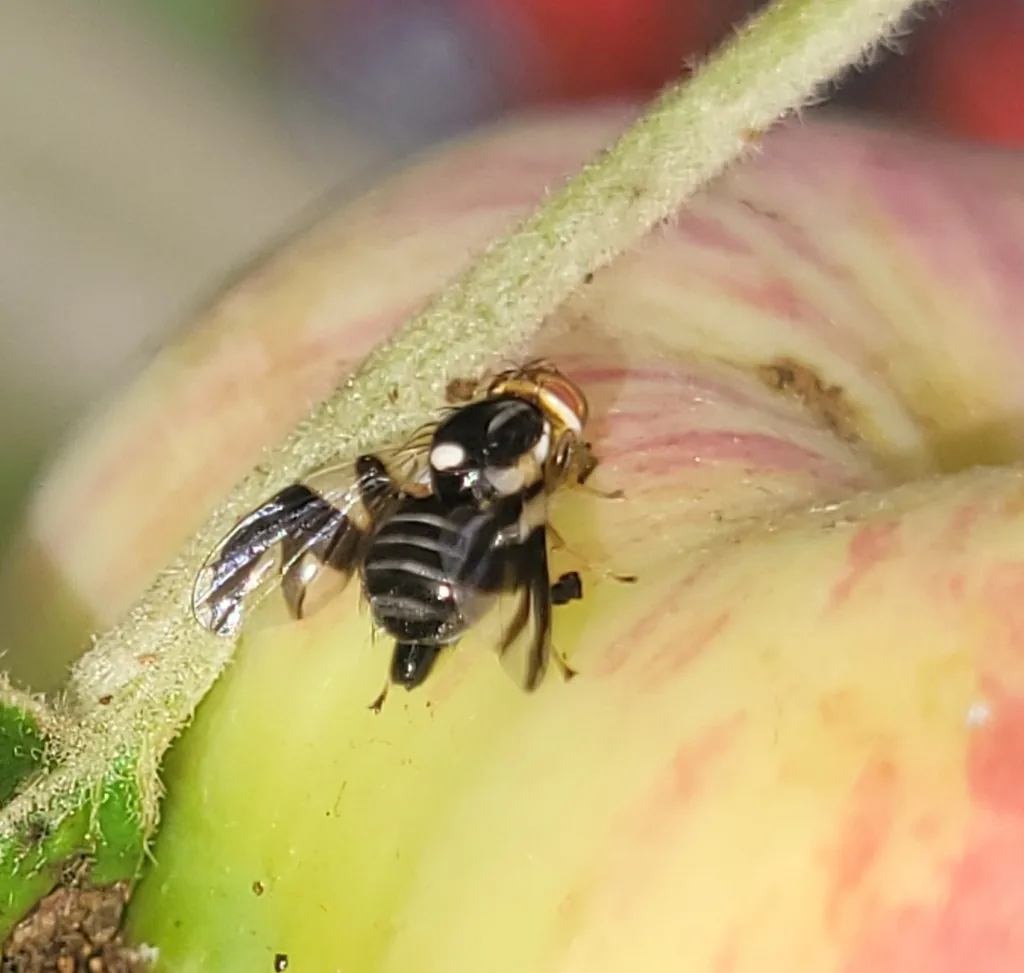
- Adults are small flies, about 1/5 inch (UC IPM) to 1/4 inch (Minnesota) long and somewhat smaller than a house fly. The clear wings carry black bands, which Wisconsin describes as a W pattern, and there is an obvious white spot at the rear of the thorax.[3][1][2]
- Females have four pale bands across the black abdomen and males have three.[3][1]
- The larva is a typical legless maggot, cream colored, blunt at the tail and tapered toward the front, where a pair of small black mouthhooks shows. It is up to 1/4 inch long by UC IPM's measure, about 8 mm (5/16 inch) by Wisconsin's.[3][2]
- Because larvae are small and the color of apple flesh, they are rarely seen; the sign is usually the trails. The oblong orange puparium, about 1/5 inch long, is found mostly in the topsoil.[2][1][3]
Look-alikes
| Look-alike | How to tell them apart |
|---|---|
| Vinegar flies | Small drosophilid flies are also called fruit flies but are much smaller than apple maggot flies.[3] |
| Codling moth larvae | Codling moth larvae are much larger caterpillars and feed mainly in the core, while apple maggot larvae tunnel throughout the flesh.[1][2] |
| Blueberry maggot | Looks virtually identical to the apple maggot fly but is restricted to blueberry and related hosts.[2] |
| Snowberry fly (Rhagoletis zephyria) | A close relative that looks much the same and gets caught on the same survey traps in the West, but it attacks white snowberry fruit rather than apple or hawthorn.[4] |
Where it lives
Apple maggot is native to the northeastern and midwestern United States and adjacent Canada and was accidentally introduced into the western United States in the late 1970s. In California it is found from Sonoma County north, and Washington keeps quarantine areas, including the Leavenworth area of Chelan County and part of Okanogan County, to protect pest-free fruit districts. It is also a pest in the Southern Appalachian Mountains.[2][5][3][6][7]
Biology and life cycle
It spends the winter as a pupa a few inches deep in the soil. Adults emerge from late June through August, with a peak in July by UC IPM's account and from late July through early August in Minnesota; in dry soil they wait for rain or irrigation, and some keep emerging into early September.[2][3][1]
New flies cannot lay eggs right away. They feed on honeydew and other residues on leaves, often in nearby wooded or brushy areas, for about 7 to 10 days before the females are ready.[3][2][1]
A female lays her eggs just under the apple skin and marks the fruit with a scent that discourages other females from laying there. UC IPM puts her output at about 300 eggs over a 30-day life; Wisconsin gives 300 to 500 over a few weeks. Eggs hatch in about 2 to 10 days.[3][2]
Larvae feed for three to four weeks, faster in warm weather and soft, ripe fruit, then leave the fallen apple and burrow about 2 inches into the soil to pupate. Some pupae wait in the soil an extra year.[3][1][2]
There is usually one generation a year, with a partial second in some years. In abandoned orchards at low elevations in the Carolinas, flies were active from late May or early June into November and appeared to have two generations, while orchards above about 630 m had mainly one.[3][2][7]
Damage and signs
- Each egg puncture becomes a small dark, decayed spot on soft-fleshed apples or a dimple on hard-fleshed ones, so heavily hit fruit is pitted and misshapen.[3][1][2]
- Larvae tunnel through the flesh, leaving slender brown trails that rot and spread until the whole apple decays and usually drops early. Lightly infested fruit can look sound, go into storage and rot there.[3][2][8]
- It prefers earlier, softer, sweeter apple varieties. Besides apple it attacks hawthorn and crabapple, and Wisconsin adds pear and stone fruits; UC IPM says it occasionally uses other plants in the rose family.[2][8][3][6]
Health risk
It is a fruit pest only; none of the sources lists any risk to people. Wisconsin notes that young larvae in sound-looking fruit are probably eaten by accident every year.[2][3]
Control
Prevention
A well-kept coating of kaolin clay turns fruit grayish-white and unattractive to egg-laying females; Minnesota says it can protect 90 percent of fruit but must be renewed after rain, and Wisconsin applies it weekly.[1][2][10]
Keep them out
Bag fruit after thinning, while apples are small, and leave the bags on for the season. Minnesota and Wisconsin use sandwich bags with a corner snipped for drainage; Washington State prefers paper, wax paper or nylon footie bags placed 4 to 6 weeks after petal fall, about dime size.[1][2][8]
Netting the whole tree after bloom and thinning kept out an average of 96% of apple maggots in a Minnesota orchard study; it works best on small trees that can be fully enclosed.[1][9]
Sanitation
Pick up dropped apples often during the season and after harvest, before the larvae leave them for the soil. Bag them for the trash or a municipal compost site, or crush them or leave them sealed in a plastic bag in the sun for a week; don't compost them at home.[1][2][8]
Remove unmanaged apple trees and other hosts within 200 yards if you can; Minnesota cautions that cleanup alone won't stop flies flying in from elsewhere.[2][1]
Traps and physical control
Hang bright red sticky spheres at least 3 inches across on the outer canopy by the end of June and clean and recoat them every week or two. Wisconsin suggests one in a small tree, 2 to 4 in a medium tree and 6 to 8 in a large one; mind birds and wildlife, which can get stuck.[1][2][3]
Pesticides
If insecticide is needed, let traps time it: UC IPM sprays spinosad, ideally premixed with a fruit fly bait, once yellow sticky traps catch the first flies, and Minnesota sprays at the first catch on unbaited traps or five on baited ones. Washington State advises homeowners not to spray foliage of trees over 10 feet tall.[3][1][8]
Quarantines in the West
California and Washington both restrict moving home-grown fruit to keep apple maggot out of commercial districts. As of 2021, UC IPM lists twelve California counties, including Fresno, Kern and Ventura, that prohibit bringing in noncommercial apples, and asks that maggots found in Central or Southern California be reported to the County Agricultural Commissioner.[3]
Washington says the fly spreads through homegrown fruit and municipal waste. Residents of quarantine areas may not take homegrown fruit or green waste such as leaves and tree trimmings into the pest-free area, and since 2020 soil around the roots of host plants from the quarantine area is regulated too.[6][8]
Hawthorn flies and apple flies
The apple maggot originally lived on hawthorn. In the 1850s some flies in the Northeast shifted to introduced apple, a well-studied case of a new host race forming; Wisconsin says the two forms look virtually the same but generally keep to their own host.[5][2]
Southern populations on native hawthorns show their own host races, and after the fly reached the Pacific Northwest, flies on apple, native black hawthorn and ornamental hawthorn there have become genetically distinct in the decades since.[11][5]
Where sources disagree
Size: UC IPM gives about 1/5 inch for the adult, Minnesota 1/4 inch, Wisconsin 5 to 6 mm and Washington State 1/4 to 3/8 inch. Full-grown larvae are up to 1/4 inch (UC IPM), about 5/16 inch (Wisconsin) or 3/8 inch (Washington State).[3][1][2][8]
Bags: Minnesota and Wisconsin recommend plastic sandwich bags, while Washington State warns that clear plastic bags can hold moisture and encourage fruit disease.[1][2][8]
Traps as control: Wisconsin says baited red spheres can give fairly successful control where populations are low to moderate, while Washington State says such traps attract flies only from short distances and don't work as a stand-alone strategy.[2][8]
Kaolin clay: Minnesota reports up to 90 percent protection and a USDA study found the coating deters and kills flies, but a two-season calendar spray trial in Quebec found no effect on apple maggot.[1][10][12]
Common questions
- Why are my apples full of brown trails?
- Apple maggot larvae tunnel through the flesh, leaving slender brown trails that rot. Look for small dimples or dark spots on the skin where the eggs were laid.[3][2][1]
- Does bagging apples really work?
- Yes, if the bags go on early, after thinning and before egg laying starts, and stay on all season. Minnesota uses snipped sandwich bags; Washington State prefers paper or nylon footie bags because plastic can trap moisture.[1][8][2]
- I found it in Southern California. What now?
- Apple maggot is known in California only from Sonoma County north. If you find suspected flies or maggots in Central or Southern California, report them to your County Agricultural Commissioner.[3]
- Can I compost wormy apples?
- Not at home. The larvae leave the fruit and pupate in the soil, so bag infested apples for the trash or a municipal compost site, or kill the larvae first by crushing or bagging the fruit in the sun for a week.[1][8][2]
Sources
- University of Minnesota Extension, “Apple maggot (Yard and garden insects).” extension.umn.edu/yard-and-garden-insects/apple-maggot (accessed 2026-11-11)
- University of Wisconsin-Madison Division of Extension, Wisconsin Horticulture, “Apple Maggot: Scourge of Home Apple Production (A4159).” hort.extension.wisc.edu/articles/apple-maggot-scourge-of-home-apple-production/ (accessed 2026-11-11)
- University of California Statewide IPM Program, “Apple Maggot (Pests in Gardens and Landscapes).” ipm.ucanr.edu/PMG/GARDEN/FRUIT/PESTS/applemaggot.html (accessed 2026-11-11)
- Environmental Entomology, via PubMed, “Yee, Goughnour, Feder, Linn and Cha (2017), Comparative responses of Rhagoletis zephyria and Rhagoletis pomonella to commercial and experimental sticky traps and odors in Washington State.” pubmed.ncbi.nlm.nih.gov/29028975/ (accessed 2026-11-11)
- Evolution, via PubMed, “Hood, Powell, Doellman and others (2020), Rapid and repeatable host plant shifts drive reproductive isolation following a recent human-mediated introduction of the apple maggot fly, Rhagoletis pomonella.” pubmed.ncbi.nlm.nih.gov/31729753/ (accessed 2026-11-11)
- Washington State Department of Agriculture, “Apple Maggot.” agr.wa.gov/departments/insects-pests-and-weeds/insects/apple-maggot (accessed 2026-11-11)
- Environmental Entomology, via PubMed, “Meck, Walgenbach and Kennedy (2008), Phenology of the apple maggot (Diptera: Tephritidae) in the Southern Appalachian Mountains.” pubmed.ncbi.nlm.nih.gov/19036194/ (accessed 2026-11-11)
- Washington State University Extension, “Apple: Apple maggot (Hortsense, last reviewed 2026).” hortsense.cahnrs.wsu.edu/fact-sheet/apple-apple-maggot/ (accessed 2026-11-11)
- Journal of Economic Entomology, via PubMed, “Nelson, Klodd and Hutchison (2023), Hail netting excludes key insect pests and protects from fruit damage in a commercial Minnesota apple orchard.” pubmed.ncbi.nlm.nih.gov/37904544/ (accessed 2026-11-11)
- Journal of Economic Entomology, via PubMed, “Leskey, Wright, Glenn and Puterka (2010), Effect of Surround WP on behavior and mortality of apple maggot.” pubmed.ncbi.nlm.nih.gov/20429454/ (accessed 2026-11-11)
- Evolution, via PubMed, “Powell, Cha, Linn and Feder (2012), On the scent of standing variation for speciation: behavioral evidence for native sympatric host races of Rhagoletis pomonella in the southern United States.” pubmed.ncbi.nlm.nih.gov/22946800/ (accessed 2026-11-11)
- Journal of Economic Entomology, via PubMed, “Bostanian and Racette (2008), Particle films for managing arthropod pests of apple.” pubmed.ncbi.nlm.nih.gov/18330129/ (accessed 2026-11-11)
- iNaturalist, “Rhagoletis pomonella taxon page (order and family).” www.inaturalist.org/taxa/366909 (accessed 2026-10-06)