On this page
How to identify it
- The finished mine is an oval blotch about 3/4 inch long and 1/2 inch wide, raised along its long axis like a small tent, with tiny pale feeding spots on the upper surface that show best when the leaf is held up to the light.[1][2]
- Young mines are visible only from the underside of the leaf. They become tent-like and spotted once the larva moves into its later, tissue-feeding stage.[1][2]
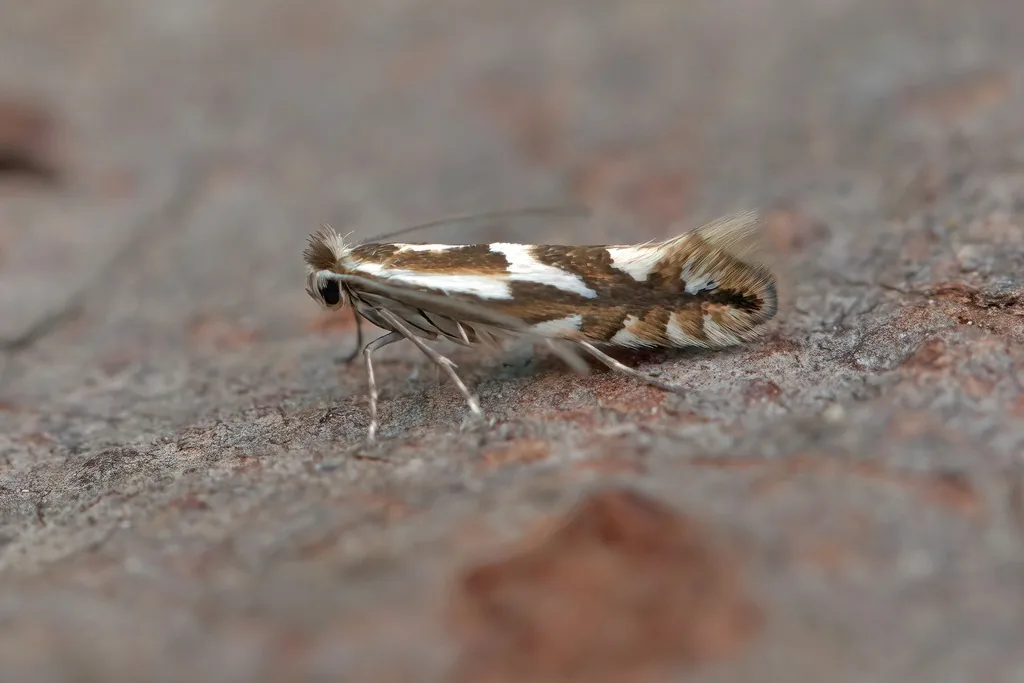
- The adult is a slender moth barely 1/8 inch long. Wisconsin describes the wings as white with an irregular orange or gold pattern narrowly edged in black; NC State describes brown wings with white, black-edged cross stripes, and Cornell brown moths with silver to cream markings.[1][3][2]
- The larva is tiny: Wisconsin says never more than 5 mm (1/5 inch), NC State 1/8 inch (3 mm) and Cornell about 4 mm when full grown. NC State describes it as yellow to pale green and Cornell as white to pale green. Before the moth emerges, the pupa cuts through and partly sticks out of the underside of the mine, and its empty skin stays attached to the leaf.[1][3][2]
Look-alikes
| Look-alike | How to tell them apart |
|---|---|
| Apple blotch leafminer | Another leafminer occasionally found on apple leaves. Its mine is more irregular in shape and not spotted.[1] |
| Western tentiform leafminer | A second species that causes similar damage in apple-growing areas of Washington and other western states.[1] |
Where it lives
Native to Europe, it is now found throughout the eastern United States and Canada, with a more northerly range than two native relatives that also mine apple leaves there. Tentiform leafminers of one species or another occur in virtually every North American apple-growing region. Wisconsin Extension dates the first published Wisconsin record to 1960 and names New York and Michigan among the apple regions where it became a pest.[3][2][1]
Biology and life cycle
Pupae spend the winter in fallen apple leaves. Adults emerge early in spring, around the half-inch green stage of the buds and sometimes before bud break, and keep emerging through bloom.[3][2][1]
The moths are inactive by day and fly at dusk and into warm nights. Each female lays about 25 tiny, nearly translucent eggs one at a time on the undersides of leaves, and first-generation eggs usually go on the first two or three leaves to unfold from each bud.[1][3][2]
The young larva tunnels straight into the leaf and first feeds on sap, then becomes a tissue feeder that hollows out the mine and nibbles the upper leaf tissue, making the pale spots. It pupates inside the mine.[1][3][2]
There are three generations a year in Wisconsin and most other areas, and NC State says usually three to four. In Wisconsin the second and third flights come in early July and mid-August, and the insects usually stay active until the leaves drop in fall.[1][2][3]
Tiny parasitic wasps attack all three generations, and in unsprayed trees natural enemies can kill as many as 98 percent of the larvae before they mature.[1]
Damage and signs
- The larvae never feed on fruit. Mined leaf tissue dies and browns, cutting photosynthesis, and a leaf with many mines can die and drop.[1][3][2]
- Heavy mining over a whole tree can mean small, poorly colored fruit that ripens and drops early, softens and stores poorly, and fewer flowers and fruit the next year. Mining is especially damaging when combined with drought, mites or leaf diseases.[1][2][3]
- It takes a lot of mines to matter. Wisconsin suggests the crop may start to suffer at an average of about 5 mines per leaf accumulated over the season, and that an average of one mine per leaf at the end of the first generation may be cause for concern. First- and second-generation outbreaks matter more than late-summer ones, when the fruit is largely grown.[1][2][3]
Health risk
A leaf feeder on apple and occasionally crabapple. Wisconsin Extension, NC State and Cornell don't mention any risk to people or pets.[1][3][2]
Control
Prevention
Check before treating. Mines stay visible after the larvae have left or died, so open a few to see whether live larvae are inside. Pheromone traps show when adults are flying, but estimating the population takes a careful search of the leaves.[3]
Biological control
Wisconsin says natural enemies will reliably control it as long as frequent broad-spectrum insecticide use does not interfere; in Wisconsin's studies, where broad-spectrum insecticides were used against other apple pests, natural enemies never killed more than 16% of the leafminers. Wisconsin advises avoiding sprays during the 10 to 14 days right after apple bloom, when one of the most effective parasites attacks first-generation larvae. Cornell says spray programs reduce or eliminate control by beneficial species in commercial orchards.[1][2]
Pesticides
If natural enemies fall short, Wisconsin suggests a selective insecticide that spares beneficial insects, such as spinosad, applied against the first generation as soon as the petals drop; one application usually gives control for the whole season.[1]
Cornell notes that third-generation injury usually comes too late in the season to be a serious problem, and skipping sprays against it helps natural enemies become established.[2]
Where the sources disagree
Adult wings: Wisconsin describes white wings with an irregular orange or gold pattern narrowly outlined in black; NC State describes brown wings with white cross stripes outlined in black; Cornell describes silver to cream markings on the upper wings.[1][3][2]
Larva size: Wisconsin says never more than 5 mm; NC State says 1/8 inch (3 mm); Cornell says about 4 mm when full grown.[1][3][2]
Generations: Wisconsin and Cornell give three a year in most areas; NC State gives 3 to 4.[1][2][3]
Egg hatch: NC State says 6 to 10 days; Cornell says 5 to 16 days.[3][2]
When to act: Wisconsin says an average of 5 accumulated mines per leaf may start to affect the crop and that one mine per leaf at the end of the first generation may be cause for concern; NC State's action thresholds are 6 eggs per cluster at pink, 1 mine per leaf for first-generation larvae, 2 for the second generation and 5 for the third in July.[1][3]
Sprays: Cornell's 1980 sheet says chemical control is recommended for the first and second generations; Wisconsin says natural enemies reliably control it and suggests a selective insecticide such as spinosad only if it is a serious pest.[2][1]
Common questions
- Are the blotches on my apple leaves hurting the tree?
- Usually not. Spotted tentiform leafminer is common enough in home apple trees for the mines to be seen, but it rarely reaches numbers that injure the tree or cost fruit; Wisconsin puts the level where the crop may suffer at an average of about 5 mines per leaf over the season.[1]
- Why did leafminers become a problem in orchards?
- Frequent insecticide sprays killed the parasitic wasps that normally control them, and once the leafminers became resistant to those sprays in the 1970s, outbreaks followed. Home orchards and organic orchards rarely saw such outbreaks.[1]
- Does it attack crabapples or other fruit trees?
- It feeds almost entirely on apple, with occasional mines on some crabapples, including ornamental flowering crabs. Similar mines on pear, cherry and other trees are made by related species.[1]
Sources
- University of Wisconsin-Madison Division of Extension, Wisconsin Horticulture, “Spotted Tentiform Leafminer, Phyllonorycter blancardella (D. Mahr).” hort.extension.wisc.edu/articles/spotted-tentiform-leafminer-phyllonorycter-blancardella/ (accessed 2026-11-13)
- Cornell University, New York State Agricultural Experiment Station, “Spotted Tentiform Leafminer, Tree Fruit IPM Insect Identification Sheet No. 9 (R. W. Weires and D. Ophardt, 1980).” hdl.handle.net/1813/43130 (accessed 2026-11-13)
- NC State Extension, “Spotted Tentiform Leafminer (J. Walgenbach, 2015).” content.ces.ncsu.edu/spotted-tentiform-leafminer (accessed 2026-11-13)
- Global Biodiversity Information Facility (GBIF), “Phyllonorycter blancardella (Fabricius, 1781) (GBIF Backbone Taxonomy).” api.gbif.org/v1/species/1749904 (accessed 2026-11-13)
- iNaturalist, “Phyllonorycter blancardella taxon page (order and family).” www.inaturalist.org/taxa/1677214 (accessed 2026-11-08)