On this page
How to identify it
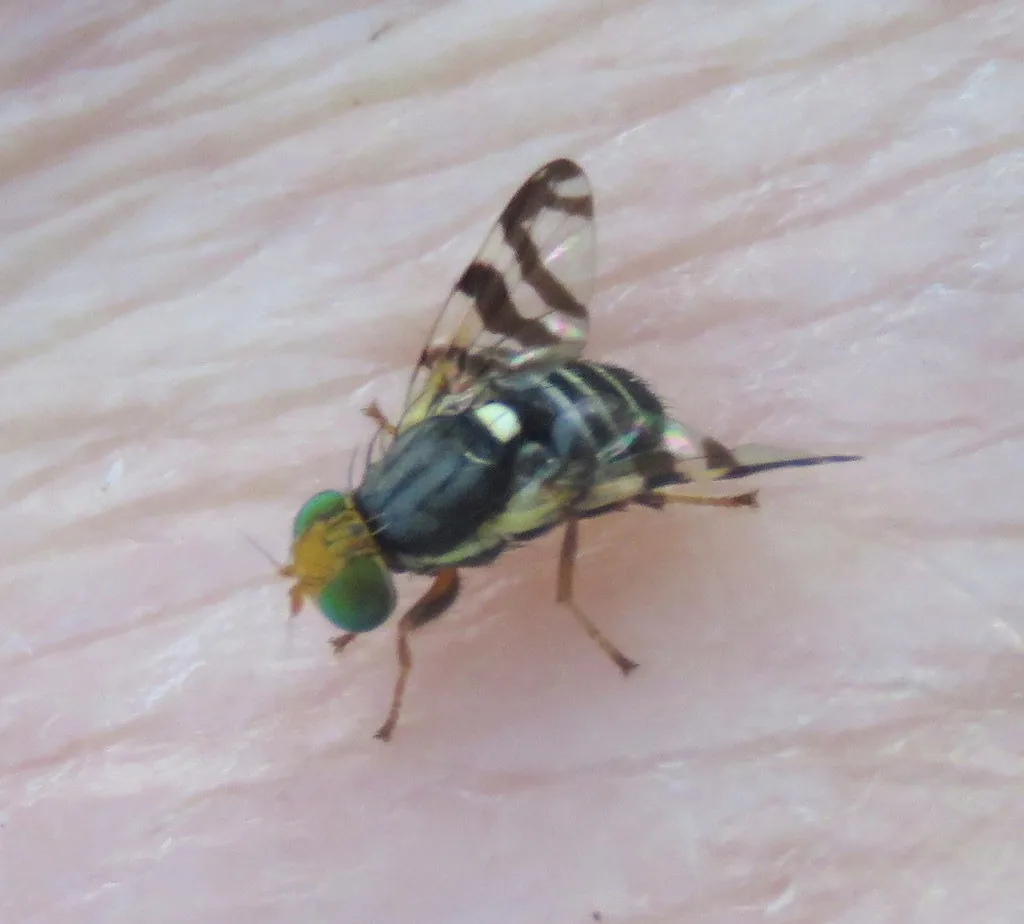
- Adults are a little smaller than a house fly, about 0.2 inch long, with a black body, white bands across the abdomen and clear wings marked with dark bands.[1][3]
- Maggots are creamy white and legless, about 5/16 inch long when grown, tapered at the head end. A grown maggot leaves an exit hole in the cherry; until then you can't tell a cherry is infested without cutting it open.[1][3][2]
- Pupae are light to dark brown, about 3/16 inch long and shaped like a large grain of wheat, 1 to 4 inches deep in the soil under the tree.[3]
Look-alikes
| Look-alike | How to tell them apart |
|---|---|
| Cherry fruit fly (eastern) | A related Rhagoletis fly; the western cherry fruit fly is the Pacific Northwest and Utah species.[1][2] |
| Spotted-wing drosophila | Another fly that infests ripe cherries; the PNW handbook notes the spinosad fruit fly bait used for cherry fruit fly is not for spotted-wing drosophila.[1] |
Where it lives
Found in the western United States: the PNW handbook says it infests home-grown and commercial cherries in the Northwest, Utah State calls it the primary insect pest of sweet and tart cherries in Utah, and USDA-ARS researchers report it in unmanaged cherries across dry climates in Washington and other regions of the western United States and Canada.[1][3][5]
Biology and life cycle
It overwinters as pupae in the soil under host trees, and a few pupae can stay there up to three years.[1][3]
Adults feed on honeydew and pollen. Females can't lay eggs until the cherries start to turn a salmon blush; they insert eggs under the skin without leaving visible marks, and the eggs hatch in 5 to 8 days.[1][3][2]
Larvae burrow toward the pit and feed for 10 to 21 days, then bore out, drop to the ground and pupate in the soil.[1][3]
There is one generation a year. Flies move only short distances, under 40 yards, when host fruit is nearby, so infestations can be spotty.[1][3]
Hosts are sweet and tart cherries and wild cherries, including the native bitter cherry.[1][3][2][6]
Damage and signs
- Maggots feed inside the fruit, making it unmarketable; large populations can infest a high share of the fruit on a tree.[1][2][3]
- Commercial cherries have zero tolerance for maggots, and a single larva found by a processor can get a whole orchard's crop rejected. Utah State says home growers help the cherry industry by keeping the fly under control in backyard trees.[1][3]
- USDA researchers report the fly in unmanaged cherry trees across dry parts of Washington and other western regions.[5]
Health risk
It's a fruit pest; the PNW handbook and Utah State describe no risk to people or pets.[1][3]
Control
Prevention
Grow early-maturing varieties and pick within 8 to 9 days of catching the first flies; watch for adults with yellow sticky traps hung in sunny parts of the tree from May to mid-July.[1][2]
Sanitation
Pick and remove every cherry each season and pick up fallen fruit, which may hold larvae. Years when fruit is left on the tree build up the population for the next year.[1][3]
Remove nearby abandoned or wild cherry trees so they don't keep the local fly population going.[3]
Traps and physical control
Landscape fabric or dense ground covers and mulches under the tree can stop larvae from burrowing in to pupate. Tilling the soil doesn't work, because the pupae are very hard-shelled.[3][5][1]
Pesticides
Sprays must go on before eggs are laid and be kept up through harvest; the PNW handbook says to begin in late May and repeat at 10- to 21-day intervals. Utah State lists spinosad, carbaryl, malathion, esfenvalerate and permethrin for residential use. Many are hazardous to bees, so don't spray during bloom or while bees are foraging.[1][2][3]
California's cherry fruit fly quarantine
California's Plant Quarantine Manual lists a state quarantine against cherry fruit flies, naming the western cherry fruit fly and Rhagoletis fausta. It lists Idaho, Montana, New Mexico, Oregon, Utah, Washington and Colorado as infested, except Colorado's Delta and Mesa counties.[4]
Fruit of all domesticated and wild cherries is covered: cherries from the quarantine area may enter California only if treated and certified at origin or shipped under a master permit, and host cherry nursery stock is also regulated. Check with the California Department of Food and Agriculture before carrying cherries or cherry trees into the state.[4]
Ground covers and soil moisture
In central Washington, USDA-ARS researchers found more pupae survived in bare soil (24.5 to 47.7%) than under grass (6.7 to 17.0%), and watering grass-covered soil raised survival. They suggest dry, grass-covered soil or mulch barriers in mid and late summer could reduce fly survival under some conditions.[5]
Where sources disagree
Overwintering stage: the PNW handbook and Utah State's fact sheet say pupae; Utah State's short IPM page says larvae.[1][3][2]
Adult emergence: the PNW handbook says from mid-May until the end of July; Utah State says from late May or early June, continuing through summer into early fall.[1][3]
Time before egg-laying: the PNW handbook says 7 to 10 days after emergence; Utah State says 5 to 7 days.[1][3]
Larval feeding time: the PNW handbook says 10 to 21 days; Utah State says about 14 to 21 days.[1][3]
Common questions
- Why are there white worms in my cherries?
- In the West, usually western cherry fruit fly maggots.[1][2][3]
- Why does my backyard tree matter?
- Commercial cherries have zero tolerance for maggots, and flies from unmanaged cherry trees add to the local population; Utah State asks home growers to keep the fly under control.[1][3]
- What is the easiest fix?
- Pick every cherry early and leave none on the tree or the ground.[1][3]
Sources
- Pacific Northwest Pest Management Handbooks (OSU, WSU, UI), “Cherry-Western cherry fruit fly (Pacific Northwest Insect Management Handbook).” pnwhandbooks.org/insect/tree-fruit/cherry/cherry-western-cherry-fruit-fly (accessed 2026-11-11)
- Utah State University Extension (Integrated Pest Management), “Western Cherry Fruit Fly (fruit pest fact sheet).” extension.usu.edu/planthealth/ipm/notes_ag/fruit-west-cherry-ff.php (accessed 2026-11-11)
- Utah State University Extension, “Western Cherry Fruit Fly in Utah Orchards (January 2020).” extension.usu.edu/planthealth/research/western-cherry-fruit-fly.pdf (accessed 2026-11-11)
- California Department of Food and Agriculture, “Plant Quarantine Manual 3256: Cherry Fruit Fly.” pi.cdfa.ca.gov/pqm/manual/htm/305.htm (accessed 2026-11-11)
- Environmental Entomology, via PubMed, “Irrigation and grass cover effects on pupal survival rates in soil and adult emergence patterns of Rhagoletis indifferens (USDA-ARS, 2018).” pubmed.ncbi.nlm.nih.gov/29438537/ (accessed 2026-11-11)
- Environmental Entomology, via PubMed, “Differences in body size and egg loads of Rhagoletis indifferens from introduced and native cherries (USDA-ARS, 2011).” pubmed.ncbi.nlm.nih.gov/22217749/ (accessed 2026-11-11)
- iNaturalist, “Rhagoletis indifferens taxon page (order and family).” www.inaturalist.org/taxa/779395 (accessed 2026-11-11)