On this page
How to identify it
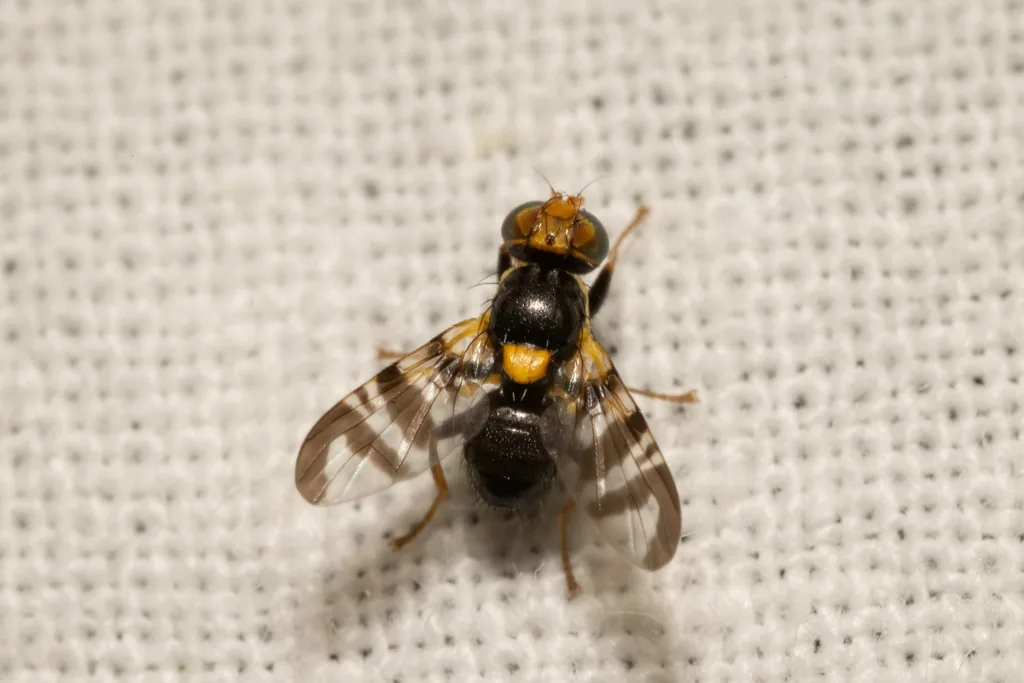
- Adults are small, mostly black flies. Cornell IPM gives about 3/16 inch (5 mm) for females and 1/8 inch (4 mm) for males, with a tan head and a distinctive yellow spot on the thorax; CFIA gives 3.5 to 4.0 mm and says the scutellum at the base of the thorax is entirely yellow.[1][4]
- The clear wings carry four large blue-black bands and one small band. CFIA says the wing pattern and the yellow scutellum separate it from most other Rhagoletis species.[1][4]
- Cornell IPM describes the maggots as white and about 1/4 inch (6 mm) long, living inside the fruit, and the overwintering pupae in the soil as light yellow-brown and about 1/8 inch (3 to 4 mm) long.[1]
- Adults are often seen on sunlit parts of cherry trees and honeysuckle bushes, because females prefer to lay eggs in fruit in sunlight.[1]
Look-alikes
| Look-alike | How to tell them apart |
|---|---|
| Cherry fruit fly (Rhagoletis cingulata) | A native relative. Cornell IPM says the European species can be told from the other cherry fruit flies by its different wing band pattern, and the New York State IPM Program says the cherry fruit fly ranges over most of eastern North America.[1][2] |
| Black cherry fruit fly (Rhagoletis fausta) | Another native cherry pest. The New York State IPM Program says it has a more northern distribution than the cherry fruit fly, reaching only as far south as Pennsylvania, in both eastern and western North America; Cornell IPM says wing band patterns separate the species.[2][1] |
Where it lives
Native to most of Europe (CFIA notes the United Kingdom as an exception) and temperate Asia. CFIA reports it in Ontario (confirmed June 2016), New York State (2017) and Quebec (2022), and the New York State Department of Agriculture and Markets says it was first discovered in New York in 2017. CFIA says it may be introduced to new areas with fresh cherries or with soil or fruit from host plants.[4][7]
Biology and life cycle
There is one generation a year, with a long winter diapause as pupae in the soil, usually about 180 days, though some pupae stay dormant through one, two or even three winters. Adults usually appear from May to July and live about two weeks on average.[4]
Females usually lay one egg per fruit, just beneath the skin, and the larvae feed inside the fruit for up to six weeks.[4][1]
Cherries are the main hosts: CFIA lists sweet, sour, black and mahaleb cherry, and Cornell IPM adds all saints cherry. Honeysuckle fruit is also a host; in Canada it has been found on wild honeysuckles including Lonicera x bella, L. morrowii and L. tatarica, and CFIA says U.S. reports add barberry, common dogwood, common snowberry and coralberry.[4][1]
Mature larvae leave the fruit through exit holes, drop to the ground and burrow about 1 to 13 cm into the soil, where they pupate within a few days.[4][1]
Damage and signs
- The egg puncture is small. As the larva grows, the tissue around it turns brown and soft, and infested cherries may shrivel, develop soft spots and rot, with small exit holes where larvae left.[1][4]
- Cutting or breaking open suspect fruit reveals the larvae and the internal feeding damage.[1][4]
- In Europe it is the most serious pest of cherries: CFIA says losses can reach 100% if it is left uncontrolled, and Cornell IPM says infested cherries can't be sold for fresh or processed use. The USDA National Agricultural Library calls it a highly destructive pest of cherries. CFIA adds that, to date, it has not been reported as a pest of concern in commercial cherry production in North America.[4][1][3]
Health risk
It is a pest of cherry fruit, and no cited source describes any risk to people or pets.[1][4]
Control
Prevention
The New York State Department of Agriculture and Markets has a quarantine covering Cayuga, Erie, Genesee, Monroe, Niagara, Ontario, Orleans and Wayne counties in their entirety to control its spread, and asks the public to let survey crews place and monitor traps on private land.[7]
CFIA regulates it as a quarantine pest under directive D-17-03. Under the movement requirements CFIA set in 2017, fresh Ontario cherries may not go to British Columbia or the United States, and may go to other provinces only with a CFIA Movement Certificate showing the orchard applied fruit fly controls and the fruit was inspected and found free of cherry fruit flies.[4][6][5]
When to call a professional
CFIA asks anyone who suspects cherries are infested with European cherry fruit fly to contact the nearest CFIA office.[5]
Where the sources disagree
Adult size: Cornell IPM gives about 5 mm for females and 4 mm for males, CFIA 3.5 to 4.0 mm.[1][4]
Hosts: Cornell IPM lists cherries and honeysuckle, the New York State Department of Agriculture and Markets cherries, honeysuckle and other plants, and CFIA adds U.S.-reported barberry, common dogwood, snowberry and coralberry.[1][7][4]
Threat in North America: Cornell IPM raises concern about the devastation it could cause to U.S. cherry crops, while CFIA says that to date it has not been reported as a pest of concern in commercial cherry production in North America.[1][4]
Common questions
- How do I know if my cherries have fruit fly maggots?
- Infested cherries may look fine at first, then develop brown, soft areas around the egg puncture, shrivel or rot, or show small exit holes. Cutting or breaking open suspect fruit reveals the white larvae and the internal damage.[1][4]
- Why does honeysuckle matter for this fly?
- The European cherry fruit fly also breeds in honeysuckle berries, including invasive bush honeysuckles. CFIA's 2017 FAQ said that in Ontario it had been found only on invasive honeysuckle in parks or natural settings, not in cherry orchards.[1][5]
- How is it different from the cherry fruit fly already in New York?
- Cornell IPM says the European species can be told from the native cherry fruit flies by its wing bands, four large blue-black bands and one small one, and it has a distinctive yellow spot on the thorax.[1]
- Is the European cherry fruit fly under quarantine?
- Yes. CFIA regulates it as a quarantine pest under directive D-17-03 and says it is also regulated by the United States, and the New York State Department of Agriculture and Markets has quarantined eight western New York counties in their entirety.[4][7]
Sources
- Cornell University, Cornell Integrated Pest Management, “European Cherry Fruit Fly, Invasive and Exotic Pest Fact Sheet (J. Carroll and T. Herrmann).” cals.cornell.edu/integrated-pest-management/outreach-education/fact-sheets/european-cherry-fruit-fly (accessed 2026-11-13)
- Cornell University, New York State Integrated Pest Management Program, “Cherry Fruit Flies, tree fruit fact sheet (2021), eCommons record abstract (A. Agnello).” hdl.handle.net/1813/43083.2 (accessed 2026-11-13). Read 2026-11-13 from the eCommons record page abstract only; the PDF download returned a human-verification challenge and was not read, so only abstract statements are cited.
- USDA National Agricultural Library, “European Cherry Fruit Fly, National Invasive Species Information Center.” www.invasivespeciesinfo.gov/terrestrial/invertebrates/european-cherry-fruit-fly (accessed 2026-11-13)
- Canadian Food Inspection Agency, “Rhagoletis cerasi (European cherry fruit fly): Fact sheet.” inspection.canada.ca/en/plant-health/invasive-species/insects/european-cherry-fruit-fly/fact-sheet (accessed 2026-11-13)
- Canadian Food Inspection Agency, “Frequently asked questions: Movement requirements for Ontario cherries.” inspection.canada.ca/plant-health/invasive-species/insects/european-cherry-fruit-fly/ontario-cherries-faq/eng/1495544859895/1495544860490 (accessed 2026-11-13)
- Canadian Food Inspection Agency, “Notice to Industry: New movement requirements for Ontario cherries to prevent spread of plant pests (May 23, 2017).” inspection.canada.ca/en/plant-health/invasive-species/insects/european-cherry-fruit-fly/notice-industry-2017-05-23 (accessed 2026-11-13)
- New York State Department of Agriculture and Markets, “European Cherry Fruit Fly.” agriculture.ny.gov/plant-industry/european-cherry-fruit-fly (accessed 2026-11-13)
- Global Biodiversity Information Facility (GBIF), “Rhagoletis cerasi (Linnaeus, 1758) (GBIF Backbone Taxonomy).” api.gbif.org/v1/species/1622583 (accessed 2026-11-13)