On this page
How to identify it
- Adult sap beetles are small, 1/8 to 1/4 inch long, oval and generally dark, sometimes with orange or yellow spots.[1]
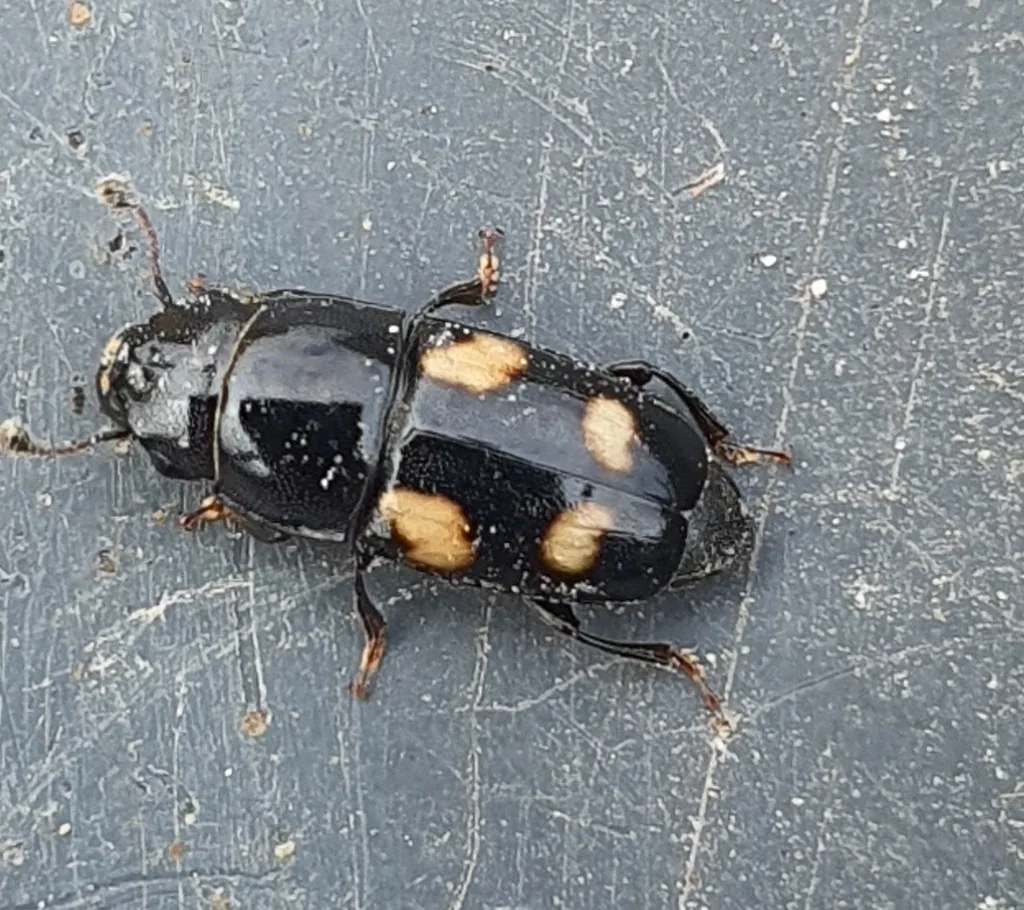
- The picnic beetle is the largest of the common ones, about 1/4 inch long and shiny black, with four orange or yellowish spots on its wing covers.[1][2][3]
- Its wing covers are shorter than the abdomen, leaving the tip exposed.[3]
- All sap beetles have antennae ending in a knob-like club, a handy way to recognize the group.[1]
- Eggs are milky white, about 1/25 inch long and laid inside plant matter. Larvae are under 1/4 inch, white to cream-colored (pale yellow when grown) with a brown head, and are found in decaying produce.[1][3]
Look-alikes
| Look-alike | How to tell them apart |
|---|---|
| Strawberry sap beetle | The smallest common sap beetle, under 1/8 inch, mottled brown with no clear markings on its wing covers. It is a serious pest of strawberries in the northeastern U.S., where adults and larvae feed on and contaminate ripe fruit.[1][8][7] |
| Dusky sap beetle | About 1/8 inch, uniformly dull black, with short wing covers and no spots.[1] |
Where it lives
Iowa State counts nearly 180 species of sap beetles, and Minnesota lists the strawberry sap beetle, picnic beetle and dusky sap beetle as its three most common. GBIF's public U.S. records since 1990 for the family (about 25,500) come from 48 states on the map, most from California, Florida and Kansas.[2][1][11]
Biology and life cycle
Minnesota and Iowa State say adults spend the winter outside the garden and become active in spring, in April and May by Iowa State's account. Illinois says picnic beetles may winter as larvae or adults, in decaying vegetation, debris and fruit buried in the soil.[1][2][3]
They lay eggs near fermenting or decaying plant material, and later in the silks and kernels of damaged corn.[1][3]
Larvae feed for about three weeks, then drop to the soil to pupate; development from egg to adult takes about 30 to 35 days.[1][3]
Minnesota reports one generation a year, with new adults appearing in late June or early July, while Illinois reports two or more.[1][3]
Numbers build through the summer, so they are most noticeable in late summer and fall.[2]
In a study of strawberry fields, overwintered strawberry sap beetles turned up in traps along the edge of nearby woods about 19 days before they were caught in the strawberries.[8]
Sap beetles are drawn to the fungal mats that form under the bark of oaks dying of oak wilt and to fresh wounds on healthy oaks, so they can carry spores from tree to tree. In Minnesota two species, Colopterus truncatus and Carpophilus sayi, are the main insect carriers.[5][6]
Damage and signs
- They mostly attack fruits and vegetables already damaged by other insects or disease, but they can also bore into sound produce, especially berries and sweet corn.[1][3]
- They hollow out deep cavities in strawberries, much like slug damage, and carry fungal spores that spread rot. Raising berries off the ground doesn't protect them; in caged tests, fruit held up off the soil was damaged as badly as fruit touching it.[1][8]
- Corn earworm damage at an ear tip draws sap beetles, and their larvae then feed on the undamaged kernels. In a USDA study of Bt sweet corn, which resists caterpillar damage, sap beetle damage was the most common insect injury to the ears.[1][9]
- In Iowa, Aspergillus flavus, a mold that infects corn kernels, was isolated from sap beetles in piles of waste corn near storage bins, and beetles carrying it, including the picnic beetle and the dusky sap beetle, were found in decreasing numbers out into nearby cornfields.[10]
- At picnics they gather around garbage cans, food and drinks, especially fermented drinks such as beer, earning the nickname beer-bug.[2]
- By carrying oak wilt spores to fresh pruning cuts and other wounds, sap-feeding beetles start new oak wilt infections. Once the disease is in an area, it spreads to nearby oaks through grafted roots.[6][5]
Health risk
Sap beetles are a nuisance around food and drinks and make produce unfit to eat; the extension sources describe no bite or disease risk to people.[2][3]
Control
Prevention
Don't prune or wound oaks from April through July, when sap beetles carrying oak wilt are most active. If an oak must be cut then, cover the wound right away with latex or water-based paint, shellac or a wound sealer.[5][6]
In strawberry beds, studies disagree on timing. A 2026 study found that renovating right after the last harvest cut the number of sap beetles emerging by 60% compared with waiting 10 days, but a 2008 study comparing immediate renovation with a one-week delay found that the year mattered more than the timing.[7][8]
Sanitation
Sanitation is the best control: pick produce as soon as it ripens and regularly remove damaged, diseased and overripe fruits and vegetables.[1][2][3]
Bury fallen apples, peaches, melons, tomatoes and other rotting produce deep in the soil or destroy it so beetles have nothing to feed or breed on.[1]
At a cookout, empty trash promptly and keep food and drinks covered.[2]
Traps and physical control
Traps baited with stale beer, molasses-water-yeast, vinegar, overripe fruit or whole wheat bread dough, set a few feet outside the garden and emptied every three or four days, may reduce numbers. Iowa State notes there is no convincing evidence that traps work, and Illinois suggests them for monitoring in commercial plantings.[1][2][3]
Pesticides
Sprays are discouraged: they would go on a crop that is ripe or being harvested, and new beetles keep flying in while ripe produce is present. For severe infestations Minnesota mentions carbaryl or bifenthrin and Iowa State permethrin, using a product labeled for the crop and observing its harvest waiting period.[1][2]
Common questions
- What are the black beetles with four orange spots in my sweet corn?
- They are likely picnic beetles, a common sap beetle. They are drawn to damaged or overripe ears and produce, and their larvae feed on the kernels.[1][2]
- Why do little black beetles keep landing in my drink outside?
- Picnic beetles are attracted to fermenting juices, so they gather around open drinks, especially beer, plus food and trash cans.[2]
- Will spraying stop sap beetles?
- Not well. New beetles keep flying in while ripe produce is present, so removing overripe and damaged fruit works better.[1][2]
- Do sap beetles spread oak wilt?
- Some do. Sap-feeding beetles carry oak wilt spores from fungal mats on diseased oaks to fresh wounds on healthy ones, which is why Minnesota and Wisconsin advise against pruning oaks from April through July.[5][6]
Sources
- University of Minnesota Extension, “Sap Beetles (reviewed 2021).” extension.umn.edu/yard-and-garden-insects/sap-beetles (accessed 2026-11-11)
- Iowa State University Extension and Outreach, “Sap Beetles Love a Picnic (Yard and Garden, July 25, 2007).” yardandgarden.extension.iastate.edu/article/2007/7-25/SapBeetle.html (accessed 2026-11-11)
- University of Illinois Extension, “Picnic Beetle.” extension.illinois.edu/insects/picnic-beetle (accessed 2026-11-11)
- iNaturalist, “Glischrochilus quadrisignatus taxon page (order and family).” www.inaturalist.org/taxa/203328 (accessed 2026-11-11)
- University of Minnesota Extension, “Oak wilt in Minnesota.” extension.umn.edu/plant-diseases/oak-wilt-minnesota (accessed 2026-11-11)
- Wisconsin Department of Natural Resources, “Oak Wilt (Forest Health).” dnr.wisconsin.gov/topic/foresthealth/oakwilt (accessed 2026-11-11)
- Journal of Economic Entomology, via PubMed, “Cultural practices affect sap beetle (Nitidulidae) populations in matted row and plasticulture production of strawberries (Dively 2026).” pubmed.ncbi.nlm.nih.gov/42611828/ (accessed 2026-11-11). Cited from the PubMed abstract.
- Journal of Economic Entomology, via PubMed, “Evaluation of cultural practices for potential to control strawberry sap beetle (Loughner et al. 2008).” pubmed.ncbi.nlm.nih.gov/18613586/ (accessed 2026-11-11). Cited from the PubMed abstract.
- Journal of Economic Entomology, via PubMed, “Suitability of commercially available insect traps and pheromones for monitoring dusky sap beetles and related insects in Bt sweet corn (Dowd 2005).” pubmed.ncbi.nlm.nih.gov/16022314/ (accessed 2026-11-11). Cited from the PubMed abstract.
- Plant Disease, via PubMed, “Waste corn as a point source of inoculum for Aspergillus flavus in the corn agroecosystem (Olanya et al. 1997).” pubmed.ncbi.nlm.nih.gov/30861837/ (accessed 2026-11-11). Cited from the PubMed abstract.
- Global Biodiversity Information Facility (GBIF), “Nitidulidae: occurrence records in the U.S., 1990-2026 (GBIF occurrence search).” api.gbif.org/v1/occurrence/search?taxonKey=7840&country=US&hasGeospatialIssue=false&occurrenceStatus=PRESENT&year=1990%2C2026&facet=stateProvince&facetLimit=400&limit=0 (accessed 2026-11-11). State counts are records reported (iNaturalist research-grade, museum specimens, surveys), not abundance.