On this page
How to identify it
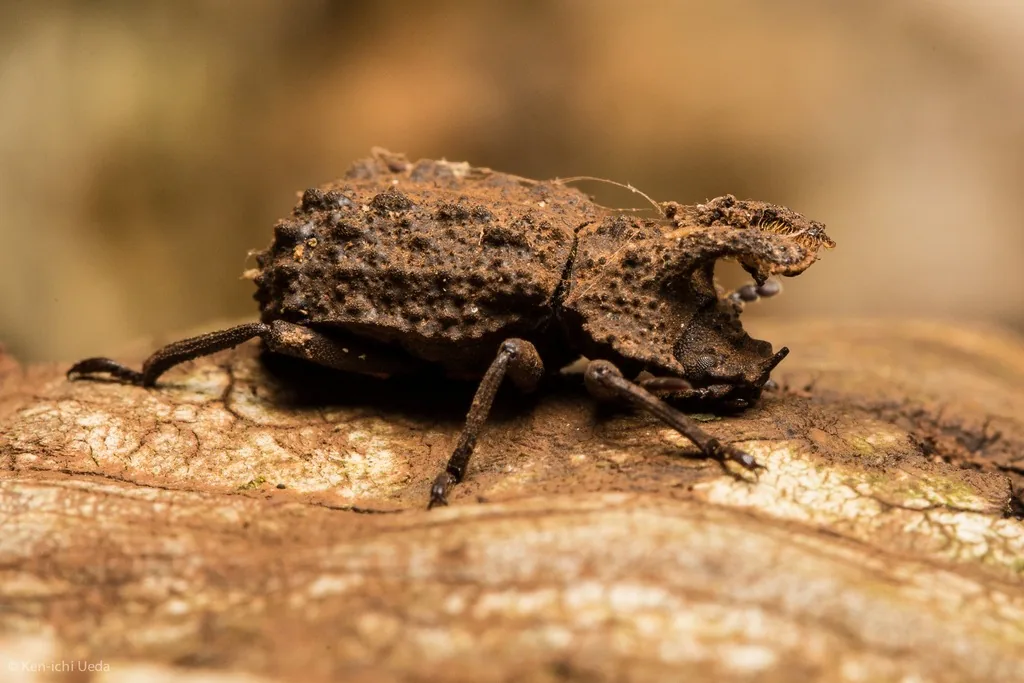
- Males typically have prominent horns on the thorax lined with distinct orange hairs, smaller horns on the front of the head, and fuzzy patches of orange hair on the underside. Females have no horns and lack these hair patches. Horn and body size vary continuously among males, with no separate large and small forms.[2][4]
- In the field they show up as small dark beetles on the tops of shelf fungus brackets on dead logs, where they feed, mate and interact.[2][3]
- UF/IFAS gives adults as 10.0 to 12.0 mm long and 3.5 to 4.0 mm wide, dull black to brown, with an elongate body that is rectangular in cross section and ten-segmented antennae.[1]
- The pronotum is roughly sculptured with rounded teeth, the wing covers have rows of large and small irregular tubercles (small rounded bumps), and the underside is dull black. In males the thoracic horns end in a brush-like tip with a dense patch of yellow hairs underneath; females have no horns, only two small tubercles on the pronotum.[1]
- Larvae are white, cylindrical and segmented, with fine transparent hairs and a darker, globular head. Pupae are pale yellow and found inside the fungus; male pupae already show two slightly curved projections where the horns will grow.[1]
Where it lives
UF/IFAS describes it as widespread across most of eastern North America, with records from New York, Connecticut, Massachusetts, Michigan, Ohio, Indiana, Wisconsin and Florida, extending into eastern Canada; a 2025 study calls it native to northeastern North America. Much of what is known about it comes from long-term studies of wild populations at Mountain Lake Biological Station in Virginia.[1][2][3]
Biology and life cycle
Adults and larvae live on three polypore shelf fungi that grow on dead logs: Ganoderma tsugae, Ganoderma applanatum and Fomes fomentarius. They feed on the tissue and spores of the fungus's fruiting bodies, and females also use it for egg laying.[1][2][3]
Females lay single eggs on the surface of the fungus and cover each with a dark secretion that probably protects it. Eggs hatch in about 16 days on average, and larvae burrow into the fungus, where they feed and pupate; larvae developing in the same bracket often cannibalize each other.[1][2][3]
Beetles mate and females lay eggs continuously through the active season, from mid-May to mid-October.[3]
Adults are long-lived for insects. In the wild they often reach three years of adult life, and beetles up to six years old have been recorded in captivity and in the wild.[2]
Adults are most active at night. By day they hide under bark or inside the bracket, and mating, contests between males and egg laying all take place on the surface of the fungus shelves.[1][2][3]
A courting male mounts a female with his rear end over her head and periodically waggles; courtship can last several hours. Rival males use their horns to pry or peel a courting male off the female, and a male displaced during courtship usually leaves the bracket. Selection favors larger horns and larger bodies, especially in low-density populations.[2][4]
Larvae often spend the winter inside the fungus and emerge as adults the next summer; some adults emerge in late summer and overwinter in the fungus or under bark.[1]
Courtship lasts from ten minutes to several hours. A female accepts or rejects a male by raising or not raising a plate at the tip of her abdomen, and after mating a male often guards her by staying on top of her for two to five hours. Horn length does not seem to help a male hold food or breeding sites, but it does raise his mating success, and older males mate more than younger ones.[1]
Because its populations depend on decaying logs that carry its host fungi, established and newly founded populations exist side by side, and the beetle has been used to study local extinction, recolonization and habitat fragmentation.[1]
Damage and signs
Health risk
No harm to people is reported in the cited studies. When poked, adults play dead. When exposed to mammalian breath, they raise the abdomen and release a volatile defensive secretion made up mostly of benzoquinones; one researcher quoted by UF/IFAS described it as having a pungent odor and a burning, bitter, nauseating taste.[1][5]
Control
Prevention
No control is needed: it lives on shelf fungi growing on decaying logs, and its populations rise and fall with the logs and fungi it depends on.[1][2][3]
Where the sources disagree
Lifespan: UF/IFAS says adults can live up to eight years; a 2025 study reports beetles up to six years old in captivity and in the wild.[1][2]
Range: UF/IFAS describes it across most of eastern North America, including Florida; the 2025 study calls it native to northeastern North America.[1][2]
Common questions
- What are the forked fungus beetle's horns for?
- Males use them in contests over females. A rival male uses his horns like a wedge or a bottle opener to pry or peel a courting male off the female's back, and selection favors males with larger horns, especially where beetles are few.[1][4]
- How long does a forked fungus beetle live?
- A long time for an insect: adults often live three years in the wild and beetles up to six years old have been recorded, while UF/IFAS says adults can live up to eight years, often staying on the brackets of one tree.[2][1]
- Where can I find forked fungus beetles?
- Look on shelf fungi such as Ganoderma and Fomes growing on decaying logs. Adults are most active at night; by day they hide under bark or inside the bracket.[1][2][3]
- Why does a forked fungus beetle smell when I breathe on it?
- Breath from a mammal makes adults raise the abdomen and release irritating defensive chemicals from abdominal glands. UF/IFAS notes that the makeup of the secretion differs with the fungus the beetle feeds on.[1][5]
Sources
- University of Florida IFAS Extension (EDIS), “Forked Fungus Beetle, Bolitotherus cornutus (Panzer) 1794, EENY-698/IN1195 (U. Somjee and A. Lucky).” ask.ifas.ufl.edu/publication/IN1195 (accessed 2026-11-14)
- Ecology and Evolution (Wiley), full text in PubMed Central (PMC12353013), “Jiron et al. Male Mating Preference for Larger Females Does Not Vary Among Age Classes in the Long-Lived Beetle Bolitotherus cornutus. Ecology and Evolution 15: e71958 (2025), doi:10.1002/ece3.71958.” doi.org/10.1002/ece3.71958 (accessed 2026-11-12)
- Mitchem, L. D. et al., Ecology and Evolution (via PubMed Central), “Mycophagous beetle females do not behave competitively during intrasexual interactions in presence of a fungal resource (2022) (full text).” pmc.ncbi.nlm.nih.gov/articles/PMC9163480/ (accessed 2026-11-12)
- Benowitz, K. M., E. D. Brodie III and V. A. Formica, PLoS One (via PubMed Central), “Morphological correlates of a combat performance trait in the forked fungus beetle, Bolitotherus cornutus (2012) (full text).” pmc.ncbi.nlm.nih.gov/articles/PMC3419742/ (accessed 2026-11-12)
- Holliday, A. E. et al., Journal of Chemical Ecology (via PubMed), “Differences in defensive volatiles of the forked fungus beetle, Bolitotherus cornutus, living on two species of fungus (2009) (abstract).” pubmed.ncbi.nlm.nih.gov/19936835/ (accessed 2026-11-12)
- iNaturalist, “Bolitotherus cornutus taxon page (order and family).” www.inaturalist.org/taxa/53814 (accessed 2026-11-09)