On this page
How to identify it
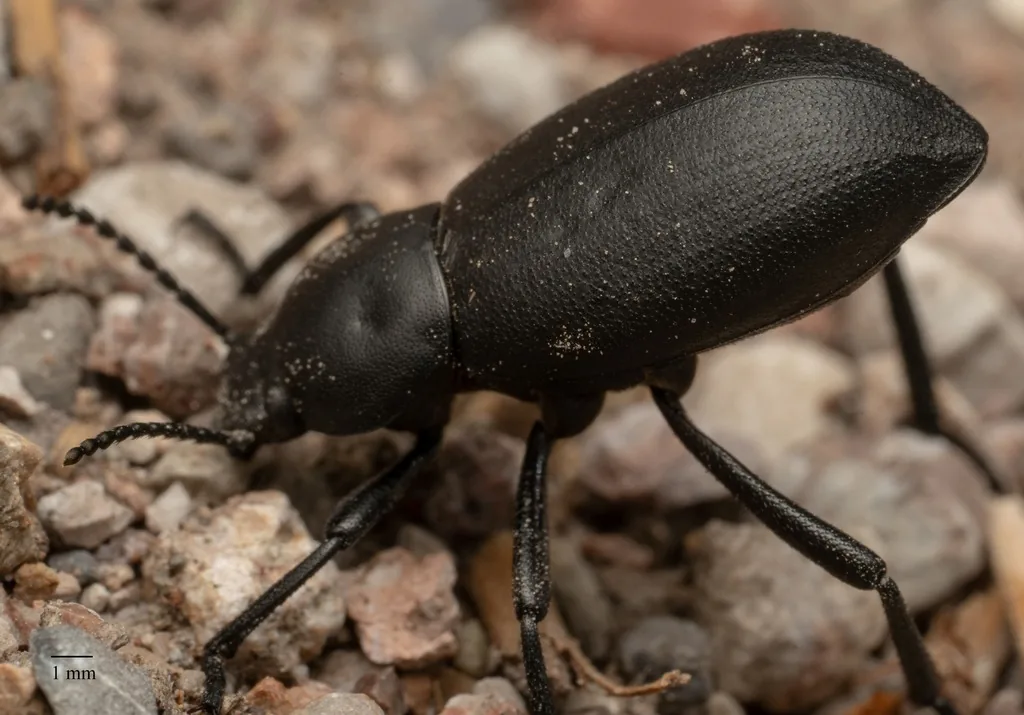
- Eleodes adults are black and slow-moving, and among the largest beetles commonly seen in California. Sources give different sizes: the Bohart Museum says they generally run 1 to 2 inches, while University of Arizona Extension gives 0.4 to 1.4 inches for the pinacate beetles it describes.[1][2]
- They cannot fly. The wing covers are fused into a single rounded shell over the back, which Missouri's conservation department says also helps them save water in the desert.[1][2][4]
- When disturbed they raise the rear end in a headstand and may release a smelly, reddish-black fluid; if that fails, they may play dead.[1][2]
- Across the whole family, Missouri lists a set of clues: usually black or brown, often dull; a wide, rounded head whose jaws are hard to see from above; short antennae, usually 11-segmented and often slightly clubbed, that start under a shelf in front of each eye, which makes the eye look notched; and five foot segments on the front two pairs of legs but four on the hind pair.[4]
- The larvae, called false wireworms, are shiny, hard, cylindrical and brown to yellowish, with six short legs behind the head. They look much like the mealworms sold in pet stores, which are also darkling beetle larvae.[1][4][8]
Look-alikes
| Look-alike | How to tell them apart |
|---|---|
| Ground beetles | Ground beetles are usually shiny and have big, easy-to-see jaws; darkling beetles are dull and their jaws are hard to see from above. UC IPM adds that a ground beetle's hind legs have a large lobe where they meet the body, and that ground beetles rarely have the slightly enlarged antenna tips of darklings.[5][4] |
| Mealworms and flour beetles | These are darkling beetles too, but small indoor ones: flour beetles are 1/8 to 1/4 inch long and infest flour, broken grain, dried fruit, nuts and pet food, and they can't feed on whole, unbroken grain. Large outdoor stink beetles aren't pantry pests.[4] |
| Lesser mealworm | The lesser mealworm is a darkling beetle of stored grain and poultry houses, where it lives in the litter, eats feed and can bite the birds.[4] |
Where it lives
Darkling beetles are found worldwide, most abundant and diverse in dry regions such as the desert Southwest. Missouri's conservation department counts about 20,000 species worldwide and about 1,200 north of Mexico, roughly 1,000 of them west of the Mississippi; a 2018 catalogue of North American darkling beetles lists 2,825 species. Eleodes stink beetles are found across the American West, including Arizona and California, and the Bohart Museum calls them particularly common in coastal and desert areas. GBIF's public U.S. records since 1990 for the genus Eleodes (about 44,000) come from 17 states on the map, most from California, Texas and Arizona.[4][7][2][1][11]
Biology and life cycle
Adults and larvae live on the ground and feed mostly on dead or decaying plant matter. In yards and open ground they turn up under boards, rocks and decaying wood, and the larvae are most often found under the bark of dead trees, in stumps or under logs.[1][4]
In hot country they spend the hottest part of the day sheltering in animal burrows and under rocks, are drawn to moist spots, and can be seen throughout the year.[2]
They overwinter as adults or larvae, and adults can live several years; one Arizona study of Eleodes obscura gives up to 4 years as adults. In desert areas some species migrate in large numbers at certain times of year.[1][10]
The spray is a real defense. Predators such as grasshopper mice push the beetle's rear end into the soil and eat the head end, and scorpions hold the beetle with the abdomen pointed away. In one field test, bats, skunks and ringtails took Eleodes obscura at a much lower rate than its abundance would predict, while a palatable look-alike darkling beetle was taken in proportion to its numbers.[2][1][9][4]
Missouri notes that other darklings, and at least one longhorn beetle, copy the headstand without producing any chemicals, and many predators avoid them anyway.[4]
Damage and signs
- Pinacate beetles feed on ironwood blossoms, saltbush foliage and other leaves, and may eat planted vegetable and flower seedlings.[2]
- In California gardens, UC IPM says darkling beetles chew off seedlings or feed on the foliage of several vegetable crops and sometimes feed on fruit such as figs. They are most active at night and hide under clods or debris in the heat of the day. In cotton, small darkling beetles (1/8 to 1/4 inch) girdle or cut off seedlings at or below the soil surface, but are usually no longer a problem once plants reach 4 to 6 inches.[5][6]
- Larvae of several Eleodes species are considered agricultural pests, though only a handful of species have been described in the larval stage.[8]
Health risk
University of Arizona Extension says there is no reason to be afraid of stink beetles if you keep your distance from the tip of the abdomen. The spray contains a type of benzoquinone that smells bad and can irritate skin, eyes and mucous membranes.[2]
Control
Keep them out
Keep them out the same way you would scorpions and centipedes: maintain weather stripping, caulk around windows and doors, and keep window screens in good repair.[2]
Sanitation
Where darkling beetles chew garden seedlings, UC IPM suggests removing organic matter or speeding its breakdown so larvae have less to feed on, and making sure the garden and borders are free of weeds and debris before planting.[5]
Common questions
- Why is it called a stink beetle?
- When threatened, it stands on its head with the rear end raised and releases a bad-smelling fluid to put off predators. Missouri notes that pinacate comes from a Mexican Spanish word for an acrobat or tumbler.[1][2][4]
- Are stink beetles dangerous?
- No. They mostly mind their own business. The only concern is the spray, which can irritate skin and eyes, so don't handle them near the tip of the abdomen.[2]
- Can stink beetles fly into my house?
- No. Their wing covers are fused shut, so they walk in through gaps around doors and windows. Some other darkling beetles can fly and come to lights at night.[1][4][2]
- Are mealworms the same thing as darkling beetles?
- Yes. Mealworms are the larvae of certain darkling beetles; the yellow mealworm sold for pets, birds and bait turns into a black adult beetle if left alone.[4]
Sources
- Bohart Museum of Entomology, University of California, Davis, “Darkling Beetles (Information Note No. 033).” bohart.ucdavis.edu/sites/g/files/dgvnsk4616/files/media/documents/note_33_darkling_beetle.pdf (accessed 2026-11-11)
- University of Arizona Cooperative Extension, Yavapai County, “Pinacate Beetle (Backyard Gardener #55, January 15, 2023).” www.extension.arizona.edu/sites/extension.arizona.edu/files/barnesm/PinacateBeetle.pdf (accessed 2026-11-11)
- iNaturalist, “Eleodes taxon page (order and family).” www.inaturalist.org/taxa/53817 (accessed 2026-11-11)
- Missouri Department of Conservation, “Darkling Beetles (Tenebrionids).” mdc.mo.gov/discover-nature/field-guide/darkling-beetles-tenebrionids (accessed 2026-11-11)
- University of California Statewide IPM Program, “Darkling Beetles (Home and Landscape).” ipm.ucanr.edu/home-and-landscape/darkling-beetles/ (accessed 2026-11-11)
- University of California Statewide IPM Program, “Darkling Beetles (Cotton Pest Management Guidelines).” ipm.ucanr.edu/agriculture/cotton/darkling-beetles/ (accessed 2026-11-11)
- ZooKeys, via PubMed, “Catalogue of Tenebrionidae (Coleoptera) of North America (Bousquet et al. 2018).” pubmed.ncbi.nlm.nih.gov/29416389/ (accessed 2026-11-11). Cited from the PubMed abstract.
- ZooKeys, via PubMed, “Larvae of the genus Eleodes (Coleoptera, Tenebrionidae): descriptions, cladistic analysis and key (Smith, Dornburg and Wheeler 2014).” pubmed.ncbi.nlm.nih.gov/25009429/ (accessed 2026-11-11). Cited from the PubMed abstract.
- Oecologia, via PubMed, “Predation pressure on an imperfect Batesian mimicry complex in the presence of alternative prey (Hetz and Slobodchikoff 1988).” pubmed.ncbi.nlm.nih.gov/28312410/ (accessed 2026-11-11). Cited from the PubMed abstract.
- Oecologia, via PubMed, “Reproduction and the energy cost of defense in a Batesian mimicry complex (Hetz and Slobodchikoff 1990).” pubmed.ncbi.nlm.nih.gov/28312777/ (accessed 2026-11-11). Cited from the PubMed abstract.
- Global Biodiversity Information Facility (GBIF), “Eleodes: occurrence records in the U.S., 1990-2026 (GBIF occurrence search).” api.gbif.org/v1/occurrence/search?taxonKey=4724278&country=US&hasGeospatialIssue=false&occurrenceStatus=PRESENT&year=1990%2C2026&facet=stateProvince&facetLimit=400&limit=0 (accessed 2026-11-11). State counts are records reported (iNaturalist research-grade, museum specimens, surveys), not abundance.