On this page
How to identify it
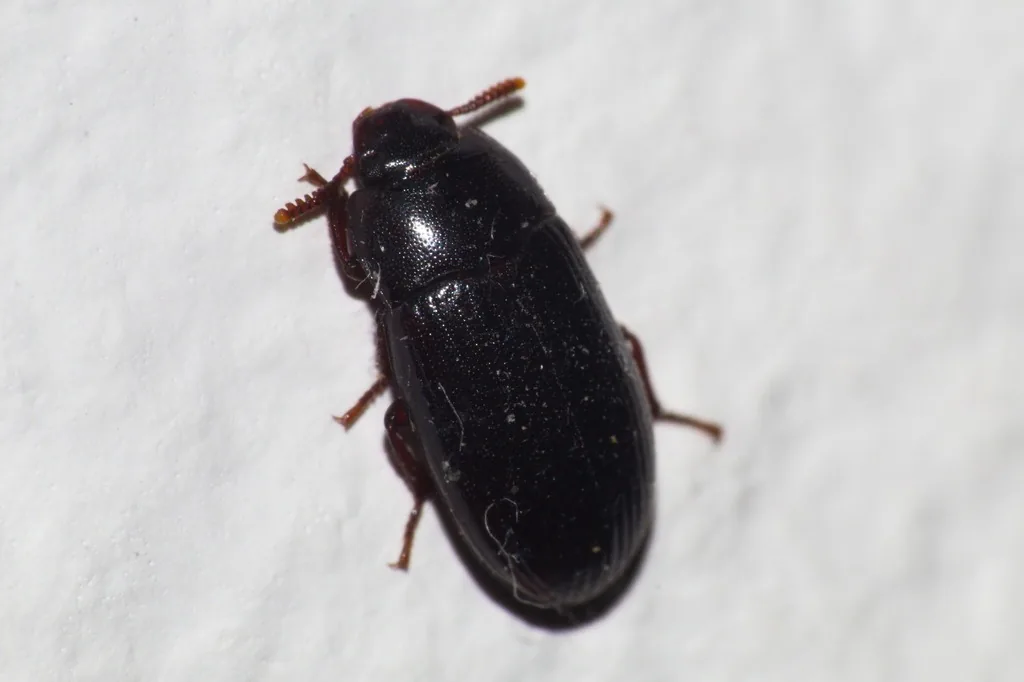
- Adults are oval, dark brown to black beetles; the BC fact sheet gives them as about 6 mm long, while Kentucky's sheet says 1/2 inch.[3][1]
- Larvae are segmented, tan to light yellow-brown grubs with a hard, cylindrical body like a wireworm and three pairs of legs. BC gives them as 1.5-11 mm long as they grow; Kentucky says 1/2 to 3/4 inch when full grown.[1][3]
- Both stages are most active at night and burrow quickly into the litter when disturbed, and they gather under feeders and anything else lying on the litter.[1]
Look-alikes
| Look-alike | How to tell them apart |
|---|---|
| Yellow mealworm | The larva has a hard, cylindrical body like a wireworm, but lesser mealworm larvae live in poultry litter, droppings and feed rather than in garden soil.[1] |
Where it lives
It turns up wherever poultry is raised on litter. The BC fact sheet calls it the most common insect pest of poultry production in Canada, and Kentucky's fact sheet describes it as one of the best-adapted scavengers of U.S. broiler and deep-pit egg houses. It is also an important beetle in the grain industry.[3][1][4]
Biology and life cycle
It is one of the best-adapted scavengers of litter-based broiler houses and deep-pit egg houses, feeding on spilled feed, dried droppings and dead birds; it is also an important beetle in the grain industry.[1][4]
Moisture is the key need: with feed everywhere, a leaking waterer or pipe is all a population needs to thrive in the litter.[1]
Females lay eggs in batches in damp litter; Kentucky says they hatch in 4 to 5 days at typical room temperatures. The larval stage normally lasts about 10 weeks (as short as 8), the pupal stage 5 to 10 days, and egg to adult about 80 days, with development between 60°F and 90°F.[1][3]
BC reports that a female can produce 200-2,000 eggs and adults live for 60-400 days; Kentucky says adults live for several months.[3][1]
Full-grown larvae leave the litter, especially when crowded, to pupate in a dry spot, often tunneling into insulation or wooden beams.[1]
They are not winter-hardy and die in cold temperatures, although they can supercool to keep from freezing. After a clean-out they can move from one barn or bay to another through the attic.[3]
Fun fact: at night the beetles fly toward lights as faint as a single candle or as bright as car headlights.[1]
Damage and signs
- Larvae leaving the litter tunnel into polystyrene insulation and even wooden beams to pupate. BC estimates severe infestations can destroy up to 25% of a poultry house's insulation a year and raise energy costs by up to 60%.[1][3]
- They carry poultry diseases. Kentucky names Salmonella, E. coli and infectious bursal disease virus, and BC lists more than 60 poultry diseases including Newcastle disease, avian influenza, coccidiosis, roundworms and poultry tapeworm; birds become infected by eating the beetles.[1][3]
- In a 2023 Poultry Science study, culturable Salmonella was still found in the beetles sixty-nine days after infected chickens were removed.[6]
- When infested litter or manure is spread on fields in warm weather, adults can fly to nearby homes by the thousands, drawn to lights mostly between 8 p.m. and midnight, and such invasions have led to lawsuits against producers.[1]
Health risk
They don't bite or sting, but they can cause allergies in people who work around them. A 1988 Journal of Allergy and Clinical Immunology study described three workers with asthma, runny nose, eye irritation (conjunctivitis), hives and swelling (angioedema) on exposure, all with positive skin tests to larvae, pupae and adults.[4]
Control
Prevention
Monitor with simple traps: a short length of PVC pipe holding a rolled sheet of corrugated cardboard, staked in the litter along the center line of the house and checked every week or two, shows whether numbers are rising or falling.[1]
Keep them out
Seal the routes larvae use into walls with resin, caulking or metal flashing, and don't share equipment between barns or neighbors.[3]
Sanitation
Keep the litter dry: fix leaking pipes and waterers, and clean up spilled feed, since feed storage areas and spilled feed outside the house can be where an infestation starts.[1]
Clean out and dispose of litter regularly, ideally when temperatures are near or below freezing, which kills most of the insects; moving feeders and waterers to pack down loose litter also makes it less suitable.[1]
Biological control
The fungus Beauveria bassiana is sold as a bio-insecticide that can kill all life stages. A 2025 review also points to insect-killing nematodes, plant essential oils and pheromones as tools for integrated control.[3][5]
Pesticides
Insecticides alone won't eliminate them, because the beetles are protected down in the litter, which can also bind the product. Some labeled products go on the floor litter and others only on walls as residual sprays, so read the label.[1]
Apply insecticide between flocks, after cleaning and before new litter goes down, and rotate between product groups each flock cycle, since the beetles can become resistant.[3]
Kentucky's 1998 list included Rabon 50 WP (stirofos) and Sevin (carbaryl) for floor litter, and Countdown (cyfluthrin), GardStar (permethrin) and Grenade WP (lambda cyhalothrin) as wall sprays, not applied while birds are present. Registrations change, so check current labels.[1]
Diatomaceous earth or boric acid products can go in cracks in posts and cement where beetles walk, before new litter is added; they must stay dry to work.[3]
Where sources disagree
Size: the BC fact sheet gives adults as about 6 mm and larvae 1.5-11 mm; Kentucky's 1998 sheet says adults are 1/2 inch and full-grown larvae 1/2 to 3/4 inch.[3][1]
Adult lifespan: Kentucky says several months; BC says 60-400 days.[1][3]
Common questions
- Why are small black beetles swarming the lights of my house in the country?
- If poultry farms are nearby, lesser mealworms are one possibility. When infested litter or manure is spread on fields in warm weather, the adults fly toward house lights, mostly between 8 p.m. and midnight.[1]
- Do lesser mealworms spread disease?
- To poultry, yes. They carry Salmonella, E. coli, infectious bursal disease virus and many other poultry pathogens, and birds that eat infected beetles can become sick.[1][3]
- Can insecticides get rid of them?
- Not on their own. Kentucky calls it virtually impossible to eliminate them from a poultry house with insecticides, because they are protected in the litter; dry litter, regular clean-out and sanitation matter more.[1]
- Can lesser mealworms cause allergies?
- Yes, in people exposed at work. A 1988 study confirmed allergy to all three life stages in three workers with asthma, rhinitis, hives and swelling.[4]
- Does cold weather kill them?
- Yes. Kentucky advises cleaning out litter when temperatures are near or below freezing to kill most of them, and BC notes they are not winter-hardy.[1][3]
Sources
- University of Kentucky Entomology, “Lesser Mealworms or Litter Beetles, ENTFACT-507 (L. Townsend).” entomology.ca.uky.edu/ef507 (accessed 2026-11-12)
- iNaturalist, “Alphitobius diaperinus taxon page (order and family).” www.inaturalist.org/taxa/53926 (accessed 2026-11-12)
- BC Climate Change Adaptation Program (Governments of Canada and British Columbia, delivered by the Investment Agriculture Foundation of BC), “Darkling Beetle Fact Sheet (January 2018).” www.bcclimatechangeadaptation.ca/app/uploads/FV05-2018-factsheet-Darkling-Beetle.pdf (accessed 2026-11-12)
- Journal of Allergy and Clinical Immunology (1988), via PubMed, “Occupational sensitivity to Alphitobius diaperinus (Panzer) (lesser mealworm).” pubmed.ncbi.nlm.nih.gov/2462582/ (accessed 2026-11-12). Cited from the PubMed abstract.
- Veterinary Sciences (2025), via PubMed, “A Review of Biological and Sustainable Management Approaches for Alphitobius diaperinus, a Major Pest in Poultry Facilities.” pubmed.ncbi.nlm.nih.gov/40005918/ (accessed 2026-11-12). Cited from the PubMed abstract.
- Poultry Science (2023), via PubMed, “Research Note: Role of darkling beetles (Alphitobius diaperinus) and litter in spreading and maintaining Salmonella Enteritidis and Campylobacter jejuni in chicken flocks.” pubmed.ncbi.nlm.nih.gov/37717478/ (accessed 2026-11-12). Cited from the PubMed abstract.