On this page
How to identify it
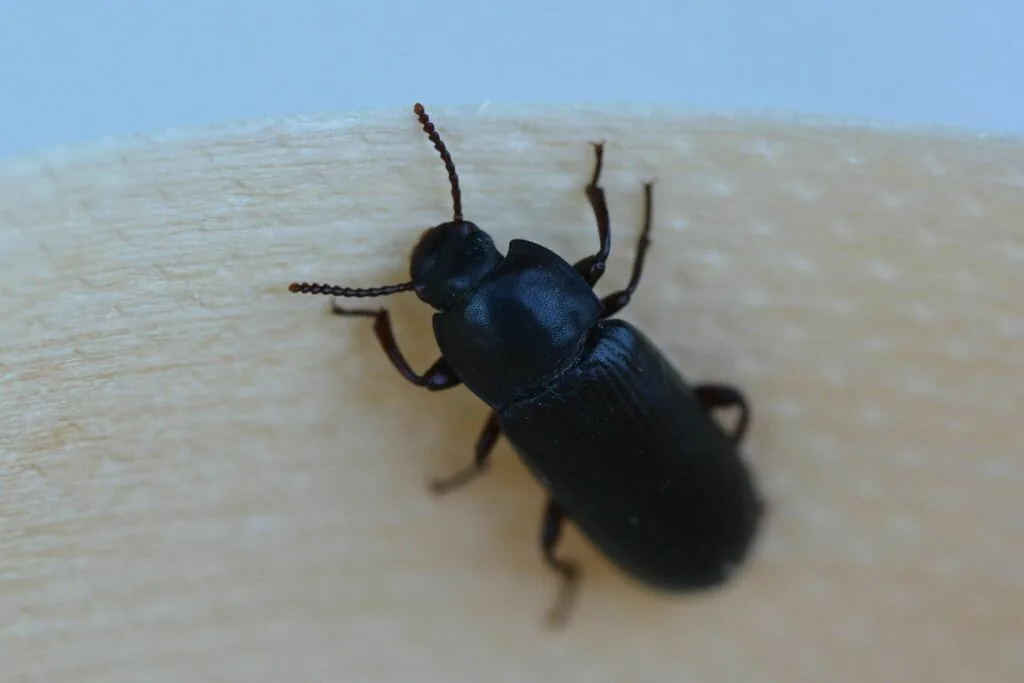
- Adults are polished dark brown to black beetles, usually just over 1/2 inch long. Kansas State gives 14 to 20 millimeters (1/2 to 2/3 inch) and calls them the largest beetles found in stored products.[2][3][1]
- Grown larvae are about an inch long: Kansas State gives 26 to 30 millimeters (1 to 1 1/4 inches). They are hard-shelled, cylindrical and active, and look a lot like wireworms.[3][2][1]
- The larvae are honey-yellow to yellowish brown, shading darker toward each end and at the joints between segments. The beetle is named for that yellowish larval color.[1][3][2]
- The adult's wing covers are grooved lengthwise and its thorax is finely punctured. Newly hatched larvae are slender and white and soon turn yellow.[1]
Look-alikes
| Look-alike | How to tell them apart |
|---|---|
| Dark mealworm | Similar in size and habits, and often found with the yellow mealworm, but the adult is dull pitch black instead of shiny, and the larvae are much darker brown.[1][3][2] |
| Lesser mealworm | Shaped and colored like the yellow and dark mealworms but considerably smaller, about 3/16 to 4/16 inch long, black or very dark reddish brown. Its yellowish-brown larva looks like a young yellow mealworm.[1] |
| Cadelle | Another large stored-grain beetle, shiny dark to red-brown and about 0.6 inch long, with a distinct waist between the thorax and wing covers. Its larvae are creamy white with black heads.[4] |
Where it lives
USDA's stored-grain handbook calls it cosmopolitan, but in the United States abundant only in the northern states. It can also arrive in homes with mealworms bought as pet food.[1][2]
Biology and life cycle
Females are prolific: USDA's handbook says each may lay as many as 500 eggs. The eggs are coated with a sticky secretion, so flour or meal clings to them, and they hatch in about 2 weeks.[1]
There is one generation a year. The larvae are fully grown in about 3 months but keep feeding and molting until cold weather, spend the winter as larvae, and pupate in late spring or early summer for about 2 weeks. Missouri Extension puts egg to adult at about a year in good conditions.[1][2]
Around the latitude of Washington, D.C., adults begin to appear in late May and early June and can be found until late August.[1]
Mealworms are night-active and keep to dark, moist places. They breed in refuse grain, coarse cereal and mill products that pile up in dark corners, under sacks and in bins, and are often found among slightly damp bags.[1]
In homes, larvae are associated with cereal products that are damp or in poor condition and stored in out-of-the-way places. Kansas State says they also infest meals, meat meal and mill sweepings.[2][3]
Mealworms are raised in large numbers and sold live or dried as food for poultry, backyard birds, reptiles, amphibians and fish, and as fishing bait.[5][2]
Damage and signs
- They feed on grain and grain products, especially grain that is out of condition. Because the larvae feed only from the outside of kernels and there is one generation a year, USDA's handbook says it is not a serious pest.[3][1]
- Grain left in storage a long time is the exception: well-grown larvae can do serious injury to whole grain held for long periods without being moved.[1]
- Mealworms brought home as pet food can be the source of a household infestation.[2]
Health risk
They don't bite or sting; the household problem is contaminated food. UC IPM notes pantry pests can introduce microbes that may produce mycotoxins, especially in warm, humid storage. Mealworms can also cause allergy: a 2025 case report described occupational allergic asthma in a worker who reared them, traced to airborne mealworm material, and a Polish study of 6,173 people found 4.3% had IgE antibodies to mealworm, usually alongside sensitization to other invertebrate allergens.[6][7][8]
Control
Prevention
Store grain products, pet food and birdseed in containers with tight-fitting lids, not plastic bags, and wash old containers before refilling them.[6]
Sanitation
Find every infested package. Check dry pet food and birdseed first, since large amounts that sit for long periods invite trouble, then seal infested items in bags and take them to an outdoor trash bin.[2][6]
If you buy live mealworms for pets, keep track of them: Missouri Extension notes mealworms brought home as pet food may be the source of an infestation.[2]
In grain bins and feed rooms, don't let grain sit undisturbed for long periods. USDA's handbook says screening and fanning easily remove the insects from grain.[1]
Traps and physical control
For food worth saving, Missouri Extension says to heat it to 130 degrees F for at least 30 minutes or hold it in a deep freezer at zero degrees for at least four days.[2]
Vacuum corners and crevices of cupboards with a crevice tool and wash shelves with soap and water, so no spilled flour or meal is left to feed survivors.[6]
Pesticides
Sources differ on sprays. UC IPM says insecticides aren't recommended for any pantry pest. Missouri Extension calls a mild crack-and-crevice insecticide labeled for indoor stored-product pests optional after a thorough cleaning.[6][2]
Pet food, bait and human food
A container of yellow mealworms left alone will eventually turn into a container of black adult beetles.[5]
The so-called giant mealworms sold since the 1980s are fed a juvenile hormone that keeps them from pupating, so they keep growing and molting as larvae.[5]
Yellow mealworms are edible for people and are eaten in southwest Asia, Japan and, increasingly, Europe, where the European Commission authorized dried yellow mealworm as a food ingredient in 2021.[5][8]
Common questions
- Are the mealworms in my house the same ones sold as pet food?
- Yes. The yellow mealworm is the species sold live or dried in pet stores, and Missouri Extension says pet-food mealworms brought home can be the source of an infestation.[5][2]
- Why are there mealworms in my basement?
- They seek out grain products that are damp or in poor condition in undisturbed places such as basements. Look for old birdseed, pet food, flour or feed.[2]
- Will freezing kill mealworms in food?
- Yes. Missouri Extension recommends a deep freezer at zero degrees F for at least four days, or heating the food to 130 degrees F for at least 30 minutes.[2]
- Can mealworms cause allergies?
- They can. Allergy researchers have documented occupational asthma in a person who reared mealworms and IgE sensitization to mealworm in about 4% of a large group of people tested in Poland.[7][8]
Sources
- U.S. Department of Agriculture, Agricultural Research Service, “Stored-Grain Insects, Agriculture Handbook No. 500.” www.ars.usda.gov/ARSUserFiles/2863/pdfdocuments/StoredGrainInsects.pdf (accessed 2026-11-11)
- University of Missouri Extension, “G7370: Stored Product Pests.” extension.missouri.edu/publications/g7370 (accessed 2026-11-11)
- Kansas State University Research and Extension, “Stored Products Pest Control, Pesticide Application Training Category 7B.” bookstore.ksre.ksu.edu/download/stored-products-pest-control-7b_S16 (accessed 2026-11-11)
- University of Kentucky College of Agriculture, Entomology, “ENTFACT-134: Insect Pests of Stored Grain: Cadelle Beetle (revised March 2026).” entomology.mgcafe.uky.edu/ef134 (accessed 2026-11-11)
- Missouri Department of Conservation, “Darkling Beetles (Tenebrionids) field guide.” mdc.mo.gov/discover-nature/field-guide/darkling-beetles-tenebrionids (accessed 2026-11-11)
- University of California Statewide IPM Program, “Pest Notes: Pantry Pests, Publication 7452.” ipm.ucanr.edu/home-and-landscape/pantry-pests/ (accessed 2026-11-11)
- Allergologie Select, via PubMed, “Airborne exposure-induced occupational type I allergy to Tenebrio molitor: case report (Weissenborn et al. 2025).” pubmed.ncbi.nlm.nih.gov/40709281/ (accessed 2026-11-11)
- Scientific Reports, via PubMed, “IgE-based analysis of sensitization and cross-reactivity to yellow mealworm and edible insect allergens (Majsiak et al. 2025).” pubmed.ncbi.nlm.nih.gov/39789064/ (accessed 2026-11-11)
- iNaturalist, “Tenebrio molitor taxon page (order and family).” www.inaturalist.org/taxa/131970 (accessed 2026-10-06)