On this page
How to identify it
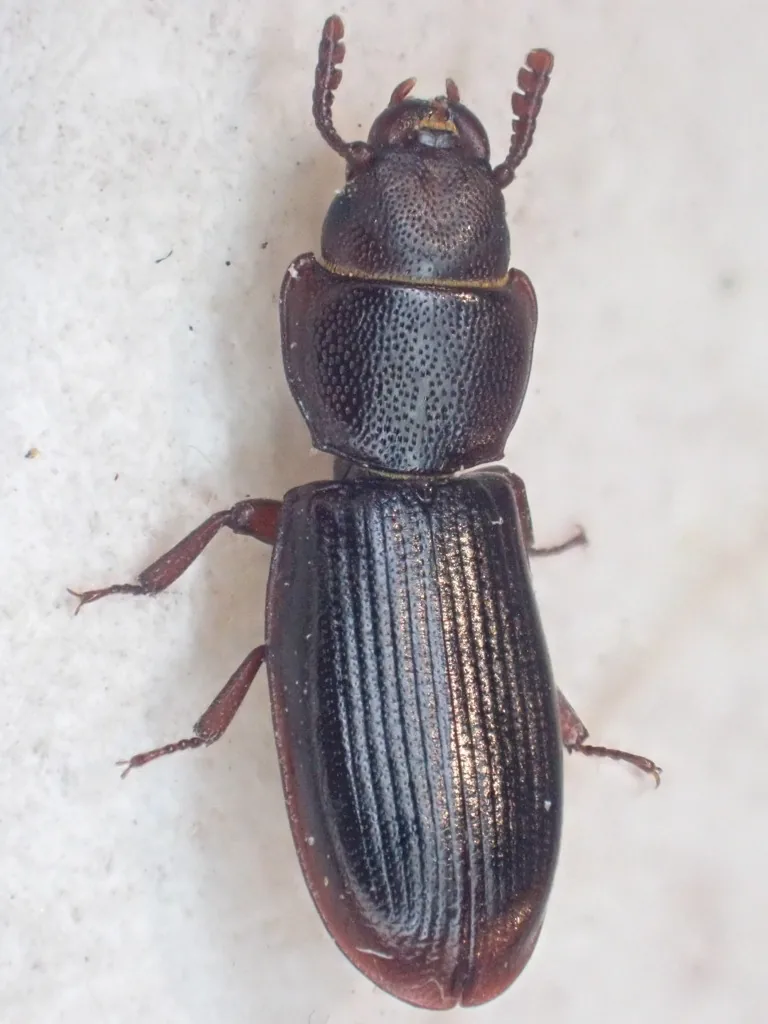
- Adults are shiny black to dark reddish brown, elongate and flattened. Sources disagree on size: the USDA stored-grain handbook and K-State put the adult at about 1/3 inch (K-State: about 8 mm), while Kentucky Entomology says about 0.6 inch. UF/IFAS gives the adult as 8 mm and calls it among the largest insects that feed on grain products, and Purdue notes that adults and larvae are large and easy to see.[1][2][3][9][10]
- The head and prothorax are closely joined but set off from the wing covers by a clear waist, and the outer front corners of the prothorax project forward toward the head. UF/IFAS describes the prothorax as set off from the rest of the body by a loose, prominent joint.[1][3][9]
- Larvae are creamy or chalky white with a black head, dark plates on the segment just behind the head, and a black plate at the tail bearing two horny points. UF/IFAS describes the larva as fleshy and white to grayish white, with two projections on the black plate at the tip of the abdomen.[1][3][2][9]
- Full-grown larvae are among the largest grain-infesting larvae: about 3/4 inch long per USDA, or 0.6 to 1 inch per Kentucky Entomology.[2][1]
- USDA notes an older name, bolting-cloth beetle, from its habit of cutting the silk sifting cloths in flour mills.[2]
Where it lives
USDA describes the cadelle as widespread over the world and frequently found in mills, granaries and storehouses. Public occurrence records are sparse: GBIF holds only a handful of U.S. records since 1990 and about 440 worldwide, most from France and Switzerland. Purdue Extension lists it among the principal stored-grain insects of Indiana.[2][4][5][10]
Biology and life cycle
Females lay about 1,000 eggs, in batches of 10 to 60 in grain or other food, and USDA says the white eggs hatch in 7 to 10 days in warm weather. Adults are long-lived: Kentucky says females may live more than a year, and USDA that many adults live more than a year and some nearly two.[1][2][3]
Development time varies widely. Kentucky Entomology says there are usually four larval stages and larval development can take as little as eight weeks, K-State gives a minimum of 70 days for the whole life cycle, and USDA says larvae take 2 to 14 months to complete growth.[1][3][2]
There are usually one or two generations a year in temperate regions. UF/IFAS says there are usually three generations a year in tropical countries and fewer elsewhere.[1][9]
Larvae leave the infested material to pupate in holes in wood. K-State says larvae and adults burrow into the wood of bins in cold weather or when no grain is present. Purdue says larvae leave stored grain in the fall and burrow into woodwork, such as wooden bins or boxcars, to hibernate.[1][3][2][10]
Eggs and pupae die quickly at 0 degrees F, but larvae and adults can survive 15 to 20 degrees F for several weeks. K-State adds that cadelles can go dormant and survive low temperature and moisture for more than a year.[1][3]
Larvae and adults can go a long time without food and often stay hidden in the woodwork of a bin after the grain is removed, so new grain put into the bin becomes infested quickly.[2]
Damage and signs
- Adults and larvae go from kernel to kernel eating the germ, leaving irregular holes in undamaged kernels, and also eat endosperm and milled products such as flour and meal. Besides grain and flour, UF/IFAS lists breakfast foods, potatoes, shelled and unshelled nuts, and fruit among its foods, and says it can gnaw through sacks, paper packages and even boards.[1][2][3][9]
- In wooden bins they bore into the walls and floors to pupate, and USDA says they can later emerge from the wood in enormous numbers.[2][1]
- It also attacks the larvae of other grain-infesting insects, according to UF/IFAS.[9]
- Purdue says larvae may burrow into packaged cereal products, opening an entrance for other cereal pests.[10]
Health risk
Cadelles damage stored grain and food rather than people. In the home, UC IPM cautions that spraying pesticides on or near food can do more harm to your family than pantry pests.[1][6]
Control
Prevention
Prevention is the most economical and efficient way to manage cadelles in stored grain.[1]
Move dry foods out of paper, cardboard and plastic packaging into jars or other containers with tight-fitting lids; UC IPM notes plastic bags aren't adequate.[6][7]
Sanitation
In a home, throw away every infested package and check everything else on the shelf, then vacuum the shelves top and bottom, using a crevice tool on cracks.[7][6]
In grain storage, look for larvae in woodwork as well as in the grain. USDA warns that fresh grain put into bins that weren't properly cleaned becomes infested quickly, and K-State says that for long-dormant pests like the cadelle, thorough cleaning of storage structures followed by a residual insecticide helps prevent carryover from one batch to the next.[2][3][1]
Pesticides
Insecticides aren't recommended for pantry pests in the home.[6]
When to call a professional
Once cadelles are spread through a grain mass, fumigation is the best remedy; Kentucky Extension points growers to crop-specific insecticide recommendations for stored grain.[1]
Where the sources disagree
Adult size: UF/IFAS and K-State give about 8 mm and USDA about 1/3 inch, while Kentucky Entomology says up to about 0.6 inch.[9][3][2][1]
Lifespan: UF/IFAS says adult females generally live one year, Kentucky says females may live more than a year, and USDA says some adults live nearly two years.[9][1][2]
Common questions
- What is the large black beetle in my stored grain or flour?
- If it is shiny black, flattened and about 1/3 inch long (Kentucky says up to about 0.6 inch) with a distinct waist, it may be a cadelle, one of the largest stored-grain beetles.[1][2][3]
- Will freezing kill cadelles?
- Cold works only if it is deep: eggs and pupae die quickly at 0 degrees F, but larvae and adults can survive 15 to 20 degrees F for several weeks.[1]
- Can cadelles get into sealed packages?
- Paper and cloth won't stop them: UF/IFAS says the cadelle can gnaw through sacks, paper packages and even boards, and Purdue says larvae burrow into packaged cereal products, letting other cereal pests in behind them.[9][10]
Sources
- University of Kentucky College of Agriculture, Entomology, “ENTFACT-134: Insect Pests of Stored Grain: Cadelle Beetle (revised March 2026).” entomology.mgcafe.uky.edu/ef134 (accessed 2026-11-11)
- U.S. Department of Agriculture, Agricultural Research Service, “Stored-Grain Insects, Agriculture Handbook No. 500.” www.ars.usda.gov/ARSUserFiles/2863/pdfdocuments/StoredGrainInsects.pdf (accessed 2026-11-11)
- Kansas State University Research and Extension, “Stored Products Pest Control, Pesticide Application Training Category 7B.” bookstore.ksre.ksu.edu/download/stored-products-pest-control-7b_S16 (accessed 2026-11-11)
- Global Biodiversity Information Facility (GBIF), “Tenebroides mauritanicus: U.S. occurrence records since 1990 by state (GBIF occurrence search).” api.gbif.org/v1/occurrence/search?taxonKey=1161887&country=US&hasGeospatialIssue=false&occurrenceStatus=PRESENT&year=1990%2C2026&facet=stateProvince&facetLimit=400&limit=0 (accessed 2026-11-11). Exact count at access: 6 U.S. records since 1990 (California 2; Hawaii, Missouri and Tennessee 1 each).
- Global Biodiversity Information Facility (GBIF), “Tenebroides mauritanicus: occurrence records since 1990 by country (GBIF occurrence search).” api.gbif.org/v1/occurrence/search?taxonKey=1161887&hasGeospatialIssue=false&occurrenceStatus=PRESENT&year=1990%2C2026&facet=country&limit=0 (accessed 2026-11-11). Exact count at access: 438 records worldwide since 1990 (France 119; Switzerland 93; Malaysia 54).
- University of California Statewide IPM Program, “Pest Notes: Pantry Pests, Publication 7452.” ipm.ucanr.edu/home-and-landscape/pantry-pests/ (accessed 2026-11-11)
- University of Kentucky College of Agriculture, Entomology, “ENTFACT-612: Stored Product Pests in the Pantry.” entomology.mgcafe.uky.edu/ef612 (accessed 2026-11-11)
- iNaturalist, “Tenebroides mauritanicus taxon page (order and family).” www.inaturalist.org/taxa/232377 (accessed 2026-10-06)
- University of Florida, Entomology and Nematology Department (UF/IFAS), “Cadelle, Tenebroides mauritanicus (Stored Product Pests image gallery).” entnemdept.ufl.edu/projex/gallery/dl/stored_product_pests/text/cadelle.htm (accessed 2026-11-14)
- Purdue University Extension, Department of Entomology, “Principal Stored Grain Insects of Indiana, E-80-W.” extension.entm.purdue.edu/publications/E-80.pdf (accessed 2026-11-14)