On this page
How to identify it
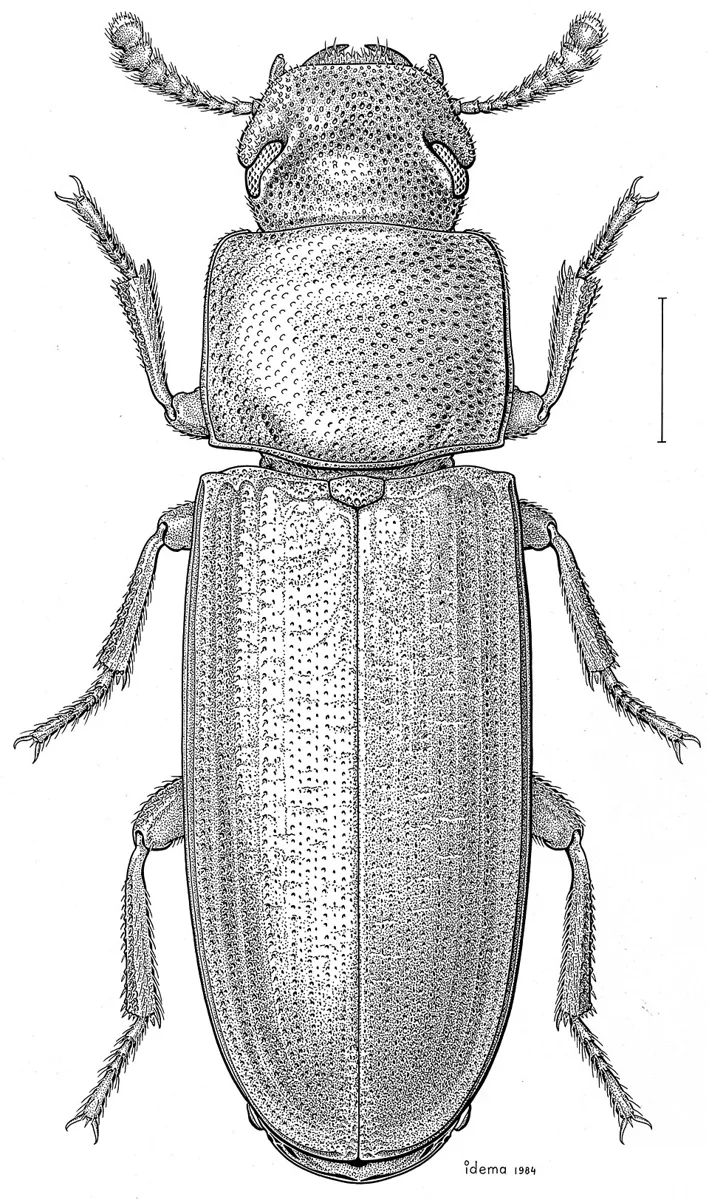
- Adults are shiny reddish brown, flattened and oval, about 1/7 inch long. Kentucky gives about 1/8 inch for flour beetles and similar pantry beetles. UF/IFAS gives about 1/8 inch.[1][2][6]
- The antennae widen gradually toward the tip into a four-segmented club; the red flour beetle's end abruptly in a three-segmented club. UF/IFAS adds that the sides of the thorax are more nearly parallel than in the red flour beetle, whose thorax has slightly curved sides; both have notched eyes and a tarsal formula of 5-5-4.[1][6][7]
- Larvae are slender, wiry and white tinged with yellow, about 3/16 inch when grown. UF/IFAS describes the slender larvae as creamy yellow to light brown with two dark pointed projections on the last body segment, the pupae as white to yellowish, and the eggs as white and microscopic, often with bits of flour stuck to them.[1][6]
Look-alikes
| Look-alike | How to tell them apart |
|---|---|
| Red flour beetle | Nearly identical, but its antennae end abruptly in a three-segmented club. The University of Florida says the red flour beetle may fly, especially before a storm, while the confused flour beetle does not; Kentucky says the reverse.[1][6][7][2] |
| Drugstore beetle | Cylindrical, with lengthwise grooves on the wing covers, rather than flat.[1] |
Where it lives
Found in pantries, mills and food storage; it cannot attack whole, undamaged grain but feeds on flour, meal, cereals, broken kernels, dried fruit, dry pet food, candy and more. UF/IFAS says it originated in Africa, occurs worldwide in cooler climates and in the United States is more abundant in the northern states, while the red flour beetle, of Indo-Australian origin, is found mainly in the southern states.[2][1][6]
Biology and life cycle
Females lay small, sticky white eggs loosely in flour or food; the eggs become coated and cling to bags and boxes.[1]
In summer, egg to adult takes about six weeks; adults average about a year of life and some live almost four years. Kentucky gives about 7 weeks for the flour beetle life cycle and says adult females live several months to more than a year.[1][2]
Kentucky Extension says confused flour beetles fly and are attracted to lights. The same fact sheet says red flour beetles apparently do not fly, but lab studies show red flour beetles do take flight, so treat flight as a poor way to tell the two apart and check the antennae instead. The University of Florida's Featured Creatures sheet and stored-product pest gallery say the opposite: the confused flour beetle does not fly.[2][4][6][7]
UF/IFAS says flour beetles can breed year round in warm areas, the life cycle takes 40 to 90 days, adults may live more than three years, and all life stages may be found in infested products at the same time.[6][7]
Adults are attracted to light but head for cover when disturbed. They favor grain with a high moisture content and also live in cracks and crevices where grain has spilled.[6]
Damage and signs
- Beetles and larvae contaminate food with their bodies and by-products, and some beetle larvae give food a disagreeable odor and taste. Kentucky notes that flour beetles can't attack whole, undamaged grain, so they live in flour, meal and other processed or broken products. UF/IFAS adds that infested grain can take on a grey tint, the beetles give off a displeasing odor, and their presence encourages mold. They have chewing mouthparts but do not bite or sting.[1][2][6]
Health risk
The harm is contamination of stored food; infested products should be discarded. Clemson says their presence makes food unfit to eat.[1][3]
Control
Prevention
Store dry foods in containers with tight lids (plastic bags aren't enough), don't mix old and new lots, keep storage dry, and keep rarely used flours and mixes in the freezer. Clemson also suggests buying no more than about two months' worth of food at a time. UF/IFAS adds that infested products can come home from the store, so check for leaky packages when shopping and don't buy a product you suspect.[1][3][6]
Sanitation
Find and discard every infested package, sealed and taken outside; check opened, older packages first, then vacuum shelves with a crevice tool and wash them with soap and water. Clemson says to put bagged infested food in an outdoor trash can with a tight lid and to check places such as a bag of pet food in the garage, where infestations can start before moving into the pantry. UF/IFAS says to consider every likely food, including spices, dry pet food, dried flowers, nuts, birdseed and flower arrangements, and even furniture stuffing or stuffed animals made with natural products; look for leaky packages with bits of meal spilling out and for spills under the refrigerator or stove. It suggests removing shelf paper, cleaning under it with soap and hot water, and replacing it.[1][2][3][6]
Traps and physical control
Multi-species pheromone traps attract confused flour beetles and help detect survivors after cleanup; check weekly.[1]
Kentucky says items you want to keep, such as decorations or bird seed, can be heated to 155°F for about 20 minutes with the oven door propped open or held in a non-self-defrosting freezer at 0°F for 4 days. UF/IFAS says infested material can be frozen for four to five days, warning that the beetles may survive shorter freezing.[2][6]
Pesticides
Insecticides aren't recommended for pantry pests. Clemson says spraying should only be a last resort: never spray food, and aim any spray at cracks and crevices.[1][3]
Where sources disagree
Lifespan: UC says adults average about a year and some live almost four years; Kentucky says females live several months to more than a year. Development: about six weeks in summer (UC) or about 7 weeks (Kentucky). Size: about 1/7 inch (UC) or 1/8 inch (Kentucky). UF/IFAS gives a life cycle of 40 to 90 days, adults living more than three years, and a size of about 1/8 inch.[1][2][6][7]
Flight: Kentucky says the confused flour beetle flies and the red flour beetle apparently does not; the University of Florida says the red flour beetle may fly, especially before a storm, and the confused flour beetle does not.[2][6][7]
Freezing: Kentucky gives 0°F for 4 days; UF/IFAS gives four to five days in a freezer.[2][6]
Common questions
- Why is it called the confused flour beetle?
- It is very easily confused with the red flour beetle; the antennae are the easiest difference. UF/IFAS says it apparently got its name from confusion over its identity, since at first glance it looks so much like the red flour beetle.[1][6]
- Does the confused flour beetle fly?
- Kentucky Extension says it does and that it is attracted to lights. Sources disagree about which flour beetle flies, so use the antennae, not flight, to tell it from the red flour beetle. The University of Florida says it does not fly.[2][4][6][7]
Sources
- University of California Statewide IPM Program, “Pest Notes: Pantry Pests, Publication 7452 (March 2013).” ipm.ucanr.edu/legacy_assets/PDF/PESTNOTES/pnpantrypests.pdf (accessed 2026-11-11)
- University of Kentucky Entomology, “ENTFACT-612: Stored Product Pests in the Pantry.” entomology.mgcafe.uky.edu/ef612 (accessed 2026-11-11)
- Clemson Cooperative Extension, Home & Garden Information Center, “Pantry Pests (HGIC 2439).” hgic.clemson.edu/factsheet/pantry-pests/ (accessed 2026-11-11)
- Journal of Economic Entomology, via PubMed, “Perez-Mendoza, Campbell and Throne (2014), Effect of abiotic factors on initiation of red flour beetle (Coleoptera: Tenebrionidae) flight.” pubmed.ncbi.nlm.nih.gov/24665734/ (accessed 2026-11-11)
- iNaturalist, “Tribolium confusum taxon page (order and family).” www.inaturalist.org/taxa/232866 (accessed 2026-11-11)
- University of Florida IFAS Extension, EDIS, “Confused Flour Beetle, Tribolium confusum, and Red Flour Beetle, Tribolium castaneum, EENY289/IN566 (Featured Creatures).” ask.ifas.ufl.edu/publication/IN566 (accessed 2026-11-14)
- University of Florida, Entomology and Nematology Department, “Red flour beetle, Tribolium castaneum (stored product pests image gallery).” entnemdept.ufl.edu/projex/gallery/dl/stored_product_pests/text/red_flour_beetle.htm (accessed 2026-11-14)