On this page
How to identify it
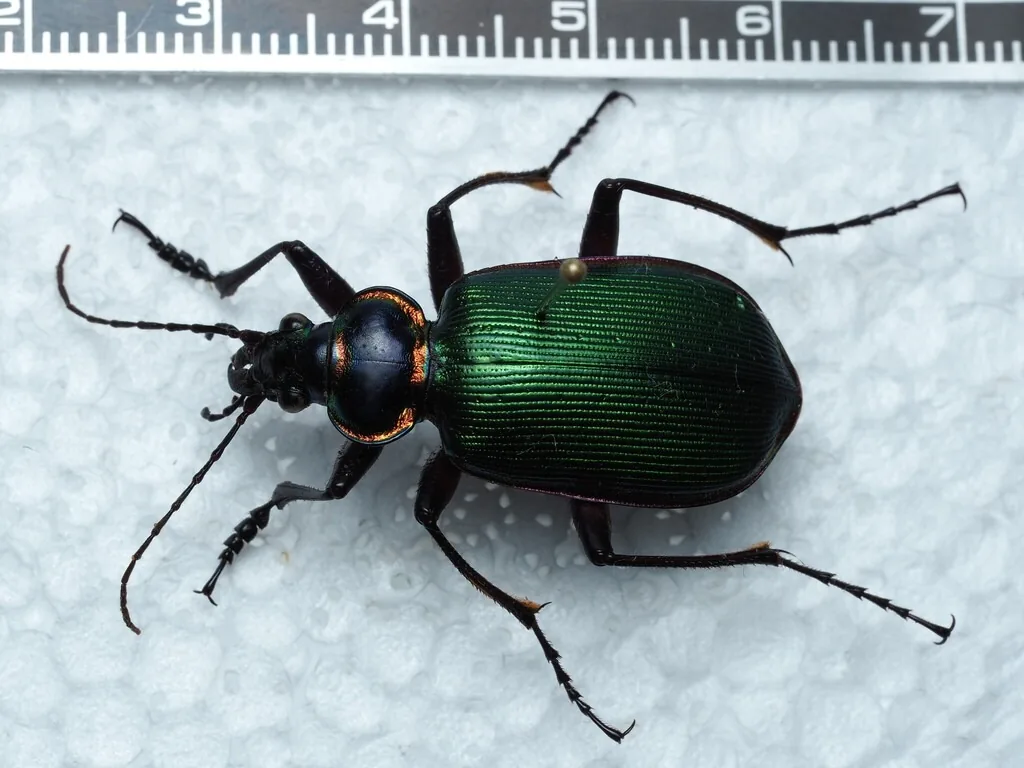
- Most are shiny black, brown or dark reddish, often with grooved or ridged wing covers; some are brightly metallic or iridescent.[1][2][4][3]
- The head is smaller than the thorax, the antennae are threadlike and unclubbed, and the legs are long and slender.[1][2][4]
- Many have prominent jaws for seizing prey.[1][3][4]
- They run quickly when disturbed and seldom fly; many species have fused wing covers and can't fly at all.[1][2][3]
- Larvae are elongate, with a relatively large head and curved chewing mouthparts; Missouri says they look rather like mealworms.[1][2][4]
- The fiery searcher, a large, brilliantly colored ground beetle common in Kentucky, was brought to the U.S. to feed on spongy moth caterpillars.[1]
Look-alikes
| Look-alike | How to tell them apart |
|---|---|
| Oriental cockroach | Both are shiny and very dark, but beetles have hard front wings, while roaches have leathery wings or none and a hood that hides the head from above.[1] |
| Darkling beetles | Darkling beetles lack the enlarged segments at the base of the hind legs that ground beetles have, and their antennae attach beneath a ridge on the head.[2] |
| Tiger beetles | Tiger beetles are a subfamily of ground beetles that are more often brightly colored and active by day; some are strong daytime fliers along trails and sandbars.[4] |
Where it lives
They live in most land habitats, from forests and wildlands to crops, gardens and landscapes, and some climb into trees. Kentucky counts more than 2,200 species in North America, and Missouri lists ground beetles statewide.[2][1][4]
Biology and life cycle
Adults hunt at night and hide by day under rocks, logs, leaf litter, mulch and plant debris, especially in damp spots. At night many climb plants to catch caterpillars.[1][2][3][4]
Prey includes caterpillars, root maggots, slugs, snails, millipedes and insect eggs; Missouri adds that some species also eat fruit or seeds or scavenge dead material.[1][2][3][4]
Females lay eggs one at a time in moist soil, commonly about 100 or more in a lifetime. Larvae live in soil or litter, are predators too and go through four instars; most pupate in a soil cell several inches deep.[2][3]
Many species take about a year to develop from egg to adult, and adults can live two years or more.[2]
Bombardier beetles, a group of ground beetles, raise the tip of the body and fire a hot chemical gas with a popping sound when threatened. Other species release foul or irritating chemicals.[1][4][3]
Damage and signs
- Indoors they are only a nuisance. Kentucky says they generally won't stay inside because they prefer the outdoors, where prey is more common.[1][3]
- Some eat seeds. In crop fields, carabids are among the most important predators of fallen weed seeds, and field studies have found them removing 65 to 90 percent of some weed seeds shed each year.[4][5]
Health risk
Larger species can bite if handled, and some release chemicals that irritate sensitive skin or smell bad, so don't handle them bare-handed. Medical reports of injury are rare: a bombardier beetle's spray gave an 11-year-old boy a second-degree burn on the eyelid and damage to the surface of the eye that healed in two weeks, and a tropical bombardier beetle in a shoe caused burning pain and a brown stain on the skin.[3][6][7]
Control
Prevention
Outdoors, no control is needed. Ground beetles eat caterpillars, root maggots, slugs, snails and other soft-bodied pests.[3][1]
If they are flying to lights at night, reposition the lights or change white bulbs to yellow.[1]
Keep them out
Caulk and weatherstrip obvious openings, and close off or screen gaps around doors, windows and foundations.[1][3]
Sanitation
Reduce hiding places next to the house, such as log piles, mulch and debris around the foundation.[1]
Traps and physical control
Sweep up, vacuum or capture stray beetles and release them outside.[1][3]
Pesticides
Kentucky says control generally isn't warranted because ground beetles are beneficial, and Washington State lists non-chemical options as the first choice.[1][3]
Where sources disagree
Number of species: Kentucky says more than 2,200 in North America, Missouri about 2,400 north of Mexico, and UC IPM over 2,500.[1][4][2]
Size: UC IPM gives about 1/8 to 1 inch for most species; Missouri says most are 1/4 to 3/4 inch, with some reaching 2 inches; Washington State gives about 1/4 inch to over an inch for common Northwest species.[2][4][3]
Flying: UC IPM says adults rarely fly and many can't; Kentucky says most don't use their wings but a few fly to lights; Missouri says many can fly and are attracted to lights at night.[2][1][4]
Common questions
- Are ground beetles in the house a sign of an infestation?
- No. They wander in from outdoors, may be drawn by lights, and generally won't stay, since they prefer the outdoors where prey is more common.[1][3]
- Do ground beetles bite?
- Larger species may bite if handled, so don't pick them up bare-handed; sweep them up or capture them and release them outside.[3][1]
- Do ground beetles eat slugs?
- Yes. Kentucky, UC IPM and Missouri list slugs and snails among their prey, and snail-eating species have an unusually long, narrow head that reaches into the shell.[1][2][4]
Sources
- University of Kentucky Entomology Extension, “Ground Beetles, ENTFACT-706 (revised August 2022).” entomology.ca.uky.edu/files/ef706.pdf (accessed 2026-11-11)
- University of California Statewide IPM Program, “Predaceous Ground Beetles (Natural Enemies Gallery).” ipm.ucanr.edu/natural-enemies/predaceous-ground-beetles/ (accessed 2026-11-11)
- Washington State University Extension, “Predaceous Ground Beetles (Carabids), PestSense Fact Sheet.” pestsense.cahnrs.wsu.edu/fact-sheet/predaceous-ground-beetles-carabids/ (accessed 2026-11-11)
- Missouri Department of Conservation, “Ground Beetles (Carabids) (Field Guide).” mdc.mo.gov/discover-nature/field-guide/ground-beetles (accessed 2026-11-11)
- Ecology and Evolution, via PubMed, “The biology of seed discrimination and its role in shaping the foraging ecology of carabids: A review (Ali and Willenborg 2021).” pubmed.ncbi.nlm.nih.gov/34707812/ (accessed 2026-11-11)
- Case Reports in Ophthalmology, via PubMed, “Ocular Injury Caused by the Bombardier Beetle (Villada et al. 2021).” pubmed.ncbi.nlm.nih.gov/34326764/ (accessed 2026-11-11)
- Revista da Sociedade Brasileira de Medicina Tropical, via PubMed, “Dermatitis after contact with Pheropsophus sp (Coleoptera, Carabidae, Brachininae) in the Para State, Brazilian Amazon (Pardal et al. 2016).” pubmed.ncbi.nlm.nih.gov/28001235/ (accessed 2026-11-11)
- iNaturalist, “Calosoma scrutator taxon page (order and family).” www.inaturalist.org/taxa/118855 (accessed 2026-11-11)