On this page
How to identify it
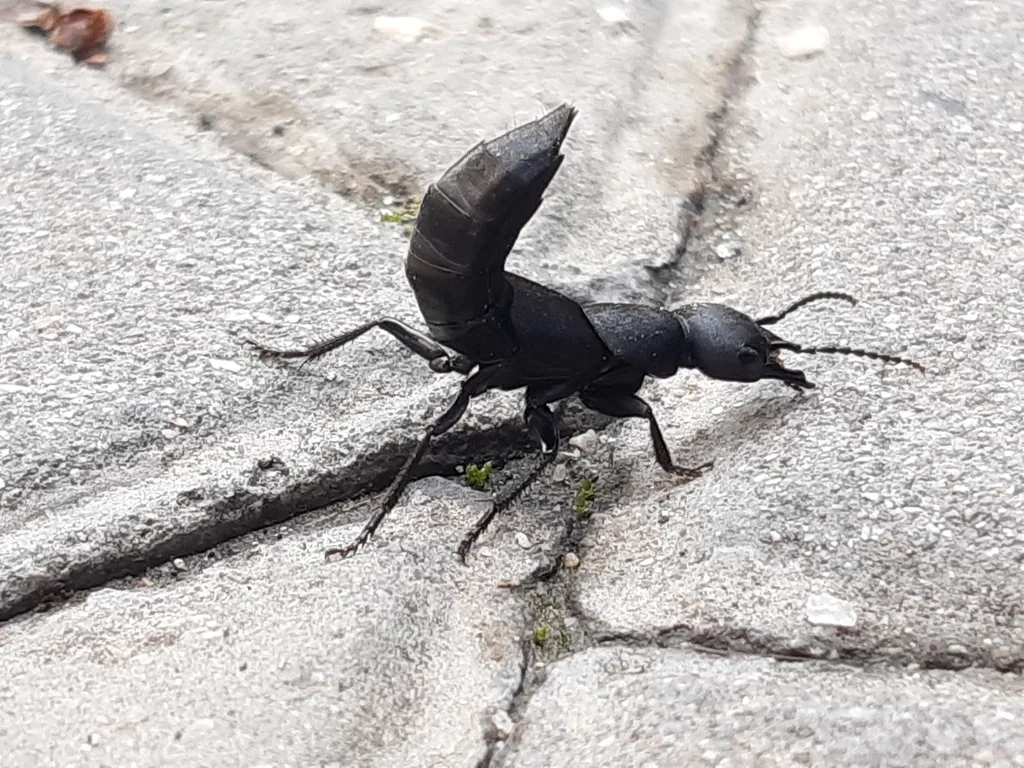
- A large, all-black rove beetle, reaching about 32 mm (1 1/4 inches); it is the largest rove beetle in the UK and one of the largest worldwide.[1][3]
- When agitated it raises its abdomen and opens its mandibles in a threat posture, which an Oregon extension expert likens to a scorpion raising its tail.[1][2]
- Fun fact: to tell the sexes apart, flip one over; males have a V-shaped notch in the plate under the last abdominal segment, and females have none.[5]
- It belongs to the rove beetles (Staphylinidae), which UF/IFAS calls the largest beetle family, with over 63,000 species known worldwide. Most rove beetles are under 7 mm long, so a 1-inch-plus all-black one stands out.[6][1]
- Like most rove beetles it has short wing covers that leave several abdominal segments exposed. UF/IFAS explains that the short covers and strong abdominal muscles make rove beetles very flexible, able to squeeze into narrow crevices, but also prone to drying out, so they depend on humid places.[6]
Look-alikes
Where it lives
Widespread and generally common across the Palaearctic, including North Africa, and introduced to North America and Australasia. In North America it was first recorded in southern California in 1931 and now lives in several western states including Oregon. It uses many habitats, especially damp woodland, grassland, brownfield sites and gardens; in California it favors cultivated and landscaped ground.[1][3][2]
Biology and life cycle
It is largely nocturnal and spends the day under leaf litter, logs and stones. Larvae and adults are both generalist predators of a wide range of invertebrates, and they also eat carrion.[1]
Adults can be found all year and spend the winter as adults. Mating takes place in late summer or autumn, eggs are laid two to three weeks later, and adults can live up to two years.[1]
It is a known snail predator. Laboratory trials with brown garden snails from Sardinian snail farms found it was one of only two of the beetles tested that could damage the snail's shell.[4]
Larvae eat snails too: in a California lab study, five large larvae each ate from 2 to 8 small brown garden snails, and the pupae were about 18 mm long.[3]
In a Polish carrion study it showed up as a late summer to early fall species on carcasses.[7]
It has been associated with evil and the devil in folklore since the Middle Ages.[1]
Biological control workers have imported various rove beetles into Italy, Hawaii, the mainland United States and Easter Island, and Ocypus is among the genera that have been moved, but UF/IFAS says those introductions brought no evident success.[6]
Predatory rove beetles in its subfamily digest food partly outside the body: they hold prey in the mandibles, release digestive fluids and drink the partly digested meal, UF/IFAS explains.[6]
Damage and signs
- Its diet is invertebrates and carrion. The one economic problem reported is on snail farms: in seven Sardinian farms surveyed in 2020 to 2022, it made up 32% of the predatory insects found.[1][8]
- University of California researchers saw it as a possible helper against the brown garden snail, a major garden pest there; one author's Riverside garden had an established beetle population and very few snails.[3]
Health risk
It can give a painful bite to people, and it readily releases defensive secretions from its mouth and the tip of its abdomen.[1]
Control
Prevention
No control is needed in a garden: it is a generalist predator of snails and other invertebrates.[1][3]
Traps and physical control
If one turns up indoors (an Oregon homeowner sent extension a photo of a likely one on a house wall), don't pick it up bare-handed, because it can bite painfully and release defensive secretions.[1][2]
Where sources disagree
North American range: a 1975 California paper says it was known in North America only from California, while a 2024 Oregon extension answer reports it in several western states including Oregon.[3][2]
Snails in the diet: UF/IFAS says rove beetles in general feed on slugs and snails only occasionally and are not specialized for it, while California and Sardinian studies record the devil's coach horse attacking snails, larvae included.[6][3][4]
Common questions
- Can the devil's coach horse beetle bite?
- Yes. It can give a painful bite to people, and it also releases defensive secretions from its mouth and abdomen tip.[1]
- Why does it raise its tail?
- Raising the abdomen and opening the mandibles is its threat posture when it is agitated.[1]
- Is it good to have in a garden?
- Usually yes. It hunts snails and many other invertebrates, and in California it was studied as a possible predator of the brown garden snail.[1][3][4]
- Where did the devil's coach horse come from?
- It is native to Europe. In North America it was first recorded in southern California in 1931 and has since been found in several western states, including Oregon.[3][2]
- Is it the same thing as an earwig?
- No. It is a rove beetle. UF/IFAS notes that non-entomologists sometimes confuse the two, but earwigs have pincers at the tail and rove beetles do not.[6]
Sources
- Wellcome Open Research (Wellcome Trust), read in PubMed Central (PMC9069170), “Crowley et al. (Darwin Tree of Life Consortium). The genome sequence of the devil's coach horse beetle, Ocypus olens (Muller, 1764). Wellcome Open Research (2021), doi:10.12688/wellcomeopenres.17342.2.” pmc.ncbi.nlm.nih.gov/articles/PMC9069170/ (accessed 2026-11-14)
- Ask Extension (expert response, Oregon), “What is this bug (Ask Extension #866493, Lane County, Oregon).” ask.extension.org/kb/faq.php?id=866493 (accessed 2026-11-14)
- Psyche 82:292-298 (1975), Cambridge Entomological Club, “Biological Notes on Ocypus olens, a Predator of Brown Garden Snail, with Descriptions of the Larva and Pupa (Coleoptera: Staphylinidae).” groups.csail.mit.edu/mac/projects/psyche/82/82-292.html (accessed 2026-11-14)
- Insects (MDPI), full text in PubMed Central (PMC11594771), “Murgia, Coroneo, Zuddas, Pani and Cogoni. Garden Snail Predatory Insects' Modus Operandi Under Laboratory Conditions. Insects 15: 865 (2024), doi:10.3390/insects15110865.” pubmed.ncbi.nlm.nih.gov/39590464/ (accessed 2026-11-14). Cited from the PubMed abstract (the publisher page refused automated access on recheck).
- Ask Extension (expert response, Oregon), “Devils Coach Horse Beetle (Ask Extension #773824, Clatsop County, Oregon).” ask.extension.org/kb/faq.php?id=773824 (accessed 2026-11-14)
- University of Florida/IFAS Extension (EDIS, Featured Creatures), “Rove Beetles of the World, Staphylinidae (Insecta: Coleoptera: Staphylinidae), EENY114/IN271 (J. H. Frank and K.-J. Ahn).” ask.ifas.ufl.edu/publication/IN271 (accessed 2026-11-14). Family-level account; its Paederus skin and eye lines are not used.
- Forensic Science International (2014), via PubMed, “Necrophilous Staphylininae (Coleoptera: Staphylinidae) as indicators of season of death and corpse relocation.” pubmed.ncbi.nlm.nih.gov/25016538/ (accessed 2026-11-14). Cited from the PubMed abstract.
- Insects (2022), via PubMed, “Entomological Investigation of the Main Entomatic Adversities for Terrestrial Gastropods Helix aspersa Muller: A Preliminary Study in Sardinian Heliciculture Farms.” pubmed.ncbi.nlm.nih.gov/35886834/ (accessed 2026-11-14). Cited from the PubMed abstract.
- iNaturalist, “Ocypus olens taxon page (order and family).” www.inaturalist.org/taxa/53869 (accessed 2026-11-14)