On this page
How to identify it
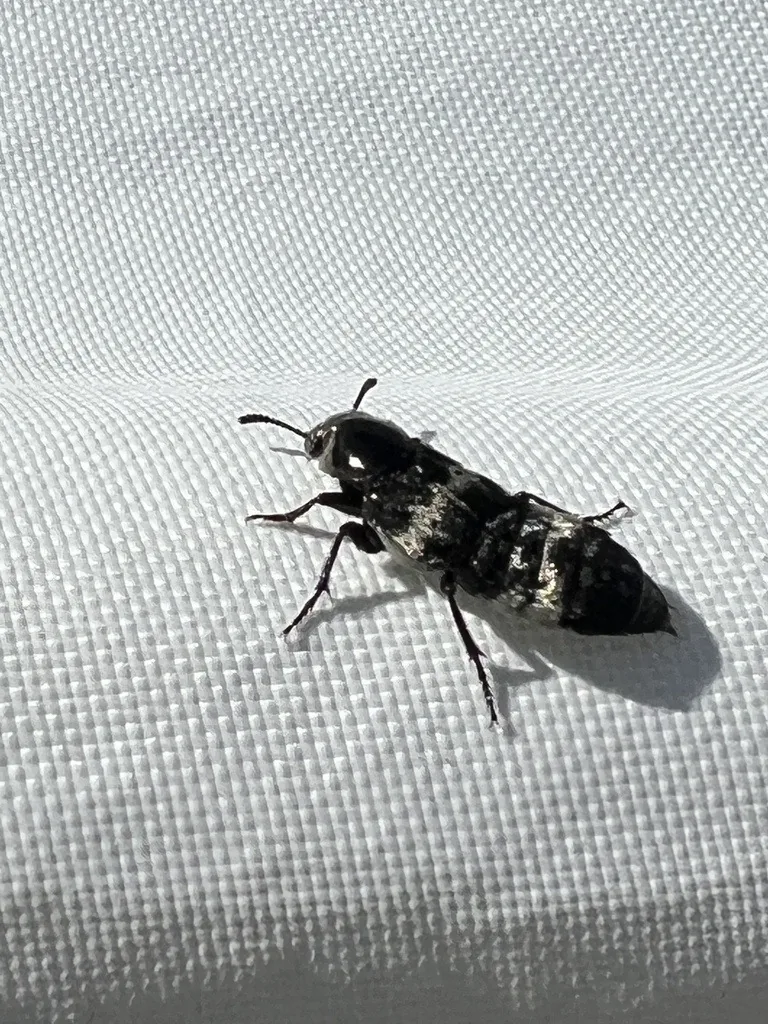
- Short, squarish wing covers leave much of the abdomen exposed, which is the easiest way to recognize a rove beetle.[1][2][3]
- Most common species are slender, shiny brown to black beetles from about 1/4 inch to 1 inch long, though many are 1/4 inch or less.[1][2]
- When disturbed or running, many raise the tip of the abdomen upward like a scorpion.[1][2][3]
- Many have large heads and prominent jaws that project forward, and some have two short projections at the tip of the abdomen.[1][3]
Look-alikes
Where it lives
Rove beetles occur throughout North America. Wisconsin Extension counts about 4,000 North American species, while New Mexico State's 2006 guide says over 1,500. The hairy rove beetle (Creophilus maxillosus), one of the most noticed, has GBIF records from every U.S. state and Washington, D.C., and from Canada, Europe and Asia.[2][3][9]
Biology and life cycle
Most live in moist places in soil or decaying matter: under rocks and debris, in compost, leaf litter, mushrooms, dung and carrion, and some live with ants or termites.[2][1]
Many are predators of fly eggs and maggots, mites, springtails and other small insects; some are scavengers or eat fungi, and the larvae of a few, such as Aleochara bilineata, are parasites of cabbage maggot pupae.[2][3]
Most species are active at night and adults are usually strong fliers; some are drawn to lights. A few, including Stenus and Paederus, are active by day.[2][1][3]
Some rove beetles prey on the flies that infest dead animals. The hairy rove beetle is one of them and is used in forensic entomology; in a lab study raised on blow fly larvae and puparia, its development took about 22 days at 30 C (86 F) and about 122 days at 15 C (59 F).[2][8]
Damage and signs
Health risk
Their strong jaws can give a sharp bite or jab, so pick them up with a tissue or container (WSU Extension). Beetles in the Paederus group carry a toxin, paederin, released when a beetle is crushed on the skin; it causes dermatitis linearis, a stinging, burning, itchy rash that develops 6 to 48 hours later and can blister. A review by CDC authors says the rash resolves on its own, with wet compresses, antihistamines and topical steroids recommended for symptoms. One review notes that Paederus themselves neither bite nor sting.[1][6][5][7]
Control
Prevention
Reviews of Paederus outbreaks recommend reducing or modifying artificial light near living and sleeping areas, screening or netting around beds and lights, and keeping vegetation and clutter down; because the toxin is released when a beetle is crushed on the skin, avoid swatting them.[5][7][6]
Keep them out
Close off or screen openings around doors, windows and foundations to keep them out.[1]
Sanitation
Repeat invasions often point to an ant or termite nest, animal droppings or a dead animal nearby; removing that source solves the beetle problem.[1][2]
Traps and physical control
Indoors, sweep or vacuum them up, or catch them and release them outside.[1]
Pesticides
WSU recommends no insecticides for home situations, and outdoors no control is needed because most rove beetles are beneficial.[1]
Common questions
- Why do I have rove beetles in my house?
- Individual beetles fly in toward lights. Repeated numbers indoors may mean a source nearby, such as carrion, animal droppings or an ant or termite nest.[1][2]
- Can rove beetles hurt you?
- Some can give a sharp bite with their jaws, and crushing a Paederus rove beetle on the skin can cause a blistering rash (dermatitis linearis). Brush them off or pick them up with a tissue rather than swatting them.[1][5][6]
- Are rove beetles beneficial?
- Yes. Most are predators or scavengers, and some help control filth flies and root maggots.[1][2]
Sources
- Washington State University Extension, “Rove beetles (Hortsense fact sheet).” pestsense.cahnrs.wsu.edu/fact-sheet/rove-beetles/ (accessed 2026-11-11)
- University of Wisconsin-Madison Division of Extension, Wisconsin Horticulture, “Rove Beetles, Staphylinidae (reviewed February 2025).” hort.extension.wisc.edu/articles/rove-beetles-staphylinidae/ (accessed 2026-11-11)
- New Mexico State University Cooperative Extension Service (hosted by Utah State University Extension), “Rove Beetles, O & T Guide T-07 (October 2006).” extension.usu.edu/planthealth/uppdl/files/factsheet/t-07-rovebeetles.pdf (accessed 2026-11-11)
- iNaturalist, “Creophilus maxillosus taxon page (order and family).” www.inaturalist.org/taxa/82463 (accessed 2026-11-11)
- Journal of Travel Medicine, via PubMed, “Beaulieu BA, Irish SR (2016), Literature review of the causes, treatment, and prevention of dermatitis linearis, Journal of Travel Medicine 23(4):taw032 (CDC Center for Global Health authors).” pubmed.ncbi.nlm.nih.gov/27178160/ (accessed 2026-11-11). Cited from the PubMed abstract.
- Journal of Medical Entomology, via PubMed, “Bong LJ, Neoh KB, Jaal Z, Lee CY (2015), Paederus outbreaks in human settings: a review of current knowledge, Journal of Medical Entomology 52(4):517-526.” pubmed.ncbi.nlm.nih.gov/26335457/ (accessed 2026-11-11). Cited from the PubMed abstract.
- Wilderness and Environmental Medicine, via PubMed, “Cressey BD et al. (2013), Dermatitis linearis: vesicating dermatosis caused by Paederus species (Coleoptera: Staphylinidae). Case series and review, Wilderness and Environmental Medicine 24(2):124-131.” pubmed.ncbi.nlm.nih.gov/23352312/ (accessed 2026-11-11). Cited from the PubMed abstract.
- International Journal of Legal Medicine, via PubMed, “Fratczak-Lagiewska K, Grzywacz A, Matuszewski S (2020), Development and validation of forensically useful growth models for Central European population of Creophilus maxillosus L. (Coleoptera: Staphylinidae), International Journal of Legal Medicine 134(4):1531-1545.” pubmed.ncbi.nlm.nih.gov/32266535/ (accessed 2026-11-11). Cited from the PubMed abstract.
- Global Biodiversity Information Facility (GBIF), “Creophilus maxillosus: occurrence records in the U.S., 1990-2026 (GBIF occurrence search).” api.gbif.org/v1/occurrence/search?taxonKey=1039254&country=US&hasGeospatialIssue=false&occurrenceStatus=PRESENT&year=1990%2C2026&facet=stateProvince&facetLimit=400&limit=0 (accessed 2026-11-11). State counts are records reported (iNaturalist research-grade, museum specimens, surveys), not abundance.