On this page
How to identify it
- Long, narrow, soft-looking beetles with a broad head and a pronotum (the section just behind the head) narrower than both the head and the rest of the body.[1][3][2]
- Size depends on the species, and sources give different spans: Kentucky Entomology says 3/4 to 1-1/4 inches, while the Missouri Department of Conservation gives less than 1/4 inch up to 2-1/2 inches, with most 1/2 to 3/4 inch.[1][2]
- Unlike most beetles, their front wings are soft and flexible. SDSU Extension adds that the wing covers do not fully cover the abdomen, which sticks out past them.[1][3]
- Many species are black, brown or another drab color, sometimes with iridescent blue or bronze or a yellow, orange or red head or markings; others are mostly yellow, orange or red with dark spots or stripes. SDSU describes them as velvety-looking.[2][3]
- Kentucky Entomology lists four species as relatively common through the eastern and central states: the ashgray (Epicauta fabricii), black (E. pennsylvanica), margined (E. pestifera) and striped (E. vittata) blister beetles. SDSU names the striped blister beetle as a common one in gardens.[1][3]
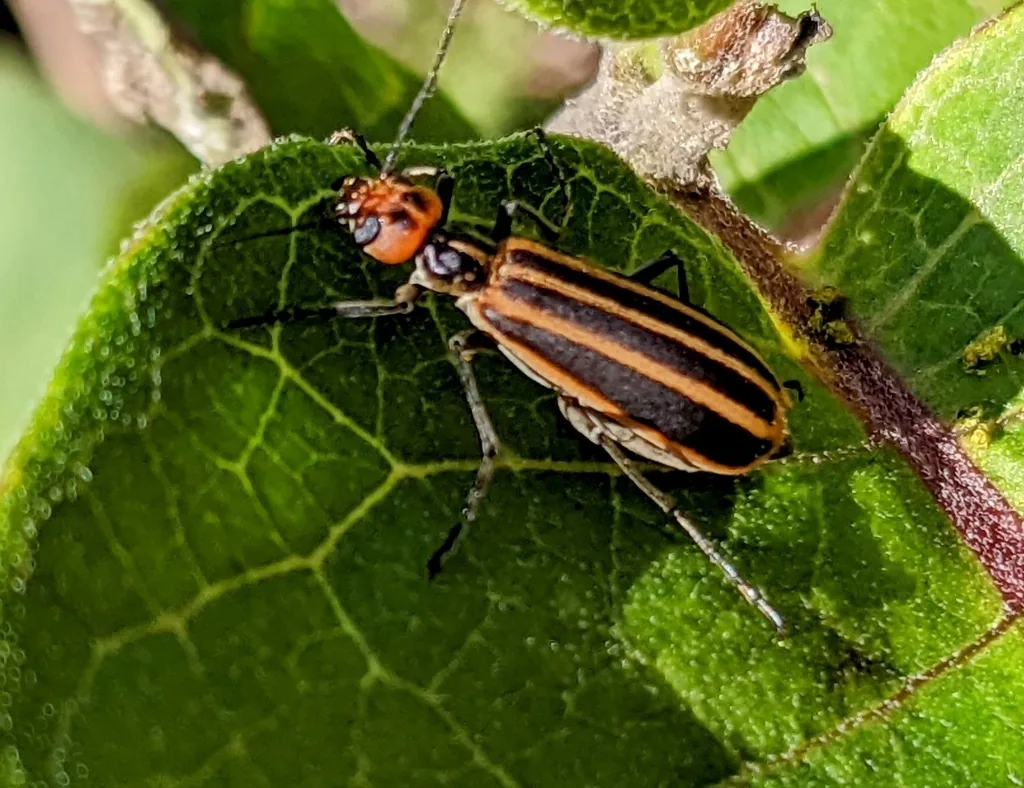
- UF/IFAS says striped blister beetle adults are 9 to 17 mm (1/3 to 2/3 inch) long and black and yellow, normally with two black spots on the head, two black stripes on the thorax and 2 to 3 black stripes on each wing cover: northern populations often have two, southern ones three. The body is finely pitted and densely covered with short hairs, and the wing covers spread apart at the tips.[4]
Look-alikes
| Look-alike | How to tell them apart |
|---|---|
| Three-striped blister beetles | Texas veterinary diagnosticians group Epicauta temexa and E. occidentalis as 3-striped blister beetles and confirmed both, along with other Epicauta species, as causes of cantharidin poisoning in horses; an Oklahoma study measured the cantharidin in E. occidentalis linked to horse cases. UF/IFAS says striped blister beetle adults are very similar to E. occidentalis and E. temexa, which have often been confused in the literature, and separating them takes a detailed key.[5][6][4] |
| Black blister beetle | Solid black (Epicauta pennsylvanica) and lower in cantharidin. Kentucky Entomology puts the other common species at about 0.5 mg per beetle, against about 5 mg in the striped blister beetle.[1] |
| Oil beetles | Blister beetles in the genus Meloe ooze a yellowish oil from their leg joints when squeezed or disturbed. The oil contains cantharidin and can blister skin, so handle them the same way.[2] |
Where it lives
Kentucky Entomology says blister beetles have historically been most abundant in arid parts of the United States where grasshoppers are plentiful most years, and that its four common species occur throughout the eastern and central states. A veterinary review describes blister beetles as found over most of North America. GBIF holds about 16,500 U.S. records of the genus Epicauta since 1990, the most from Texas, Arizona and Utah. UF/IFAS says the striped blister beetle is native and has been collected from all eastern states west to South Dakota, Nebraska, Kansas and Oklahoma, and in Quebec and Ontario. Beetles from the southeastern coastal plain (Florida, southern Georgia and eastern South Carolina), called the lemniscate race, look different but interbreed with the others. Problems are infrequent in Florida, perhaps because its favored grasshopper hosts don't occur there and alfalfa is rarely grown.[1][7][8][4]
Biology and life cycle
In Kentucky's account, females lay clusters of eggs in the soil in late summer, and the small, active larvae crawl over the soil and into cracks searching for grasshopper egg pods. Once they find one they stop moving, feed there as legless grubs, pupate the following summer and emerge as adults. UF/IFAS says striped blister beetle eggs are whitish, about 1.8 mm long, laid in a soil chamber 3 to 4 cm deep in clusters of 100 to 200, and hatch in 10 to 16 days; females start laying about 20 days after emerging, with about 10 days between egg masses.[1][4]
Sources weigh the larval diet differently. The Missouri Department of Conservation says most blister beetle larvae parasitize ground-nesting solitary bees: the egg is laid on a flower, and the active larva grabs a visiting bee, rides to its nest and eats the stored food and young. Only some groups eat grasshopper eggs, which is the life Kentucky Entomology describes for the common Epicauta species.[2][1]
Because the larvae eat grasshopper eggs, blister beetle numbers jump after summers with high grasshopper populations. UF/IFAS says the striped blister beetle is closely tied to grasshoppers that lay large egg pods, especially the twostriped and differential grasshoppers, and one study in western states found 8.8 percent of grasshopper egg pods damaged by blister beetles.[1][3][4]
Adults eat leaves at the tops of plants but are especially drawn to flowers for nectar and pollen, and they gather in groups. Kentucky describes them as mid- to late-summer insects, active in mid-July and early August.[1][2]
In the striped blister beetle, UF/IFAS says, the first five larval stages feed on grasshopper eggs and the larva overwinters in the fifth or sixth stage; a sixth stage can last about 230 days. Pupae form in the soil and last 9 to 13 days.[4]
UF/IFAS says there are one or two generations a year, with adults in the field from late May to late October in Arkansas but mostly April to June in Florida. Adults are most active in the morning and late afternoon and shelter at midday; when disturbed they drop from the plant and hide or scurry away.[4]
Damage and signs
- Swarms can strip plants quickly. SDSU has reports of blister beetles feeding on peppers, radishes and green beans, plus weeds in the garden; the Missouri Department of Conservation lists potatoes, tomatoes and clover among crops and says plants in the sunflower, bean and potato families are favored.[3][2]
- Adults visit flowers for nectar and pollen and sometimes eat whole flowers. Several species prefer sunflower-family flowers, and at least one feeds on the flowers of apple, plum and other rose-family trees.[2]
- UF/IFAS calls the striped blister beetle one of the most damaging blister beetles to vegetables: it favors foliage more than some species, feeds on the fruit of tomato-family plants, has a large appetite, forms big mating and feeding swarms and disperses widely, so swarms can appear suddenly. It has also been implicated in spreading bean pod mottle virus to soybean.[4]
- UF/IFAS lists bean, beet, carrot, cabbage, corn, eggplant, melon, pea, pepper, potato, radish, spinach, squash, sweet potato, tomato and turnip among the vegetables it sometimes injures, plus clover and soybean; adults strongly prefer pigweed.[4]
Health risk
Cantharidin circulates in the beetle's blood and oozes out when the beetle is pressed, so crushing or even brushing one against skin can raise blisters. Medical reports describe the result as burn-like lesions that are usually clinically benign and are treated like an ordinary burn; cantharidin is also poisonous if swallowed.[3][1][9]
Control
Prevention
Managing grasshoppers helps prevent future blister beetle outbreaks, since the larvae feed on grasshopper eggs.[3]
Traps and physical control
Small numbers can be handpicked. Wear gloves, ideally disposable ones, and keep the gloves from touching bare skin.[3]
Biological control
UF/IFAS says little is known about the striped blister beetle's natural enemies, but robber flies and birds such as meadowlarks, bluebirds and scissor-tailed flycatchers eat adults, and the blister beetle Epicauta atrata eats its eggs.[4]
Pesticides
For severe infestations, SDSU says a garden insecticide dust or spray reduces defoliation. Because blister beetles gather in groups, large numbers are often concentrated in one patch. UF/IFAS likewise says aggregation can cause serious defoliation in small parts of a field and little damage elsewhere, so examine plants carefully and spot-treat infested areas.[3][1][4]
Blister beetles and horse hay
Living or dead blister beetles can be toxic, sometimes lethal, to horses, sheep and cattle. Animals are poisoned by eating crushed beetles in cured hay, and veterinary sources point to alfalfa in particular.[1][2][10][7]
Cantharidin is very stable and stays toxic in dead beetles for a long time, and there is no efficient way to inspect baled hay for them. Kentucky Entomology estimates the lethal dose at 0.5 to 1.0 mg of cantharidin per kilogram of body weight.[1]
Signs usually appear within hours: colic, loss of appetite, depression, and straining with frequent attempts to urinate. Veterinary reviews add low blood calcium and magnesium and damage to the gut, urinary tract and heart muscle. Animals can die within 72 hours, so call a veterinarian as soon as poisoning is suspected; a 2024 review rates the outlook guarded to poor.[1][10][7]
A Texas diagnostic laboratory confirmed 53 episodes of cantharidin poisoning in horses over 26 months, with the most cases in late summer and early fall.[5]
Kentucky Extension advises horse owners to buy first-cutting hay, cut before blister beetles are active there, and to buy from local producers whose practices they know.[1]
Hay producers can cut at late bud or first flower, control flowering weeds, check field edges for beetle clusters from July through early September, leave infested areas uncut, and avoid crimping, which crushes beetles into the hay.[1][10]
Where the sources disagree
Season and generations: Kentucky Entomology describes adults as mid- to late-summer insects, active in mid-July and early August, with larvae pupating the following summer; UF/IFAS says the striped blister beetle has one or two generations a year, with adults from late May to late October in Arkansas and mostly April to June in Florida.[1][4]
Common questions
- Are blister beetles ever helpful?
- Partly. The larvae of some species eat grasshopper eggs and help hold down grasshopper outbreaks, but the Missouri Department of Conservation notes that the larvae of others raid the nests of solitary bees, limiting pollinators. UF/IFAS adds that higher blister beetle numbers after grasshopper years often bring more crop injury, and that larvae of blister beetles outside Epicauta feed mainly on ground-nesting bees and their provisions and have no known farm benefit.[2][1][4]
- What should I do if a blister beetle lands on me?
- Don't crush or slap it, since pressure releases the blistering chemical. If you need to pick beetles off plants, wear gloves.[1][3]
- Why does striped blister beetle matter most for hay?
- It carries more cantharidin than common relatives and tends to cluster along field edges, so harmful numbers can end up in a bale.[1]
Sources
- University of Kentucky Entomology, “ENTFACT-102: Blister Beetles (revised March 2026).” entomology.mgcafe.uky.edu/ef102 (accessed 2026-11-11)
- Missouri Department of Conservation, “Blister Beetles (Meloids) field guide.” mdc.mo.gov/discover-nature/field-guide/blister-beetles-meloids (accessed 2026-11-11)
- South Dakota State University Extension, “Blister Beetles Causing Problems in Gardens.” extension.sdstate.edu/blister-beetles-causing-problems-gardens (accessed 2026-11-11)
- University of Florida IFAS Extension (EDIS), “Striped Blister Beetle, Epicauta vittata (Fabricius), EENY280/IN556 (Featured Creatures; J. L. Capinera).” ask.ifas.ufl.edu/publication/IN556 (accessed 2026-11-14)
- American Journal of Veterinary Research, via PubMed, “Etiologic agents, incidence, and improved diagnostic methods of cantharidin toxicosis in horses (Ray et al. 1989).” pubmed.ncbi.nlm.nih.gov/2719380/ (accessed 2026-11-11)
- Veterinary and Human Toxicology, via PubMed, “Cantharidin content of two species of Oklahoma blister beetles associated with toxicosis in horses (Edwards et al. 1989).” pubmed.ncbi.nlm.nih.gov/2603362/ (accessed 2026-11-11)
- Veterinary Clinics of North America: Equine Practice, via PubMed, “Cantharidin (Bischoff 2024).” pubmed.ncbi.nlm.nih.gov/37716858/ (accessed 2026-11-11)
- Global Biodiversity Information Facility (GBIF), “Epicauta: U.S. occurrence records since 1990 by state (GBIF occurrence search).” api.gbif.org/v1/occurrence/search?taxonKey=1046361&country=US&hasGeospatialIssue=false&occurrenceStatus=PRESENT&year=1990%2C2026&facet=stateProvince&facetLimit=400&limit=0 (accessed 2026-11-11). Exact count at access: 16,580 U.S. records since 1990 (Texas 4,401; Arizona 1,603; Utah 1,085).
- Military Medicine, via PubMed, “Blister beetle dermatitis outbreaks in Mali (Velut et al. 2023).” pubmed.ncbi.nlm.nih.gov/35446414/ (accessed 2026-11-11)
- Journal of Veterinary Internal Medicine, via PubMed, “Cantharidin toxicosis in horses (Schmitz 1989).” pubmed.ncbi.nlm.nih.gov/2685272/ (accessed 2026-11-11)
- iNaturalist, “Epicauta vittata taxon page (order and family).” www.inaturalist.org/taxa/1121206 (accessed 2026-10-06)