On this page
How to identify it
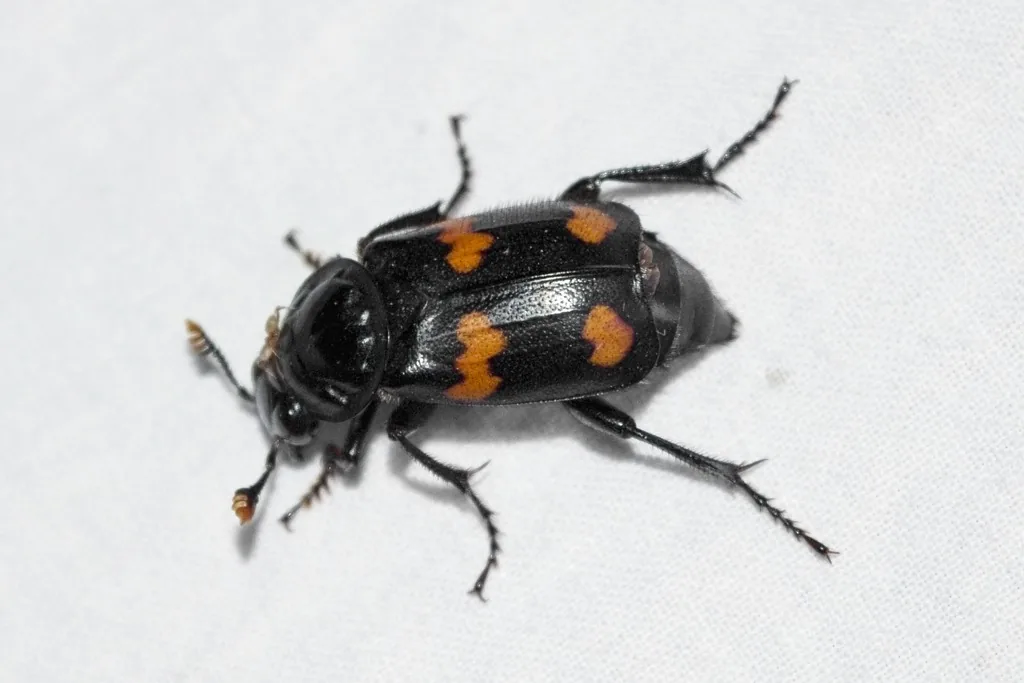
- Carrion beetles are flattened and usually black, often with red, orange or yellow markings. They range from about 1/2 to 1 1/2 inches long, depending on the species.[2]
- The wing covers are wider toward the rear than at the front, and in many species they are too short to cover the last one to three segments of the abdomen.[2]
- The antennae end in a distinct club, often with fine hairs or a different color at the very tip.[2]
- Many carrion beetles mimic bees or wasps, with black plus yellow, orange or red colors and a heavy, loud-buzzing flight.[2]
Look-alikes
| Look-alike | How to tell them apart |
|---|---|
| American carrion beetle (Necrophila americana) | This carrion beetle has a yellow pronotum with a big black spot. It and its subfamily, the Silphinae, feed on large carcasses and on the larvae of competing scavengers rather than burying small carcasses.[2][3][1] |
Where it lives
About 30 species of carrion beetles live in North America north of Mexico. A 2016 study at one site in southeastern Ontario caught six burying beetle species, and a survey of Texas confirmed the roundneck sexton beetle (N. orbicollis), N. tomentosus, N. pustulatus, N. carolinus, N. marginatus, N. mexicanus and the American burying beetle. MDC lists carrion beetles statewide in Missouri.[2][1][4]
Biology and life cycle
Burying beetles breed on small vertebrate carcasses. They dig the soil out from under a dead animal so that it sinks beneath the dirt piling up around it, or they cover it, which helps them avoid competition with flies and other scavengers.[1][2]
When more than one pair reaches a carcass, even pairs of different species, they usually fight until only one pair remains. The winners remove the fur or feathers, prepare the meat, and stay to rear and feed their larvae on it.[1][2]
Carrion beetles often carry mites that attack fly maggots, one more way they help their young compete for the carcass.[2]
Species are active at different times of year. In Texas, the roundneck sexton beetle and N. carolinus peak in late spring or early summer, N. tomentosus peaks in spring and again in late summer or fall, and N. pustulatus, N. marginatus, N. mexicanus and the American burying beetle peak in late summer or early fall.[4]
In the Ontario study the roundneck sexton beetle was the most numerous burying beetle, with 1,609 caught on the ground and 203 in traps 6 meters up in the canopy.[1]
Burying beetles usually breed on the ground, but N. pustulatus was the one species caught more often in the canopy (253) than on the ground (60). It regularly comes to lights, adults have been found feeding on gray ratsnake eggs and larvae on northern ringneck snake eggs, and in captivity it uses vertebrate carrion like other burying beetles.[1]
Damage and signs
- MDC notes that most carrion beetles perform a vastly important service by recycling dead animals, and that by competing with fly maggots, burying beetles help control the flies that annoy people.[2]
Health risk
Burying beetles feed on and bury the carcasses of small animals. MDC, the U.S. Fish and Wildlife Service and the published studies cited here describe them as scavengers and don't mention any risk to people or pets. MDC notes that carrion beetles often secrete or spray foul-smelling substances, or simply smell bad.[2][5][1]
Control
Prevention
Leave them alone. MDC says most carrion beetles perform a vastly important service by recycling dead animals. One species, the American burying beetle, is federally listed as threatened, according to the U.S. Fish and Wildlife Service.[2][5]
Regulatory status of the American burying beetle
The U.S. Fish and Wildlife Service listed the American burying beetle as endangered on July 13, 1989. It proposed reclassifying the species as threatened in May 2019, and its final rule reclassifying it from endangered to threatened, with a section 4(d) rule, was published on October 15, 2020.[5]
USFWS says a nonessential experimental population was established in southwest Missouri in 2012, and that reintroduction efforts are under way in Ohio.[5]
USFWS says the beetle now occurs in parts of Arkansas, Kansas, Oklahoma, Nebraska, South Dakota and Texas, on Block Island off Rhode Island, and in reintroduced populations on Nantucket Island and in southwest Missouri, though it has not been documented in Texas since 2008. MDC lists it as state endangered in Missouri.[5][2]
Where the sources disagree
Federal status: MDC's photo captions call the American burying beetle endangered statewide and nationally and critically endangered, while its main text calls it federally threatened. USFWS reclassified it from endangered to threatened in 2020.[2][5]
Size: MDC gives carrion beetles a length of about 1/2 to 1 1/2 inches, depending on the species; USFWS says the American burying beetle, the largest carrion beetle in North America, reaches 1.0 to 1.8 inches.[2][5]
Common questions
- Why do burying beetles bury dead animals?
- Burying is a way to keep the carcass for their young: once it is underground, flies are less likely to find it and lay their own eggs on it. The beetle pair then prepares the meat and feeds its larvae.[2][1]
- What is a sexton beetle?
- Sexton beetle is another name for burying beetles and other carrion beetles. The roundneck sexton beetle, N. orbicollis, was the most numerous burying beetle in the Ontario study.[2][1]
- Are burying beetles endangered?
- One species is federally listed. The U.S. Fish and Wildlife Service lists the American burying beetle, Nicrophorus americanus, as threatened: it was listed as endangered in 1989 and reclassified to threatened, with a section 4(d) rule, in October 2020. MDC lists it as state endangered in Missouri and describes a multi-state captive-breeding and reintroduction effort.[5][2]
Sources
- PeerJ, full text in PubMed Central (PMC6240436), “Wettlaufer, Burke, Schizkoske, Beresford and Martin. Ecological divergence of burying beetles into the forest canopy. PeerJ 6: e5829 (2018), doi:10.7717/peerj.5829.” doi.org/10.7717/peerj.5829 (accessed 2026-11-13)
- Missouri Department of Conservation, “Carrion Beetles (Burying Beetles) (Field Guide).” mdc.mo.gov/discover-nature/field-guide/carrion-beetles-burying-beetles (accessed 2026-11-13)
- Molecular Ecology (Wiley), indexed in PubMed (PMID 24102980), “Kaltenpoth and Steiger. Unearthing carrion beetles' microbiome: characterization of bacterial and fungal hindgut communities across the Silphidae. Molecular Ecology 23: 1251-1267 (2014), doi:10.1111/mec.12469 (abstract).” doi.org/10.1111/mec.12469 (accessed 2026-11-13)
- Zootaxa (Magnolia Press), indexed in PubMed (PMID 26217847), “Mullins, Riley and Oswald. Identification, distribution, and adult phenology of the carrion beetles (Coleoptera: Silphidae) of Texas. Zootaxa 3666: 221-251 (2013), doi:10.11646/zootaxa.3666.2.7 (abstract).” doi.org/10.11646/zootaxa.3666.2.7 (accessed 2026-11-13)
- U.S. Fish and Wildlife Service, “American burying beetle (Nicrophorus americanus): species profile and regulatory timeline.” www.fws.gov/species/american-burying-beetle-nicrophorus-americanus (accessed 2026-11-13)
- Global Biodiversity Information Facility (GBIF), “Nicrophorus Fabricius, 1775 (genus) (GBIF Backbone Taxonomy).” api.gbif.org/v1/species/1038957 (accessed 2026-11-13)
- iNaturalist, “Nicrophorus taxon page (order and family).” www.inaturalist.org/taxa/53850 (accessed 2026-11-09)