On this page
How to identify it
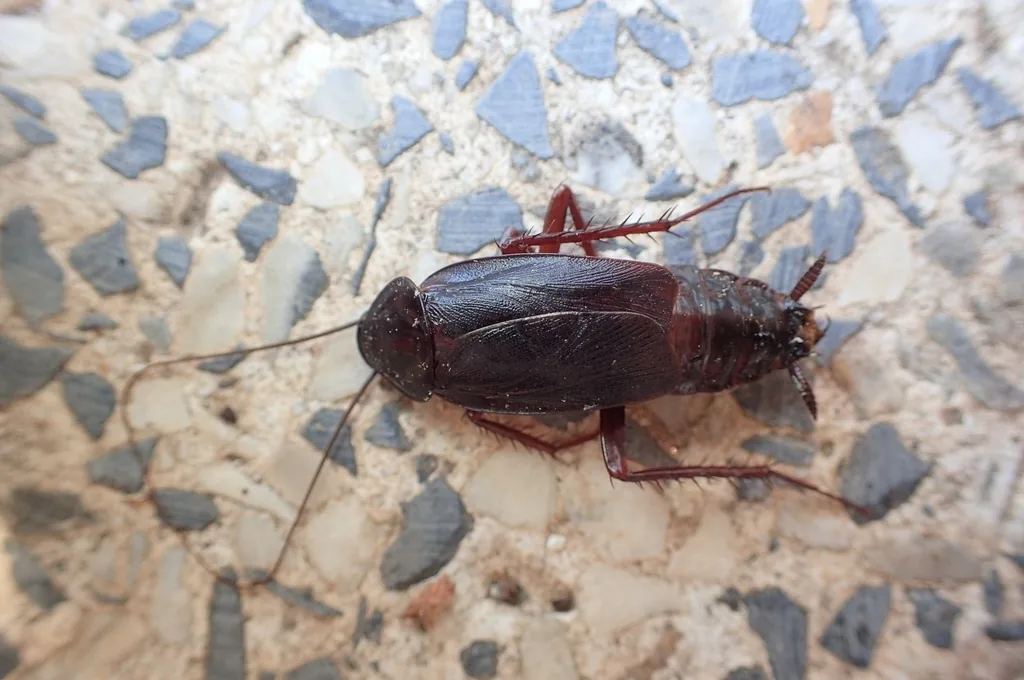
- Adults are dark brown to nearly black, often with a greasy sheen. UC IPM gives 1.25 inches and Penn State about 1 inch; Texas A&M says females reach nearly 1 1/4 inches and males about 1 inch.[1][2][4][3]
- Females have only small, nonfunctional wing pads and broader, heavier bodies. Males have wings that stop short of the tip of the abdomen; Penn State says they cover about three-quarters of it. Neither sex can fly.[1][2][4][3]
- Nymphs look like small, wingless females.[3]
- The egg case is about 3/8 inch long; UC IPM's text calls it dark red-brown and its identification table calls it dark brown to blackish.[1]
- UF/IFAS gives the male wings covering about 3/4 of the body; the male can also be recognized by the styli between its pair of jointed cerci.[5]
Look-alikes
| Look-alike | How to tell them apart |
|---|---|
| Turkestan cockroach (female) | Females look similar, but the Turkestan female has cream-colored markings along the edges behind the head and around the short, rounded wings; Turkestan nymphs have a reddish head, thorax and legs.[1] |
| American cockroach | Larger (about 2 inches), reddish brown, with fully developed wings and a light-edged plate behind the head.[1] |
Where it lives
Lives in cool, dark, damp places such as garages, basements, water meter boxes and drains, most often around single-family homes surrounded by woodpiles, ivy and ground cover, and outdoors where people feed pets, livestock or wildlife.[1]
Biology and life cycle
It tolerates cooler conditions than the other pest cockroaches. Minnesota Extension says it prefers temperatures under 84°F and has been found outdoors in freezing weather, and UC IPM notes that populations often build to large numbers in masonry enclosures such as water meter boxes.[1][3]
The female carries each egg case for about 30 hours, then drops it on a protected surface near food without gluing it down. Penn State gives an average of eight cases per female with 16 eggs each, hatching in about 60 days at room temperature, and about 200 offspring per female; UC IPM says a female and her offspring can produce nearly 200 cockroaches in a year.[2][1]
Development is slow: nymphs molt seven to ten times over 24 to 130 weeks, according to Penn State, and UC IPM says reaching adulthood can take 1 to 2 years or more.[2][1]
Unlike the other house-infesting cockroaches it has a seasonal life cycle. Penn State says adults peak in late spring or early summer and are few by late summer and early fall.[2][4]
With water available it can live about a month without food, but without water it dies within two weeks.[2]
It comes indoors through cracks in the foundation, along sewer and plumbing lines, up through floors from crawl spaces and under doors. Minnesota Extension adds that changes in season, heavy rain or lawn mowing can push it inside.[4][2][3]
In parts of California, especially warm, dry areas, the oriental cockroach is being displaced by the Turkestan cockroach.[1]
UF/IFAS says a female produces an average of eight egg capsules, each holding about 16 eggs lined up two by two. She carries a capsule from 12 hours to five days, the eggs incubate about 42 to 81 days, nymphs molt seven times over about one year, and adults live from 34 to 180 days.[5]
Outdoors it lives in warm, damp, shady places near the ground; indoors it favors basements, crawl spaces, sewer pipes, floor drains and under sinks, travels through buildings on plumbing pipes, and outside sometimes gathers near or under garbage cans. It prefers a diet high in starch.[5]
Damage and signs
- Oriental cockroaches move slowly, cannot fly and cannot climb smooth vertical surfaces, so they are often found trapped in porcelain sinks or tubs after falling in or coming up through damaged drain pipes. Indoors they usually stay on the ground floor or below.[1][4][2][3]
- They feed on garbage, rubbish and decaying organic matter. Their body secretions can taint food and, when numbers are high, leave a strong odor in the infested area.[2][3]
Health risk
Cockroach allergens are linked to asthma: research on inner-city children ties asthma severity to cockroach allergen sensitization and exposure, and lowering household cockroach allergen has been associated with fewer asthma problems. Cockroaches also carry germs on their bodies; a 2020 review found that about a quarter of the microbes isolated from cockroaches are food-borne pathogens, though it calls their actual role in human infection poorly understood and debated.[6][7][8]
Control
Prevention
Remove ivy and dense ground cover near the house, move firewood and lumber away from the building, and consider a 6- to 12-inch strip of gravel around the foundation to make it drier and less hospitable.[1]
Keep them out
Seal cracks and other openings to the outside, especially along plumbing and around foundations and crawl spaces, install door sweeps and weather stripping, and repair damaged drain pipes.[1][2][4]
UF/IFAS tips: fix plumbing leaks and ventilate moist spaces, caulk cracks at ground level, remove decaying leaves near windows and doors, keep garbage cans out of moist spots, and keep drain traps full or capped.[5]
Sanitation
Indoors, the first step is removing the food, moisture and hiding places they use, such as damp spots under sinks and washing machines and around leaky pipes.[2][3]
To find them, UF/IFAS suggests checking crawl spaces, basements and kitchen and bathroom plumbing for dead roaches, egg cases and fecal smears, and looking in spider webs there for cockroach remains.[5]
Traps and physical control
Sticky traps on the floor against walls and in corners show where cockroaches are coming in and whether control is working; Penn State says a week of trapping usually gives enough information.[1][2]
Pesticides
Outdoors, place baits and bait stations around the building perimeter, in valve and water meter boxes, woodpiles and around planters. Baits put where cockroaches hide can give a high level of control.[1][2]
Insecticidal dusts such as boric acid, silica aerogel or diatomaceous earth can go lightly into voids, cracks and crevices, but not on damp surfaces or where children and pets can reach them.[2]
Indoor sprays and foggers give only temporary knockdown and can scatter cockroaches, and many cockroaches resist common spray insecticides. Penn State says a continuous perimeter spray outside may help cut down on cockroaches coming in.[1][2]
UF/IFAS notes that egg cases tucked into cracks are hard to reach with insecticides and that treatments break down quickly because these cockroaches rest on damp surfaces; juvenile hormone analogues, which disrupt growth and reproduction, are of interest for that reason.[5]
Origin
Texas A&M says the oriental cockroach is native to the Middle East and is now found throughout much of the United States.[4]
UF/IFAS says its origin is uncertain but is thought to be Africa or south Russia, and calls it a major household pest in parts of the northwest, midwest and southern United States.[5]
Where sources disagree
Size: UC IPM gives adults as 1.25 inches long, Penn State about 1 inch, and Minnesota 1 to 1 1/4 inches; Texas A&M separates the sexes, with females nearly 1 1/4 inches and males about 1 inch.[1][2][3][4]
Egg case color: within the same UC IPM publication, the text says dark red-brown and the identification table says dark brown to blackish.[1]
Origin: Texas A&M says the Middle East, while UF/IFAS says the origin is uncertain but thought to be Africa or south Russia.[4][5]
Egg case carrying: about 30 hours (Penn State) or 12 hours to five days (UF/IFAS).[2][5]
Nymph development: seven to ten molts over 24 to 130 weeks (Penn State), or seven molts over about one year (UF/IFAS).[2][5]
Common questions
- Is a water bug the same as an oriental cockroach?
- Yes. "Water bug" is a common name for the oriental cockroach, given for its liking for damp places; it is also called a black beetle.[1][2][3]
- Can oriental cockroaches fly or climb?
- No. They do not fly and cannot climb smooth vertical surfaces, which is why they get stuck in sinks and tubs.[1][4]
- Why do I only see them on the ground floor?
- They usually stay at or below ground level and come in at night from cool, damp outdoor sites such as meter boxes, drains, crawl spaces and dense ground cover.[1][2][3]
- Why do I see more oriental cockroaches at certain times of year?
- They have a seasonal cycle, with adults most numerous in late spring and early summer, and weather changes, heavy rain or mowing can drive them indoors.[2][3]
Sources
- University of California Statewide IPM Program, “Pest Notes: Cockroaches, Publication 7467 (revised December 2019).” ipm.ucanr.edu/legacy_assets/PDF/PESTNOTES/pncockroaches.pdf (accessed 2026-11-14)
- Penn State Extension, “Oriental Cockroaches (S. Jacobs; revised January 2013, page updated June 24, 2026).” extension.psu.edu/oriental-cockroaches (accessed 2026-11-14)
- University of Minnesota Extension, “Cockroaches.” extension.umn.edu/insects-infest-homes/cockroaches (accessed 2026-11-14)
- Texas A&M Urban and Structural Entomology Program, “Oriental Cockroach.” urbanentomology.tamu.edu/urban-pests/cockroaches/oriental/ (accessed 2026-11-14)
- University of Florida/IFAS Extension (Featured Creatures), “Oriental Cockroach, Blatta orientalis Linnaeus, EENY-159/IN316 (K. McCanless).” ask.ifas.ufl.edu/publication/IN316 (accessed 2026-11-14)
- Clinical Reviews in Allergy & Immunology, via PubMed, “Poowuttikul, Saini and Seth (2019), Inner-city asthma in children.” pubmed.ncbi.nlm.nih.gov/30666508/ (accessed 2026-11-14)
- Current Opinion in Pulmonary Medicine, via PubMed, “Byrd and Joad (2006), Urban asthma.” pubmed.ncbi.nlm.nih.gov/16357582/ (accessed 2026-11-14)
- Environmental Health Insights, via PubMed, “Donkor (2020), Cockroaches and food-borne pathogens.” pubmed.ncbi.nlm.nih.gov/32425541/ (accessed 2026-11-14)
- iNaturalist, “Blatta orientalis taxon page (order and family).” www.inaturalist.org/taxa/154213 (accessed 2026-11-14)