On this page
How to identify it
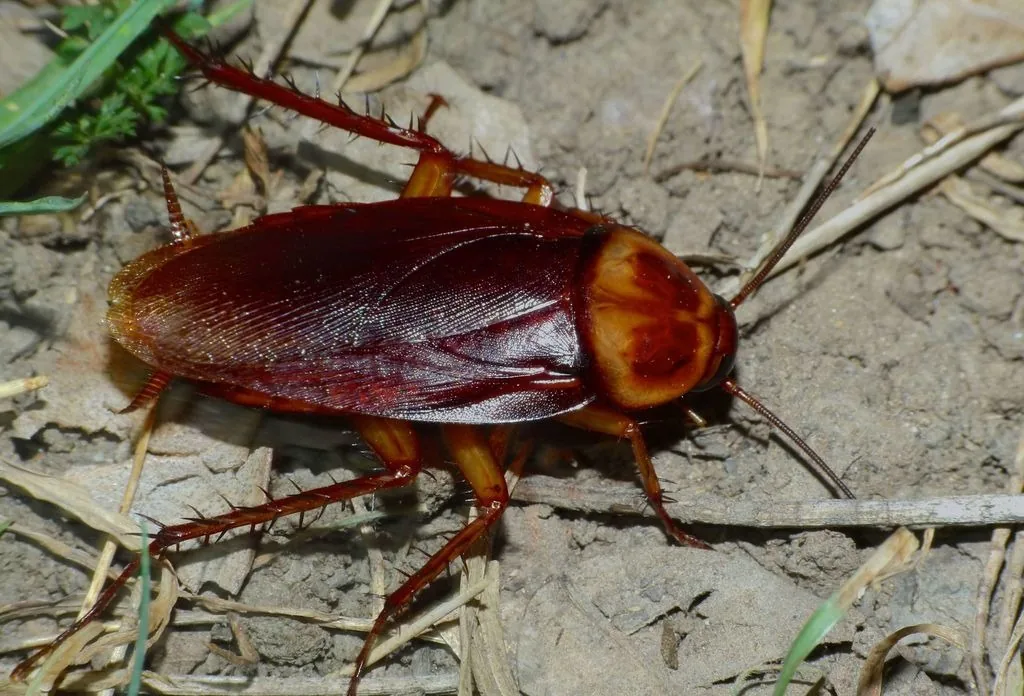
- Adults are about 2 inches long and reddish brown, with a large body.[1]
- Sources differ a little on size: about 1 1/2 inches long (Kentucky, Penn State), 1 1/2 to 2 inches (Minnesota), or about 2 inches (UC), and Mississippi State says some specimens reach 2 inches. UF/IFAS gives an average of 4 cm (1.5 inches).[5][3][4][1][6][8]
- The edges of the shield-shaped plate behind the head (the pronotum) are light colored. Kentucky describes it as a pale yellow band around the edge, and Penn State as faded yellow edges.[1][5][3]
- The egg case is about 3/8 inch long; it is brown when laid and turns black within 1 to 2 days. Penn State describes the capsule as dark brown, symmetrical and about 5/16 inch long. UF/IFAS gives about 8 mm (1/3 inch) long and 5 mm (3/16 inch) high.[1][3][8]
- Both sexes have wings that cover the abdomen; the male's wings reach slightly past the tip. Penn State says they can fly but rarely do in northern states, and Kentucky says they seldom fly. UF/IFAS says males are longer than females because their wings extend 4 to 8 mm beyond the tip of the abdomen. Males have tail feelers (cerci) with 18 to 19 segments and a pair of styli between them; females' cerci have 13 to 14 segments and no styli.[3][5][8]
Look-alikes
| Look-alike | How to tell them apart |
|---|---|
| Smokybrown cockroach | Smaller (about 1.5 inches) and uniformly dark brown to mahogany, with an almost-black pronotum instead of a light-edged one.[1] |
| Turkestan cockroach (male) | Males can look similar but are smaller, with yellowish-beige wings edged in cream-colored stripes.[1] |
| Australian cockroach | Resembles the American cockroach but has a cream-colored band along the front wing.[1] |
| Oriental cockroach | Smaller (about 1 inch) and shiny black or dark brown; females have very short wings and males' wings cover only about half the abdomen. It favors cool, damp places such as crawl spaces and floor drains.[5] |
Where it lives
Prefers warm, humid environments, usually above 82°F, and readily lives outdoors; it is common in sewers, water meter boxes, storm drains and steam tunnels, and forages into the ground floor of buildings, especially where pipes are damaged, screens are missing or drain traps are faulty. UF/IFAS says that in Florida it occurs in buildings statewide, especially commercial ones, that in the northern United States it is mainly found in steam heat tunnels and large institutional buildings, and that it is second only to the German cockroach in abundance.[1][8]
Biology and life cycle
Females carry each egg case for about 6 days, then cement it to a protected surface, where it incubates for about 2 months or longer. Penn State says the female drops the capsule within a day after it forms, often gluing it to a hidden surface near food, and that nymphs hatch in 50 to 55 days at room temperature.[1][3]
Each egg case holds about 12 young, and a female and her offspring can produce over 800 cockroaches in a year.[1]
Sources give different egg counts: Penn State says each capsule averages 14 to 16 eggs and agrees on about 800 offspring a year, while Mississippi State says each case holds 16 eggs and a female makes about 21 cases in her life, which comes to a little over 300 nymphs per female.[3][6]
They develop slowly. Penn State gives a nymphal stage of 160 to 971 days and says adult females can live up to 15 months under ideal conditions; Mississippi State says it takes around 1.5 years to go from egg to adult, and adults live up to 2 years.[3][6]
Like most cockroaches it is mostly active at night and hides in moist, dark crevices when not foraging.[1][5]
They prefer decaying organic matter. Penn State says adults can survive two or three months without food but only about a month without water.[3]
American cockroaches are not native to the United States. They thrive on ships and have been carried to ports around the world. UF/IFAS says it was introduced to the United States from Africa as early as 1625 and has spread around the world through commerce; none of the forty-seven species in its genus is native to the United States.[6][8]
UF/IFAS says a female produces her first egg case about one week after mating, may form two a week at her reproductive peak, and on average produces one a month for ten months with 16 eggs in each. She places it near food, sometimes gluing it down with a secretion from her mouth, and it holds enough water for the eggs to develop.[8]
Nymphs molt six to 14 times. They are white right after hatching or molting, then turn grayish brown (first instar) or reddish brown, and wing pads become noticeable by the third or fourth instar.[8]
UF/IFAS gives about 600 days from egg to adult, an adult life of up to about 400 more days, and an average of 150 young per female in her lifetime.[8]
It is an omnivorous scavenger that prefers sweets but will eat almost anything; UF/IFAS lists paper, boots, hair, bread, fruit, book bindings, fish, peanuts, old rice, cloth and dead insects.[8]
Outdoors it lives in moist, shady places such as hollow trees, woodpiles and mulch, and occasionally under roof shingles and in attics. It moves indoors from sewers through the plumbing and from trees and shrubs beside buildings or with branches overhanging roofs, and by day it rests near water pipes, sinks, baths and toilets.[8]
Numbers can be enormous: UF/IFAS, citing a 1991 study, says more than 5,000 have sometimes been found in a single sewer manhole, and mass migrations are common.[8]
Several parasitic wasps lay their eggs in American cockroach egg cases, which keeps the nymphs from emerging.[8]
Damage and signs
- Indoors they usually turn up on the ground floor, having foraged in from sewers and other outdoor areas. Minnesota says they are mostly found in basements and on ground floors. UF/IFAS says it is rarely found in houses, though infestations can follow heavy rain, and is common in restaurants, grocery stores, bakeries and anywhere food is prepared and stored.[1][4][5][8]
- Indoors they gather in dark, damp spots: floor drains, sump pumps, pipe chases, laundry areas, boiler rooms and crawl spaces. Kentucky says they often travel long distances from these sites, so lasting relief means finding and treating them.[5][3]
- They eat a wide range of materials, including bookbinding starch, glue, hair, leather and soiled clothing, and Penn State says they carry filth from sewers and drains onto food, dishes and kitchen surfaces, contaminating far more food than they eat.[3]
Health risk
American cockroaches forage in sewers and around pet droppings outdoors, and they carry bacteria on their bodies: a 2019 review counted at least 42 bacterial species reported from American cockroaches, second only to the German cockroach, and found that bacteria on cockroaches appear to be mostly resistant to multiple drugs.[1][7]
Control
Prevention
Trim shrubbery to let in light and air, remove ivy and dense ground cover next to the house, and move woodpiles, lumber and stored items away from the building. Mississippi State also suggests tightly covered outdoor garbage and recycling bins, pet food in bug-proof containers, and no free-choice pet feeding.[1][6]
Keep them out
Seal cracks and other openings to the outside, use door sweeps and weather stripping, and repair damaged pipes, missing screens and dry drain traps that let cockroaches in from sewers. Mississippi State adds close-fitting thresholds and sealing other cracks and entry points. UF/IFAS adds caulking penetrations through ground-level walls, removing rotting leaves and limiting moist areas in and around the building.[1][6][5][8]
Traps and physical control
Use sticky traps to find where cockroaches are concentrated, checking them daily for several days, and to judge whether treatment is working. Penn State says a week of trapping usually provides enough information to plan control.[1][3]
Pesticides
Baits are the primary insecticide tool; outdoors, place baits and bait stations around the building perimeter, in valve and water meter boxes, woodpiles and around planters. UF/IFAS calls loose, toxic pellet baits extremely effective against American cockroaches.[1][3][6][8]
Sprays give only temporary knockdown and can scatter cockroaches; treating outdoor harborage sites may be needed when populations are high and cockroaches are moving into buildings. Sources differ on sprays: Penn State says residual sprays and foggers inside a building are of little value and can scatter cockroaches, while Mississippi State says exterior perimeter sprays are useful when combined with exclusion and sanitation. UF/IFAS notes that insecticides and sprays can also kill the parasitic wasps that attack cockroach egg cases.[1][3][6][8]
Dusts such as boric acid, silica aerogel and diatomaceous earth can go into voids, cracks and crevices. Apply them lightly, keep them out of wet areas and away from children and pets, and don't let them contaminate food.[3]
When to call a professional
For serious infestations or large, complex cockroach problems, professional pest control services are often required; some effective baits are sold only to licensed professionals.[1]
American cockroaches in northern states
In the north this cockroach is often tied to steam heat tunnels; where there are none, Penn State says it is mostly limited to large institutional buildings, and it can survive Pennsylvania winters in the warmth of landfill trash piles.[3]
Minnesota says it is only occasionally found in homes and is more common in restaurants, grocery stores, bakeries and other places where food is prepared. In warm months, Kentucky says it can also live outdoors in yards and around trash containers.[4][5]
Where the sources disagree
Egg case size: UC gives about 3/8 inch long, Penn State about 5/16 inch, and UF/IFAS about 8 mm (1/3 inch).[1][3][8]
Offspring: UC says a female and her offspring can produce over 800 cockroaches a year, and Penn State about 800; UF/IFAS says a female produces an average of 150 young in her lifetime.[1][3][8]
Development: UF/IFAS gives about 600 days from egg to adult but, in the same sheet, nymphs that hatch after six to eight weeks and mature in six to twelve months; Penn State gives a nymphal stage of 160 to 971 days and Mississippi State about 1.5 years from egg to adult.[8][3][6]
Common questions
- Where do American cockroaches come from?
- Usually from outdoors: sewers, storm drains, water meter boxes and similar warm, humid places, entering through damaged pipes, faulty drain traps or missing screens.[1][5][3]
- Can American cockroaches make you sick?
- They can carry bacteria picked up from sewers and pet droppings. A 2019 review found at least 42 bacterial species reported from American cockroaches and warned that cockroach bacteria may spread foodborne and hospital infections.[1][7]
- How big is an American cockroach?
- About 1 1/2 to 2 inches long as an adult, depending on the source; it is the largest of the common pest cockroaches.[1][5][3][4]
- Can American cockroaches fly?
- They have full wings and can fly, but Penn State says they rarely do in northern states, and Kentucky says they seldom fly.[3][5]
- Why do American cockroaches show up after heavy rain?
- They mostly live in sewers, drains and moist outdoor spots and wander indoors for food and water or to escape extreme weather. UF/IFAS says they are rarely found in houses, but infestations can occur after heavy rain.[8]
Sources
- University of California Statewide IPM Program, “Pest Notes: Cockroaches, Publication 7467 (revised December 2019).” ipm.ucanr.edu/legacy_assets/PDF/PESTNOTES/pncockroaches.pdf (accessed 2026-11-11)
- iNaturalist, “Periplaneta americana taxon page (order and family).” www.inaturalist.org/taxa/82231 (accessed 2026-11-11)
- Penn State Extension, “American Cockroaches (S. Jacobs).” extension.psu.edu/american-cockroaches (accessed 2026-11-11)
- University of Minnesota Extension, “Cockroaches.” extension.umn.edu/insects-infest-homes/cockroaches (accessed 2026-11-11)
- University of Kentucky Entomology, “ENTFACT-614: Cockroach Elimination in Homes and Apartments (M. F. Potter).” entomology.mgcafe.uky.edu/ef614 (accessed 2026-11-11)
- Mississippi State University Extension Service, “American Cockroach, Bug's Eye View Vol. 5, No. 25 (B. Layton).” extension.msstate.edu/newsletters/bugs-eye-view/2019/american-cockroach-vol-5-no-25 (accessed 2026-11-11)
- Journal of Medical Entomology, via PubMed, “Nasirian (2019), Contamination of cockroaches (Insecta: Blattaria) by medically important bacteriae: a systematic review and meta-analysis, J Med Entomol 56(6):1534-1554.” pubmed.ncbi.nlm.nih.gov/31219601/ (accessed 2026-11-11)
- University of Florida IFAS Extension, EDIS, “American Cockroach, Periplaneta americana (Linnaeus), EENY141/IN298 (Featured Creatures).” ask.ifas.ufl.edu/publication/IN298 (accessed 2026-11-14)