On this page
How to identify it
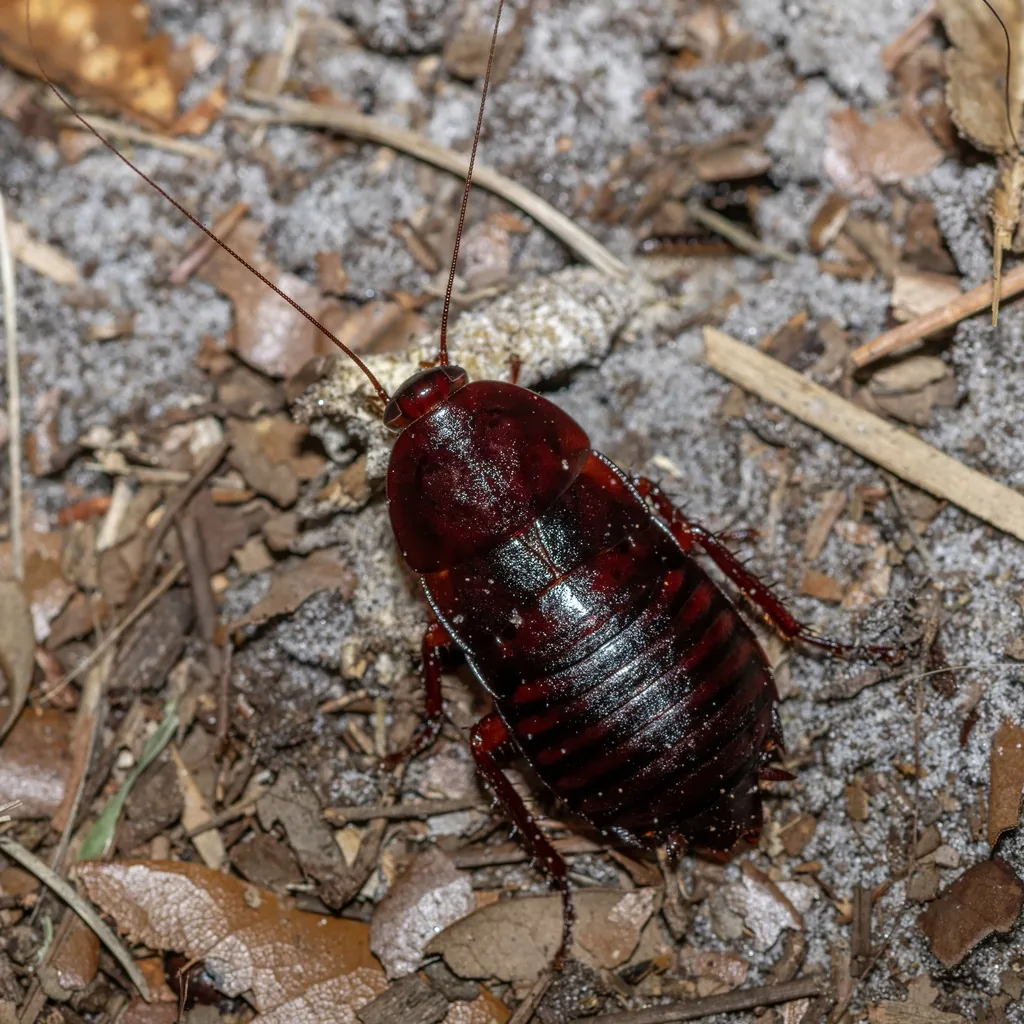
- Adults are reddish brown to almost black and grow up to about 1 1/2 inches long. UF/IFAS gives 30 to 40 mm (1.20 to 1.60 inches) long and up to 24 mm (1 inch) wide.[1][2][4][5]
- Adults are wingless, or appear to be, which sets them apart from the long-winged American and smokybrown cockroaches it shares the palmetto bug name with. UF/IFAS says neither sex has working wings: the short, leathery wing pads barely meet in the middle and leave the whole abdomen bare, and there are no hind wings, so adults cannot fly.[1][4][5]
- The name 'palmetto bug' is now used for several large Southern roaches, but a UGA entomologist notes it may have started with this species, which is commonly found in palm trees.[2][6]
- It moves slowly and does not rush away when disturbed, unlike most large roaches. Older nymphs often have yellow edges on the plates behind the head.[4]
- Other common names include Florida stinkroach, skunk cockroach and stinking cockroach, for the foul-smelling fluid it releases.[4][5]
Look-alikes
| Look-alike | How to tell them apart |
|---|---|
| American cockroach | Also called a palmetto bug, but adults are 1 1/2 to 2 inches long, reddish brown with lighter markings on the plate behind the head, and have long leathery wings reaching the tip of the abdomen or beyond. UF/IFAS adds that the Florida woods cockroach is slow moving and its wing pads leave the abdomen bare.[1][2][4] |
| Smokybrown cockroach | One of the most common large roaches in the Southeast and also called a palmetto bug. Adults are uniformly dark brown, about 1 1/3 inches long, and fully winged.[1][2] |
Where it lives
In Mississippi it occurs mainly in the extreme southern part of the state, near the coast, and is uncommon even there. Of 1,868 U.S. GBIF records since 1990, 1,726 are from Florida; the rest come mostly from Georgia, Texas and Alabama, with a few from South Carolina, Louisiana, Mississippi and North Carolina. UF/IFAS records it in coastal Georgia, Alabama and Mississippi and through most of Florida, and calls it the northernmost member of its tropical genus; the only other U.S. species, Eurycotis lixa, is confined to the Florida Keys.[1][7][4][5]
Biology and life cycle
In a USDA study in north-central Florida, adults of this roach and the smokybrown cockroach sheltered mostly in palms in fall and moved to hardwood trees with tree holes by spring, which seem to give better winter survival.[3]
Females make hard egg cases (oothecae). In a 2025 comparison of seven roach species, this one's egg cases had among the thickest walls, yet a tiny parasitic wasp, Aprostocetus hagenowii, is a known enemy that attacks them. UF/IFAS notes that the common cockroach-egg wasps (Evaniidae) are ineffective against its large egg cases, but one wasp, Anastatus floridanus, specializes on them.[8][4]
Adults defend themselves with a chemical secretion whose organic portion is about 98 percent three compounds: (E)-2-hexenal, (E)-2-hexenol and (E)-2-hexenoic acid. The amount builds over the first 60 days of adult life, and males can refill an emptied supply in about 30 days. UF/IFAS says the secretion is stored in a gland under the abdomen, can be aimed somewhat and sprayed from about three centimeters to one meter, and deters ants, other roaches and predators such as lizards, birds, frogs and rodents. Nymphs do not produce it until they molt to adults.[9][4]
Egg cases are 13 to 16 mm long, pale at first and darkening to reddish brown and black, and the female often glues them to a surface such as a decaying log. UF/IFAS's cockroach photo guide gives 20 to 24 eggs per case.[4][5]
Eggs take about 48 days to hatch at 30 to 36 C; nymphs molt six to eight times and reach adulthood in 100 to 120 days, and egg to adult is estimated at about 150 days. Females produce their first egg case after 55 days as adults, and adults live more than a year.[4][5]
It feeds mainly on decaying plant matter such as dead leaves, bark, lichens, mosses and molds, so homes offer it little food. Outdoors it shelters in tree cavities and stumps, under bark, in leaf litter and shaded shrubs, around the bases of palms and in woodpiles.[4]
Damage and signs
- It is primarily an outdoor roach. Along the coast it is an uncommon pest in garages, storage rooms and similar buildings rather than a household breeder. UF/IFAS says limited attic breeding has been recorded and that it turns up in sheds, storage areas, greenhouses and pump houses near the home.[1][4]
Health risk
Mississippi State treats it as an uncommon nuisance in garages and storage buildings. Its defense is a chemical secretion rather than a bite, and none of these sources reports it spreading disease to people.[1][9]
Control
Keep them out
Install door sweeps, seal door edges with foam or spring-metal strips, repair window screens, and caulk or foam around pipes and other openings. Check that attic and soffit vents are tight and screened. UF/IFAS adds weather stripping between doors and frames and tightly packed steel wool as a temporary filler until openings are sealed.[1][10]
Sanitation
Keep firewood, lumber and boxes away from the house, rake leaves and pine needles, and prune trees and shrubs back from the walls. Mississippi State advises keeping organic mulch out of the 3 to 4 feet next to the foundation (lava rock or pea gravel works there) and not planting palms too close to the house.[1]
UF/IFAS says outdoor cockroaches survive poorly indoors. Bring firewood in only as needed and stack it off the ground and well away from the house, pull mulch away from the house, keep shrubs trimmed back, and fill tree holes with cement.[4][10]
Traps and physical control
In the USDA study, trapping roaches out of their main outdoor shelters followed by one bait application cut the population by 90 percent for six months, so the palms and hollow trees near the home are the places to focus on.[3]
Pesticides
For large outdoor roaches, Mississippi State recommends an exterior perimeter treatment applied according to label directions, with labeled products used indoors only as needed. UF/IFAS describes an outdoor approach that it says can cut cockroach numbers by 80% or more: keep only a thin layer of mulch extending 1 ft (30.5 cm) from the foundation, treat within 3 feet of the home in pine straw, leaves or ivy and in sheltered cracks, use granular baits in plantings and mulched areas, and do not use baits and liquid products at the same time in the same place. Follow the label.[1][10]
Where the sources disagree
Adult size: Mississippi State gives up to about 1 1/2 inches, UF/IFAS Featured Creatures 30 to 40 mm (1.20 to 1.60 inches), and UF/IFAS's cockroach management guide pictures an adult at 1 1/4 inches (31.75 mm).[1][4][10]
Common questions
- Can Florida woods cockroaches fly?
- No. Adults are wingless, or nearly so, unlike the long-winged American and smokybrown cockroaches.[1]
- Why is it called a palmetto bug?
- It is commonly found in palm trees, and the nickname may have started with it before spreading to other large Southern roaches.[2][6]
- Will Florida woods cockroaches infest my house?
- Rarely. It is primarily an outdoor roach that only occasionally turns up in garages, storage rooms and similar places.[1]
- Does the Florida woods cockroach stink?
- Yes. Adults release an oily, foul-smelling defensive fluid, which is why it is also called the stinking or skunk cockroach.[4][5]
- How long does a Florida woods cockroach live?
- More than a year as an adult, UF/IFAS says; development from egg to adult takes about 150 days.[4][5]
Sources
- Mississippi State University Extension Service, “Publication 3346: Control Cockroaches in and Around Your Home.” extension.msstate.edu/sites/default/files/document/2026-01/P3346_web.pdf (accessed 2026-11-14)
- University of Georgia College of Agricultural and Environmental Sciences, “Is that a roach or a palmetto bug? (CAES Field Report).” fieldreport.caes.uga.edu/news/is-that-a-roach-or-a-palmetto-bug/ (accessed 2026-11-14)
- Journal of Economic Entomology, via PubMed, “Seasonality of peridomestic cockroaches (Blattoidea: Blattidae): mobility, winter reduction, and effect of traps and baits (USDA-ARS, 1991).” pubmed.ncbi.nlm.nih.gov/1787218/ (accessed 2026-11-14)
- University of Florida/IFAS Extension (Featured Creatures), “Florida Woods Cockroach (AKA Palmetto Bug), Eurycotis floridana (Walker), EENY-514/IN915.” ask.ifas.ufl.edu/publication/IN915 (accessed 2026-11-14). Its skin and eye irritation line is not used (medical-source rule).
- University of Florida/IFAS Entomology and Nematology Department, “Florida woods cockroach, Eurycotis floridana (UF/IFAS Cockroach Photographs CD-ROM).” entnemdept.ufl.edu/projex/gallery/dl/cockroaches/text/florida_woods_cockroach.htm (accessed 2026-11-14)
- Archives of Virology, via PubMed, “Novel cyclovirus discovered in the Florida woods cockroach Eurycotis floridana (2013).” pubmed.ncbi.nlm.nih.gov/23358613/ (accessed 2026-11-14)
- Global Biodiversity Information Facility (GBIF), “Eurycotis floridana: U.S. occurrence records since 1990 by state (GBIF occurrence search).” api.gbif.org/v1/occurrence/search?taxonKey=2000447&country=US&hasGeospatialIssue=false&occurrenceStatus=PRESENT&year=1990%2C2026&facet=stateProvince&facetLimit=400&limit=0 (accessed 2026-11-14)
- Journal of Insect Science, via PubMed, “Host range of the oothecal parasitoid Aprostocetus hagenowii (2025; full text via PMC).” pubmed.ncbi.nlm.nih.gov/39846896/ (accessed 2026-11-14)
- Insect Biochemistry and Molecular Biology, via PubMed, “Production, regeneration and biochemical precursors of the major components of the defensive secretion of Eurycotis floridana (2000).” pubmed.ncbi.nlm.nih.gov/10844252/ (accessed 2026-11-14)
- University of Florida/IFAS Extension (EDIS), “Cockroaches and Their Management, ENY-214/IG082.” ask.ifas.ufl.edu/publication/IG082 (accessed 2026-11-14). Its disease line is not used (medical-source rule); no rates used.
- iNaturalist, “Eurycotis floridana taxon page (order and family).” www.inaturalist.org/taxa/372251 (accessed 2026-11-14)