On this page
How to identify it
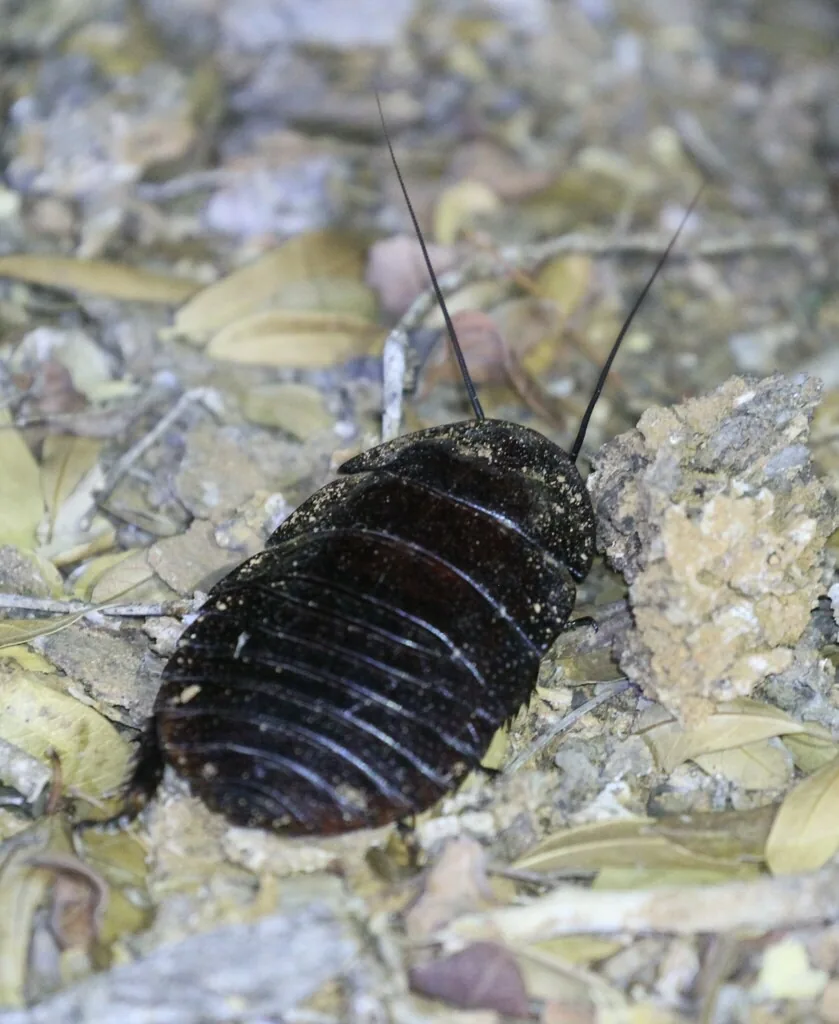
- A very large cockroach: Kentucky gives a maximum length of 3 inches, Connecticut says adults can be 2 to 3 inches long, and a 2026 review gives 6 to 10 cm. It has a dark brown to black head and shield and a brown abdomen.[1][2][3]
- Both sexes are completely wingless and slow-moving, unlike many pest cockroaches such as the American cockroach, which can fly.[1][2][3]
- It hisses. When frightened it forces air out of its breathing pores (spiracles), the small black dots along the sides of the abdomen, making a loud hissing sound.[1][2][3]
- Males have a pair of horn-like bumps on the shield behind the head and thicker, feathery antennae; females have a smoother shield and thinner antennae and tend to be slightly larger.[2][3]
- Small mites are often seen crawling over the body; Kentucky says they live on the cockroach and do not harm it.[1]
Look-alikes
| Look-alike | How to tell them apart |
|---|---|
| American cockroach | The American cockroach is a fast-moving pest that can fly, thrives in garbage and spreads germs, while the hissing cockroach is a larger, slower, wingless forest species that feeds on fruits and vegetables.[1][3] |
Where it lives
Native to Madagascar, where it lives in forests inside fallen logs. Elsewhere it is known from captivity: it is widely available from commercial breeders and is used in classrooms, as a research animal and as a feeder insect, and it cannot infest homes in temperate regions.[1][3][2]
Biology and life cycle
It does not lay eggs in the open. The female carries her egg case inside her body, the eggs hatch inside her, and she gives birth to live young: 15 to 60 nymphs, or several dozen as Connecticut puts it. Gestation in the lab is about 60 days.[1][3][2]
Newborn nymphs are about 6 to 8 mm long and look like small adults; there is no pupal stage. How long they take to grow up depends on the source: about six months to adulthood in the 2026 review, 10 to 12 months according to Connecticut.[3][1][2]
Adults are long-lived for an insect: Kentucky gives 2 to 5 years, Connecticut up to 5 years in good conditions, and the life cycle can exceed four years in captivity.[1][2][3]
Hissing is both a warning and a way to talk: males hiss at one another to establish dominance and to females during courtship. Hissing cockroaches belong to a small group of about 20 cockroach species that can hiss.[1][2]
A fun fact: in experiments, hissing cockroaches got used to being poked near the rear and hissed less and less, and males hissed more than females.[6]
In the wild it lives in fallen logs and eats fruits, vegetables, decaying matter and rotting wood. In captivity it is kept warm (about 75 to 82°F) at moderate humidity and fed fruits, vegetables and dry food such as pet food or fish flakes.[1][2][3]
Damage and signs
Health risk
It does not bite or sting, and Kentucky says the mites that ride on it cannot bite or infest people. It can cause allergies, though: in a lab study, a person sensitized to this species had IgE antibodies that also bound proteins of other cockroaches, and 8 of 15 German cockroach-sensitized patients had antibodies that bound its proteins, so the authors warn that allergic reactions can occur and urge caution with predisposed people in schools, museums and zoos. A second study cultured 14 kinds of mold from hissing cockroaches, their cast skins and droppings and warned that rearing conditions favor molds that can cause allergies or, rarely, infections in vulnerable people.[1][4][5]
Control
Prevention
No pest control is needed: it is a harmless forest cockroach that cannot infest homes in temperate regions, and a scientific review notes that it is classified as an exotic species rather than an invasive pest.[1][2][3]
Keep them out
If you keep them, use a tight-fitting, fine-mesh lid and a band of petroleum jelly around the top of the tank or bin to stop escapes, especially because newborn nymphs are very small. Keep males and females apart if you don't want them to breed.[2]
Sanitation
Replace food regularly so it doesn't spoil, and keep bedding from getting soggy; researchers found that hissing cockroach rearing conditions are ideal for mold growth. People with cockroach allergies or asthma should take care around them.[2][5][4]
Common questions
- Do Madagascar hissing cockroaches bite?
- No. They do not bite or sting and are considered harmless.[1]
- Why do hissing cockroaches hiss?
- When frightened they push air out of their spiracles, the breathing pores along the sides of the abdomen, to make a loud hiss. Males also hiss at each other to establish dominance and to females when courting.[1][2]
- Are the mites on my hissing cockroach dangerous?
- No. The small mites that crawl over hissing cockroaches do not harm the roach and cannot bite or infest humans.[1]
- Can an escaped hissing cockroach infest my house?
- Connecticut's Agricultural Experiment Station says hissing cockroaches are poorly adapted to man-made environments and cannot infest homes in temperate regions.[2]
- Can hissing cockroaches cause allergies?
- Yes, in some people. A study in Annals of Allergy, Asthma & Immunology found that sensitization and allergic reactions to this species can occur and that it shares allergens with German and American cockroaches; molds that grow in their enclosures are another allergy concern.[4][5]
Sources
- University of Kentucky Department of Entomology, “Madagascar Cockroach.” entomology.ca.uky.edu/content/madagascar-cockroach (accessed 2026-11-12)
- The Connecticut Agricultural Experiment Station, “Madagascar Hissing Cockroach (Gromphadorhina portentosa) fact sheet.” portal.ct.gov/-/media/caes/documents/publications/fact_sheets/entomology/madagascar_hissing_cockroach_gromphadorhina.pdf (accessed 2026-11-12)
- Animals (MDPI); PMC13255750, “Cockroaches as an Emerging Invertebrate Model in Bioscience Research: Gromphadorhina portentosa. Animals (Basel), 2026.” pmc.ncbi.nlm.nih.gov/articles/PMC13255750/ (accessed 2026-11-12)
- Ann Allergy Asthma Immunol 2007;98(3):258-61, via PubMed, “Allergenicity of the Madagascar hissing cockroach.” pubmed.ncbi.nlm.nih.gov/17378257/ (accessed 2026-11-12)
- Mycoses 2008;51(2):95-8, via PubMed, “The giant Madagascar hissing-cockroach (Gromphadorhina portentosa) as a source of antagonistic moulds: concerns arising from its use in a public setting.” pubmed.ncbi.nlm.nih.gov/18254744/ (accessed 2026-11-12)
- PeerJ 2025;13:e19805, via PubMed, “Habituation but not classical conditioning of the disturbance hiss of the hissing cockroach (Gromphadorhina portentosa).” pubmed.ncbi.nlm.nih.gov/40786105/ (accessed 2026-11-12)
- iNaturalist, “Gromphadorhina portentosa taxon page (order and family).” www.inaturalist.org/taxa/322550 (accessed 2026-11-09)