On this page
How to identify it
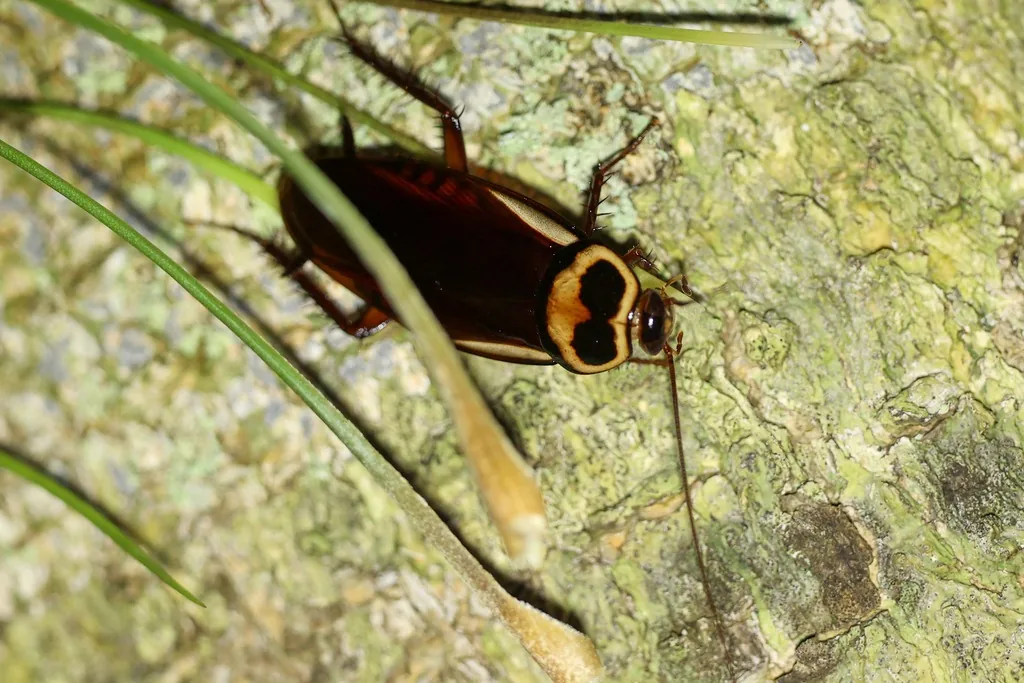
- The key mark is a pale band along the outer front edge of each forewing: pale yellow to orange in NC State's description, cream-colored in UC IPM's, and light tan to yellowish-brown in Ohio State's.[1][3][2]
- The shield behind the head (pronotum) has an irregular pale band around a two-lobed dark spot; Ohio State notes the two eye-like markings are typically dark brown, where they are paler and less distinct on the American cockroach.[1][2]
- Young nymphs are very dark brown with a pale band across the thorax and two pale spots on the abdomen, and older nymphs are variously spotted. Ohio State describes early nymphs with black and white bands and later ones with mottled yellow markings.[1][2]
- Adults have full wings and are good fliers.[2]
Look-alikes
| Look-alike | How to tell them apart |
|---|---|
| American cockroach | Similar in size, shape and color, and the adults are hard to tell apart; the American cockroach lacks the pale wing-edge 'shoulders', has lighter, less distinct pronotum markings, and its nymphs are solid colored.[2][1][3] |
| Smokybrown cockroach | UC IPM describes the smokybrown as dark brown to mahogany with an almost-black pronotum, without the pale wing edges and pale pronotum band of the Australian cockroach.[3][1] |
| Surinam cockroach | Another tropical plant-feeding roach found in indoor plantings, but Ohio State notes Surinams burrow and feed mostly on roots, while Australian cockroaches climb into plant canopies.[2] |
Where it lives
Despite the name it probably originated in tropical Africa. It is established in several southern states, including Florida, where it is now one of the most common outdoor cockroaches. Farther north it turns up in greenhouses, conservatories, animal facilities and zoos; it can't survive winter outdoors in Ohio, and Minnesota Extension says it is rarely seen there.[2][3][4]
Biology and life cycle
The female carries her brown, oval egg case, about 3/8 inch long, for a few days and then glues it in a crack or crevice.[1]
NC State says each female produces 20 to 30 egg cases in a 4- to 6-month adult life, 12 to 24 nymphs hatch from each after 40 days to 3 months, and development to adult takes about a year. UC IPM says its life cycle is similar to the American cockroach's.[1][3]
It prefers warm, damp places outdoors and in greenhouses, interior plantings and other buildings with warm, damp spots.[1][3]
Like most cockroaches it is active at night and hides during the day, including in plants.[2]
Besides plants it eats starchy material, including unprotected food.[1]
Damage and signs
- It feeds on tender seedlings and foliage, and can build damaging populations in greenhouses, conservatories and indoor plantings; Ohio State reports one conservatory that lost many seedlings and rooted cuttings to it.[1][2]
- When it infests a building it usually stays on the bottom floor.[1]
- It can be carried from place to place in infested plants year round.[2]
Health risk
Cockroaches in homes are a source of allergens, and a review in the journal Allergy calls cockroach sensitization an important risk factor for asthma. In a Hong Kong study the Australian cockroach was one of three species dominant in homes, and its droppings carried higher, more variable endotoxin levels than the others tested.[6][5]
Control
Keep them out
Seal cracks and openings, and use door sweeps and weather stripping around doors and windows to keep outdoor roaches out.[3]
Sanitation
Cut back hiding places in hollow walls, cupboards and outdoor vegetation, and check potted plants that spent the summer outdoors before bringing them in.[3][2]
Traps and physical control
Sticky traps catch Australian cockroaches for identification and show where they are getting in or feeding; set some near exterior doors.[2][3]
Pesticides
NC State says this species is not particularly resistant to insecticides and suggests abamectin cockroach baits, since some products can't be used around indoor plantings. UC IPM notes sprays alone don't give long-term control and that outdoor roaches can be baited in water meter boxes, drains and under slabs. Follow the label.[1][3]
When to call a professional
In greenhouses, conservatories and commercial plantings, Ohio State notes control may call for several kinds of licensed applicators, depending on where the roaches are.[2]
Where sources disagree
Size: NC State describes the adult as about an inch long, while Ohio State calls it similar in size to the American cockroach, which UC IPM puts at about 2 inches.[1][2][3]
Common questions
- How do I tell an Australian cockroach from an American cockroach?
- Look at the front edges of the wings: the Australian cockroach has pale yellowish bands there and the American cockroach doesn't. Australian nymphs are spotted; American nymphs are solid colored.[2][1]
- Is the Australian cockroach actually from Australia?
- Probably not. Ohio State says it most likely originated in tropical Africa and was named from specimens described in Australia.[2]
- Can Australian cockroaches fly?
- Yes. Adults have full wings and are good fliers.[2]
- Will it infest my house?
- It mainly lives outdoors and only sometimes comes inside, where it usually stays on the bottom floor.[2][1]
Sources
- NC State Extension, “Australian Cockroach in Interiorscapes.” content.ces.ncsu.edu/australian-cockroach (accessed 2026-11-11)
- Ohio State University Extension, “Unusual Plant-Eating Cockroach (Buckeye Yard and Garden onLine, August 24, 2017).” bygl.osu.edu/node/880 (accessed 2026-11-11)
- University of California Statewide IPM Program, “Cockroaches (Pest Notes).” ipm.ucanr.edu/home-and-landscape/cockroaches/ (accessed 2026-11-11)
- University of Minnesota Extension, “Cockroaches.” extension.umn.edu/insects-infest-homes/cockroaches (accessed 2026-11-11)
- International Journal of Environmental Research and Public Health, via PubMed, “Are cockroaches an important source of indoor endotoxins? (Lai 2017).” pubmed.ncbi.nlm.nih.gov/28106812/ (accessed 2026-11-11)
- Allergy, via PubMed, “Cockroach allergen exposure and risk of asthma (Do et al. 2016).” pubmed.ncbi.nlm.nih.gov/26706467/ (accessed 2026-11-11)
- iNaturalist, “Validiblatta australasiae taxon page (order and family).” www.inaturalist.org/taxa/1649046 (accessed 2026-11-11)