On this page
How to identify it
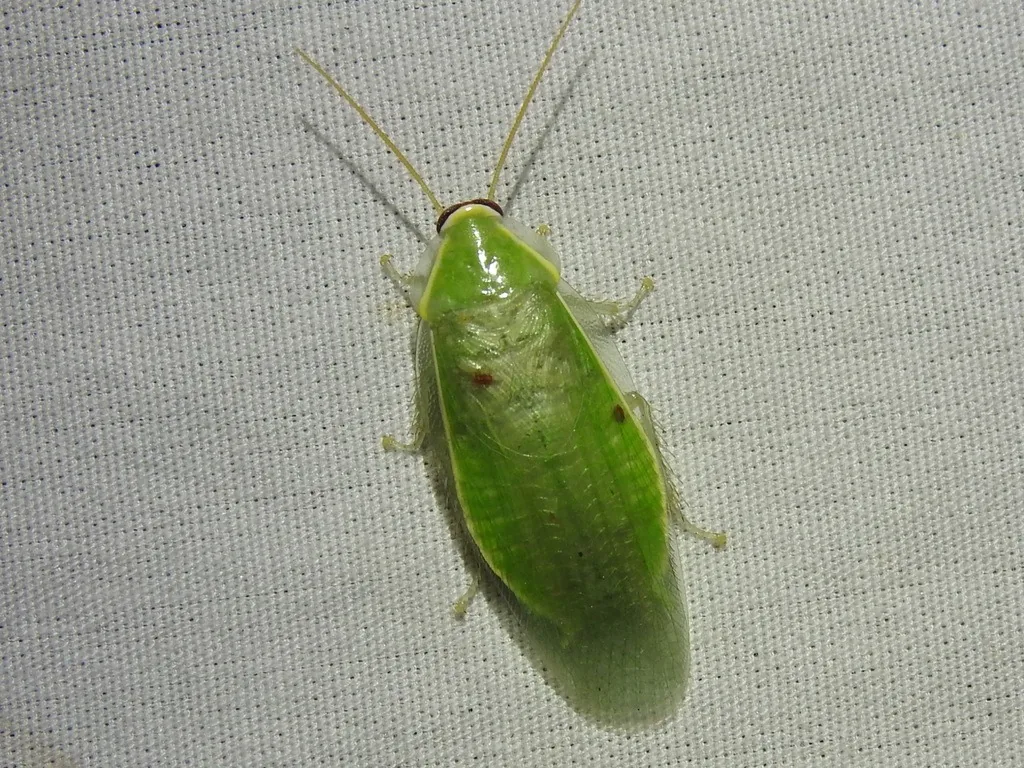
- Adults are bright to pale green. Sizes differ by source: the Texas Invasive Species Institute gives 20 to 25 mm (about 7/8 to 1 inch), occasionally up to 50 mm, while Mississippi State says females are about 3/4 inch and males smaller.[1][4]
- There's a thin yellow margin along the front of the wing covers.[1]
- Nymphs look nothing like the adults: they are dark brown to black until they mature and turn green.[1][4]
- Adults are habitual fliers and are drawn to lights, including ultraviolet light, at night.[5][1][2]
Where it lives
Native to Cuba. In the U.S. it is established near the Gulf Coast and is most abundant in Florida; in Texas it occurs from the Gulf Coast to Central Texas, and in Mississippi it is found in the extreme south. GBIF's 1990-2026 U.S. records (about 1,900) come from 10 states on the map, most from Texas, Florida and Louisiana.[1][2][4][7]
Biology and life cycle
The eggs develop inside the female for about 2 months, and she gives birth to an average of about 30 live nymphs at a time; researchers class the species as ovoviviparous.[1][6]
Nymphs take about 100 days to mature and live in mulch, leaf litter and similar spots.[1][4]
Outdoors it lives in trees, shrubs and other plants, and in piles of lumber, leaves and mulch.[1]
Its eyes are suited to flying at night: compared with the American cockroach, its eye units have a two-tiered light-sensing structure that may help it detect polarized light in the dark.[5]
It likely reached the U.S. in banana shipments, and it is also sold as a pet, which has led to escapes.[1]
Damage and signs
Health risk
It is not considered an indoor pest and usually isn't found inside unless kept as a pet.[1][4]
Control
Prevention
Turn off outdoor lights when you can, since adults are active at night and fly toward light.[1][2]
Sanitation
Scatter woodpiles and get rid of leaf piles to remove the shelter this roach prefers.[1]
Common questions
- What is the bright green cockroach I found?
- In Florida and along the Gulf Coast, it's most likely the Cuban, or green banana, cockroach, a pale green outdoor species attracted to lights.[1][4]
- Will green banana cockroaches infest my home?
- No. They can't develop and reproduce indoors, so ones that fly in are accidental visitors.[1][4]
- Why are the babies brown if the adults are green?
- Nymphs are dark brown to black and only take on the green adult color when they mature.[1][4]
Sources
- Texas Invasive Species Institute, “Green Banana Cockroach / Cuban Cockroach, Panchlora nivea (invasive species database).” tsusinvasives.org/home/database/panchlora-nivea (accessed 2026-11-11). University-based invasive species institute database entry.
- Texas A&M AgriLife Extension Service, Cooperative Extension Program, “Blattodea-Blaberidae-Panchlora nivea-Green Banana Cockroach (insect image record, June 9, 2018).” elp.tamu.edu/ipm/bugs/blattodea-termites-cockroaches/blattodea-blaberidae-panchlora-nivea-green-banana-cockroach-a-2/ (accessed 2026-11-11)
- iNaturalist, “Panchlora nivea taxon page (order and family).” www.inaturalist.org/taxa/244906 (accessed 2026-11-11)
- Mississippi State University Extension, “Control Cockroaches in and Around Your Home (Publication 3346).” extension.msstate.edu/sites/default/files/document/2026-01/P3346_web.pdf (accessed 2026-11-11)
- Journal of Experimental Biology, via PubMed, “Frolov RV, Matsushita A, Arikawa K (2017), Not flying blind: a comparative study of photoreceptor function in flying and non-flying cockroaches, Journal of Experimental Biology 220(13):2335-2344.” pubmed.ncbi.nlm.nih.gov/28404730/ (accessed 2026-11-11). Cited from the PubMed abstract.
- Archives of Insect Biochemistry and Physiology, via PubMed, “Li X (2007), Juvenile hormone and methyl farnesoate production in cockroach embryos in relation to dorsal closure and the reproductive modes of different species of cockroaches, Archives of Insect Biochemistry and Physiology 66(4):159-168.” pubmed.ncbi.nlm.nih.gov/18000875/ (accessed 2026-11-11). Cited from the PubMed abstract.
- Global Biodiversity Information Facility (GBIF), “Panchlora nivea (Cuban cockroach): occurrence records in the U.S., 1990-2026 (GBIF occurrence search).” api.gbif.org/v1/occurrence/search?taxonKey=1995489&country=US&hasGeospatialIssue=false&occurrenceStatus=PRESENT&year=1990%2C2026&facet=stateProvince&facetLimit=400&limit=0 (accessed 2026-11-11). State counts are records reported (iNaturalist research-grade, museum specimens, surveys), not abundance.