On this page
How to identify it
Look-alikes
| Look-alike | How to tell them apart |
|---|---|
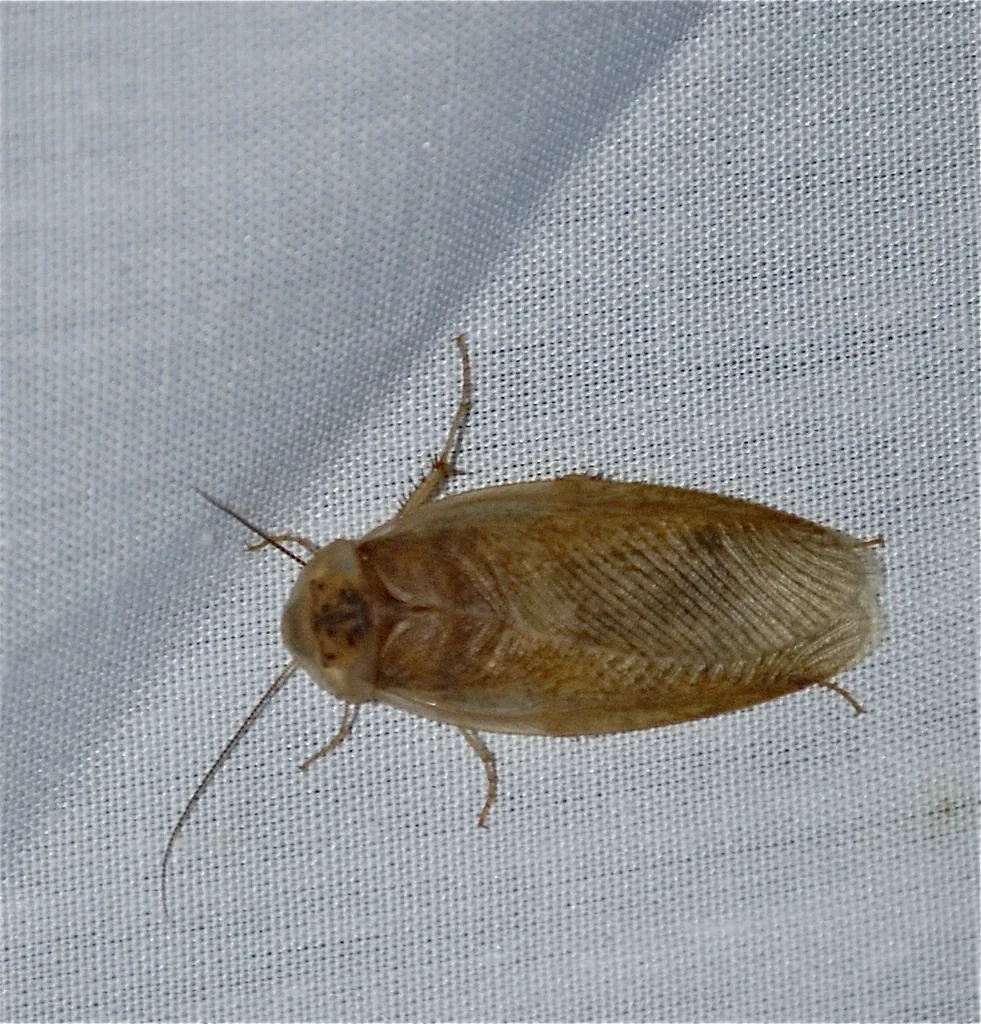
| House-infesting cockroaches | A single pale, winged roach that comes in through a door at night in desert areas is likely a desert cockroach male, which won't live indoors, rather than a roach breeding inside.[1] |
Where it lives
Native to dry habitats of the Southwest and Mexico; a 2014 revision of the genus described 39 new species, raising the total from 9 to 48.[2][1]
Biology and life cycle
Females and nymphs live underground in sand, and adults appear in summer.[1][2]
Females and nymphs live underground in sandy dune habitats, feeding on mycorrhizal fungi, leaf debris from desert shrubs, and seeds gathered by the mammals whose burrows they share.[4]
In California dunes, they burrow 20-60 cm deep in the sand by day in spring, summer and fall, then move to within 1-3 cm of the surface at night once the sand cools. They feed on decaying leaves and the roots of desert shrubs.[6]
Fun fact: the desert cockroach Arenivaga investigata can drink water straight out of humid air. Above 82.5% relative humidity it gains weight by pushing two bladder-like structures out of its mouth that collect water vapor.[5]
Another fun fact: one species, Arenivaga apacha, digs shelves in kangaroo rat mounds, lines them with material from the mounds and stores seeds there; the humidity on those shelves was never found below 91%, while the surrounding burrow dropped as low as 20%.[4]
In a laboratory rearing study of Arenivaga investigata collected from sand dunes near Palm Springs, California, the roaches were found 0.25 to 0.5 m deep, mostly in fairly fine, moist sand, though they could burrow up into dry sand.[7]
In the lab they stayed buried in the sand through the light hours; adult males and females, and on rare occasions nymphs, came to the surface only in the dark.[7]
Females lay their eggs in egg cases (oothecae), which averaged 7.7 eggs each in that study; older females laid fewer eggs per case, down to 1 to 4 near the end of life. Development from egg to adult took about seven months, and adult males lived less than two months after their final molt.[7]
Damage and signs
- They live entirely outdoors in sandy soil and are not considered pests.[1]
Health risk
They are not pests and are not known to live indoors.[1]
Control
Keep them out
No treatment is needed. The winged males often fly to lights at night and may enter houses, but they will not live indoors; the University of New Mexico's Museum of Southwestern Biology says these roaches are not pests.[1]
Common questions
- What is the pale, winged cockroach at my porch light?
- In the Southwest, a pale tan, flat roach with long wings that flies to lights at night is likely a male desert (sand) cockroach.[1][2]
- Will desert cockroaches infest my house?
- No; they live outdoors in sandy soil and are not known to live indoors.[1]
- How long do desert cockroaches live?
- Adult males are short-lived: in a laboratory study of Arenivaga investigata they lived less than two months after their final molt, while development from egg to adult took about seven months.[7]
Sources
- University of New Mexico, Museum of Southwestern Biology, “Desert Sand Cockroach (arthropods gallery).” msb.unm.edu/divisions/arthropods/resources/arthropods%20gallery/desert-sand-cockroach.html (accessed 2026-11-12)
- Entomology Today (Entomological Society of America), “39 New Species of Cockroach Discovered in the Southwestern US and Mexico (February 27, 2014).” entomologytoday.org/2014/02/27/39-new-species-of-cockroach-discovered-in-the-southwestern-us-and-mexico/ (accessed 2026-11-12)
- iNaturalist, “Arenivaga taxon page (order and family).” www.inaturalist.org/taxa/122620 (accessed 2026-11-12)
- ZooKeys (2014), via PubMed, “A revision of the genus Arenivaga (Rehn) (Blattodea, Corydiidae), with descriptions of new species and key to the males of the genus.” pubmed.ncbi.nlm.nih.gov/24624022/ (accessed 2026-11-12). Cited from the PubMed abstract and the open-access full text (PMC3950428).
- Proceedings of the National Academy of Sciences (1977), via PubMed, “Site of water vapor absorption in the desert cockroach, Arenivaga investigata.” pubmed.ncbi.nlm.nih.gov/266217/ (accessed 2026-11-12). Cited from the PubMed abstract.
- Oecologia (1973), via PubMed, “Ecology and behavior of the desert burrowing cockroach, Arenivaga sp. (Dictyoptera, Polyphagidae).” pubmed.ncbi.nlm.nih.gov/28307166/ (accessed 2026-11-12). Cited from the PubMed abstract.
- Entomological Society of Washington, “A technique for rearing and some notes on the biology of a desert sand cockroach, Arenivaga investigata (A. G. Appel, A. M. Van Dyke and M. K. Rust; Proceedings of the Entomological Society of Washington 85(3): 598-600, 1983; Internet Archive copy).” archive.org/details/biostor-75269 (accessed 2026-11-14). Read from the Internet Archive's full-text (djvu.txt) of this scan.