On this page
How to identify it
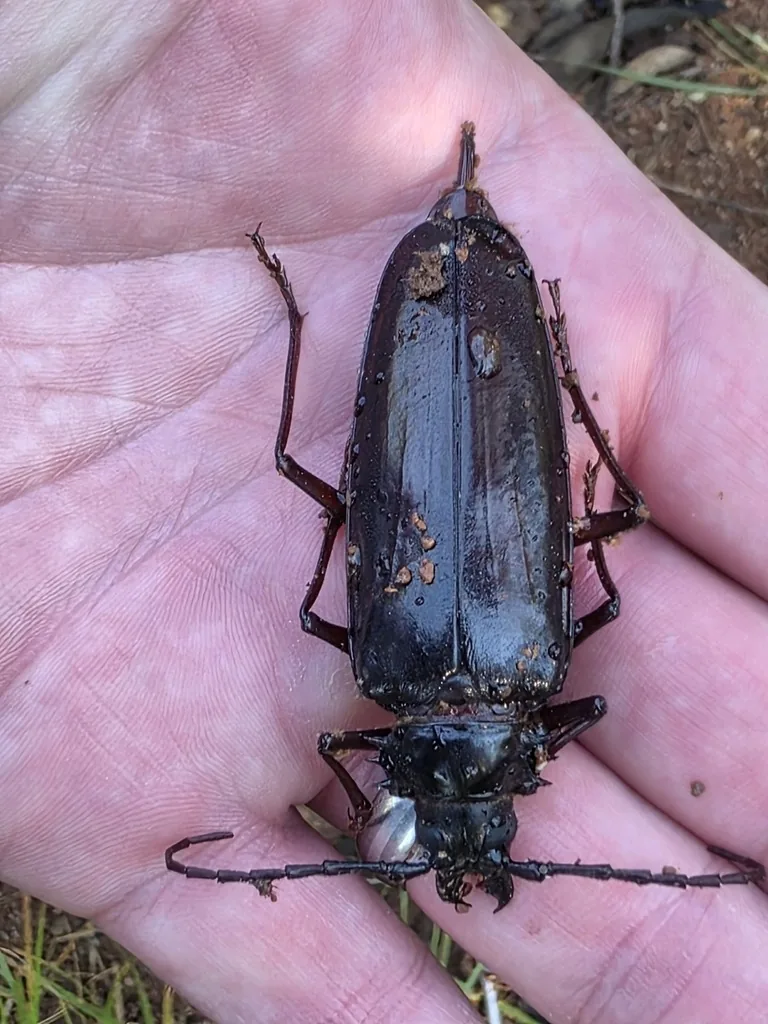
- University of Arizona Extension describes the adults as about 3 inches long and black to dark brown, with long, segmented antennae and a collar of spines behind the head; they fly at night and are drawn to lights.[1][2]
- Grubs are cream-colored and grow to 3 to 4 inches long in the roots before pupating.[1]
- Damage often shows as one large branch at a time dying back, sometimes all the way to the trunk; the real damage is in the roots.[1]
Look-alikes
| Look-alike | How to tell them apart |
|---|---|
| Cockroaches | The adults are often mistaken for giant cockroaches, but they are beetles with long, segmented antennae and a spiny collar, and they live outdoors and rarely come inside.[1] |
Where it lives
University of Arizona Extension says it lives in the desert Southwest and reports it from across Pinal County, Arizona. NMSU Extension identified a Derobrachus grub found in the roots of a live oak in Mesilla Park, New Mexico.[1][3]
Biology and life cycle
Adults usually emerge in June and July and are active in the evening and at night through the summer monsoon season. They don't feed, and they live a few weeks at most.[1][2]
Females lay eggs in oval holes 2 to 3 inches deep in the soil beneath host trees. The larvae find the roots, bore into large ones and work toward the trunk crown, feeding for several years before pupating; see where the sources disagree on how many.[1][2][3]
Damage and signs
- University of Arizona Extension has found the grubs in the roots of palo verde, mesquite, rose, privet, elm, cottonwood, mulberry, citrus and stone fruits, and says they don't seem to feed on palms, agaves, bamboo or other plants with parallel-veined leaves. NMSU adds desert willow and shade trees, but not conifers.[1][3]
- A healthy tree can usually grow enough new roots to offset the feeding, so the borers mainly hasten the decline of trees already stressed, injured or diseased; NMSU says females seek out weak or struggling trees.[1][2][3]
Health risk
University of Arizona Extension says the adults are harmless apart from a possible bite if a finger, toe or a pet's nose gets close to the head; it suggests picking one up from behind the head.[1]
Control
Prevention
Keep broadleaf trees and shrubs healthy, with appropriate watering and fertilizing, so they can outgrow root damage. NMSU lists drought, freeze injury, parking on roots and plastic over the root zone among the stresses that can make a tree a target.[1][3]
If an infested tree dies or is removed, grubs can move to a nearby susceptible plant; University of Arizona Extension suggests replanting with a palm or agave.[1]
Keep them out
The beetles fly to lights and sometimes come in through an open door or window, so keep doors and windows closed when lights are on; otherwise they rarely enter homes.[1]
Traps and physical control
NMSU warns that limbs weakened by borers can break in wind storms, so watch for dieback and remove damaged branches that could become hazards.[3]
Pesticides
University of Arizona Extension says there are no really effective controls: contact and soil insecticides can't reach grubs inside roots, and systemic insecticides don't seem to work well. NMSU's extension entomologist also advises against spraying, since the grubs are protected inside the wood.[1][3]
Where the sources disagree
Time as a grub: University of Arizona Extension says three or more years, University of Arizona News says up to three years, and NMSU's extension entomologist says about four years for Derobrachus.[1][2][3]
Color and size: University of Arizona Extension describes a 3-inch, black to dark brown beetle; NMSU describes Derobrachus as reddish-brown and about 2.5 to 3 inches long.[1][3]
Common questions
- What is the giant beetle at my porch light in Arizona?
- A dark, 3-inch beetle with long antennae flying to lights in summer is most likely a palo verde root borer.[1][2]
- Are palo verde beetles dangerous?
- No; University of Arizona Extension says they can bite if handled carelessly but are otherwise harmless, and the adults don't even eat.[1][2]
- Did palo verde root borers kill my tree?
- Probably not on their own; University of Arizona experts say they are often wrongly blamed, since healthy trees usually cope and trees tend to die from stress and other environmental factors.[2][1]
Sources
- University of Arizona Cooperative Extension, Pinal County, “Palo Verde Root Borers (Pinal County Extension newsletter, July 2019).” extension.arizona.edu/sites/extension.arizona.edu/files/attachment/july-2019.pdf (accessed 2026-11-13)
- University of Arizona News, “Bug Bonanza: 7 Big, Colorful Critters to Try to Spot This Monsoon Season (University of Arizona Insect Collection).” news.arizona.edu/news/bug-bonanza-7-big-colorful-critters-try-spot-monsoon-season (accessed 2026-11-13)
- New Mexico State University Cooperative Extension Service, “Tree borers may create hidden infestations in stressed trees (Southwest Yard and Garden, February 21, 2015).” swyg.nmsu.edu/2015/022115.html (accessed 2026-11-13)
- Global Biodiversity Information Facility (GBIF), “Derobrachus hovorei Santos-Silva, 2007 (GBIF Backbone Taxonomy).” api.gbif.org/v1/species/1100102 (accessed 2026-11-13)
- iNaturalist, “Derobrachus hovorei taxon page (order and family).” www.inaturalist.org/taxa/354643 (accessed 2026-10-06)