On this page
How to identify it
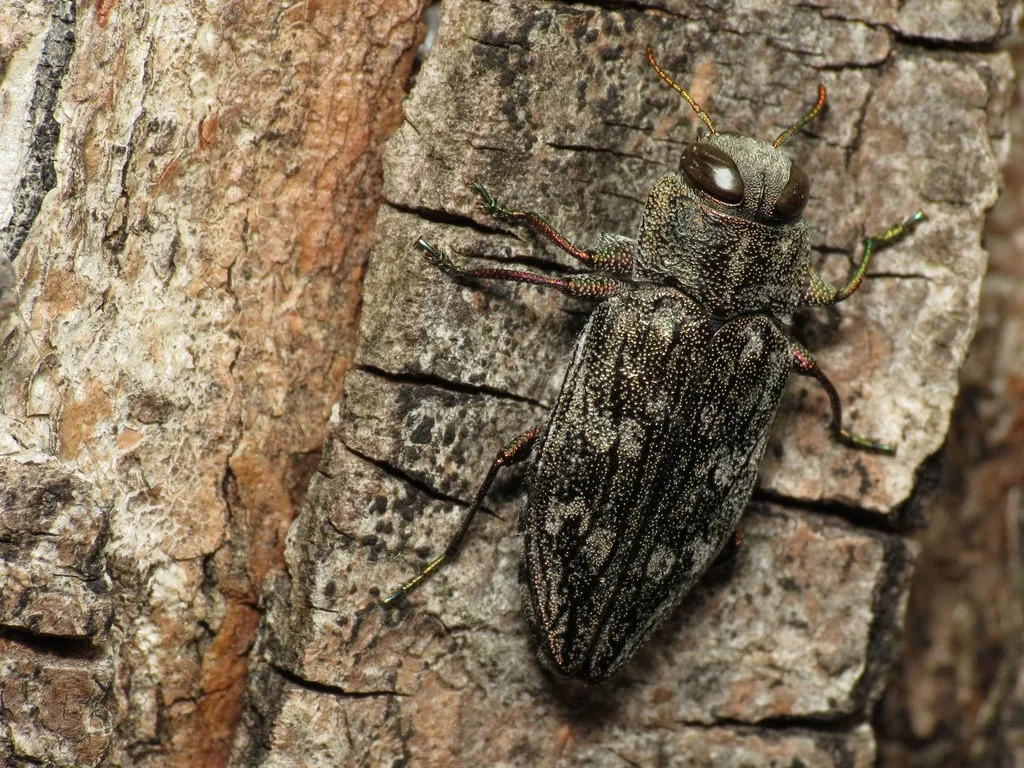
- Adults are flattened, shaped like a sunflower seed from above, gray to bronze or dark metallic brown on top with metallic greenish undersides. Sizes differ by source: about 1/2 inch (Clemson, Missouri) or 1/2 to 3/4 inch (NC State).[1][5][2]
- Larvae are legless, slender and yellowish-white, with a broad flat enlargement just behind the head that gives the borer its name. Mature larvae are about 1 inch long (Missouri) or 1 1/2 inches (Clemson).[1][2][5]
- Infested trees have dead, dark bark over the tunnels and cracks that ooze sap; the tunnels are packed with powdery, sawdust-like frass.[1][2]
- Like other metallic wood-boring beetles, emerging adults leave D-shaped exit holes in the bark.[6]
- Most Chrysobothris beetles look very much alike, so the exact species is hard to confirm by eye.[5]
Look-alikes
| Look-alike | How to tell them apart |
|---|---|
| Pacific flatheaded borer (Chrysobothris mali) | A close relative found west of the Rocky Mountains. In western insect collections it far outnumbers the flatheaded appletree borer in California, Oregon and Washington.[7] |
| Roundheaded appletree borer | A longhorned beetle (Saperda candida, family Cerambycidae) rather than a metallic wood borer; Missouri notes trunk wraps have not been entirely successful against it.[2] |
Where it lives
A native beetle found throughout the United States and most of Canada, though in California, Oregon and Washington collections hold far fewer of it than of the Pacific flatheaded borer. GBIF has about 340 U.S. records from 1990 to 2026, from 29 states and the District of Columbia, most from Maryland, Vermont, Minnesota, Oklahoma and Pennsylvania.[2][4][7][8]
Biology and life cycle
Adults are out from late spring into fall: Missouri says emergence starts in May and egg laying runs June to September, and Clemson gives late spring to November. There is one generation a year.[2][1]
Adults love sun and gather on the sunny sides of trees, so first attacks are usually on the sunny side; eggs go under bark scales and in crevices on the south and west sides of the trunk and larger branches.[2][1]
Females prefer to lay eggs at the base of the tree, on the lower trunk.[3][6]
Larvae feed in the phloem and outer sapwood, making tunnels that can reach 3 inches or more. In fall they bore deeper into the wood to spend the winter and pupate in spring.[2][5]
It attacks many thin-barked deciduous trees: apple, pear and crabapple, and in landscapes and nurseries crapemyrtle, dogwood, hawthorn, linden, maple, oak, poplar, elm, sycamore, walnut and hickory.[5][2]
Damage and signs
- Trees stressed by recent planting, drought or defoliation are attacked; the tunnels can girdle and kill young trees, and larger trees lose large patches of bark.[1][2][5]
- It is a major nursery pest: tunneling weakens or kills young or newly transplanted trees, and its wide host range costs nurseries and orchards many tree species.[3][9]
Health risk
It feeds under the bark of trees. Clemson, NC State and Missouri Extension describe it only as a tree pest and don't mention any risk to people or pets.[1][5][2]
Control
Prevention
Keep trees vigorous: water weekly during heat and drought, and mulch new plantings. Vigorous trees can drown young larvae in sap.[1][5][2]
Nursery research in Tennessee found a winter cover crop at the base of red maples cut borer attacks about as well as standard imidacloprid treatments, by blocking egg-laying sites, but it slowed tree growth; weedy tree bases likewise had 60% to 90% fewer attacks than weed-free ones.[4][10][3]
Keep them out
Wrap the trunk of newly planted trees from the ground to the lower branches before adults emerge (Missouri says May) and keep the wrap on for the first season or two; shading the trunk also helps keep adults away.[2][5]
Traps and physical control
Once a tree is infested, some larvae can be carefully cut out with a knife.[2]
Pesticides
For newly planted trees, NC State and Missouri describe trunk sprays of a labeled pyrethroid or carbaryl through the egg-laying season, or a soil-applied systemic such as imidacloprid in late winter to spring; because egg laying lasts all summer, sprays may need repeating. Follow the label, and keep pyrethroids away from pools, ponds and streams, since they are toxic to fish.[5][2]
Where the sources disagree
Size: Clemson and Missouri put adults at about 1/2 inch and NC State at 1/2 to 3/4 inch; Missouri says mature larvae are about 1 inch long, Clemson 1 1/2 inches.[1][2][5]
When adults are out: Missouri says emergence starts in May with egg laying from June to September; Clemson says adults are present from late spring to November; NC State says throughout the summer.[2][1][5]
Weak or vigorous trees: Clemson and NC State say stressed trees are the ones attacked and that vigorous trees can drown larvae in sap; in Tennessee nursery trials, weed-free maples grew faster but had more borer attacks than trees in weedy plots.[1][5][3]
Insecticides or ground cover: NC State and Missouri describe trunk sprays and soil-applied systemics for newly planted trees; Tennessee State researchers found a winter cover crop at the base of red maples cut attacks about as well as standard imidacloprid treatments, though it slowed tree growth.[5][2][4]
Common questions
- Why is sap oozing from cracks on my young apple tree?
- Flatheaded appletree borer larvae tunneling under the bark often cause sap-oozing cracks over dead, dark bark, usually on the sunny side.[1][2]
- How do I protect a newly planted tree from borers?
- Keep it watered and mulched, and wrap the trunk from the ground to the first branches for the first year or two; stressed young trees are the targets.[1][2][5]
- Does it only attack apple trees?
- No. Despite the name it attacks many thin-barked trees, including maples, oaks, dogwoods, crapemyrtles and lindens.[5][2]
Sources
- Clemson Cooperative Extension, Home & Garden Information Center, “Apple & Crabapple Insects (HGIC 2001).” hgic.clemson.edu/factsheet/apple-crabapple-insects/ (accessed 2026-11-13)
- University of Missouri Extension, “Insect Borers of Fruit Trees (G7190).” extension.missouri.edu/publications/g7190 (accessed 2026-11-13)
- Journal of Economic Entomology, via PubMed, “Addesso KM, Oliver JB, Youssef NN, Fare DC (2020), Evaluation of systemic imidacloprid and herbicide treatments on flatheaded borer management in field nursery production, Journal of Economic Entomology 113(6):2808-2819.” pubmed.ncbi.nlm.nih.gov/33080001/ (accessed 2026-11-13). Cited from the PubMed abstract.
- Pest Management Science, via PubMed, “Dawadi S, Oliver JB, O'Neal P, Addesso KM (2019), Management of flatheaded appletree borer (Chrysobothris femorata Olivier) in woody ornamental nursery production with a winter cover crop, Pest Management Science 75(7):1971-1978.” pubmed.ncbi.nlm.nih.gov/30609246/ (accessed 2026-11-13). Cited from the PubMed abstract.
- NC State Extension, “Flatheaded Appletree Borer.” content.ces.ncsu.edu/flatheaded-appletree-borer (accessed 2026-11-13)
- Colorado State University, Department of Agricultural Biology, “Shade Tree Borers.” agsci.colostate.edu/agbio/ipm-pests/shade-tree-borers/ (accessed 2026-11-13)
- Annals of the Entomological Society of America, via PubMed, “Rudolph EA, Wiman NG (2023), Insights from specimen data for two economic Chrysobothris species in the western United States, Annals of the Entomological Society of America 116(4):195-206.” pubmed.ncbi.nlm.nih.gov/37465725/ (accessed 2026-11-13). Cited from the PubMed abstract.
- Global Biodiversity Information Facility (GBIF), “Chrysobothris femorata (flatheaded appletree borer): occurrence records in the U.S., 1990-2026 (GBIF occurrence search).” api.gbif.org/v1/occurrence/search?taxonKey=5878502&country=US&hasGeospatialIssue=false&occurrenceStatus=PRESENT&year=1990%2C2026&facet=stateProvince&facetLimit=400&limit=0 (accessed 2026-11-13). State counts are records reported (iNaturalist research-grade, museum specimens, surveys), not abundance.
- Environmental Entomology, via PubMed, “Perkovich CL, Addesso KM, Basham JP, Fare DC, Youssef NN, Oliver JB (2022), Effects of color attributes on trap capture rates of Chrysobothris femorata and related species, Environmental Entomology 51(4):737-746.” pubmed.ncbi.nlm.nih.gov/35762287/ (accessed 2026-11-13). Cited from the PubMed abstract.
- Journal of Economic Entomology, via PubMed, “Gonzalez A, Oliver JB, Perkovich CL, Addesso KM (2023), Evaluation of winter cover crop methods for management of flatheaded appletree borer, Journal of Economic Entomology 116(4):1268-1275.” pubmed.ncbi.nlm.nih.gov/37210737/ (accessed 2026-11-13). Cited from the PubMed abstract.
- Global Biodiversity Information Facility (GBIF), “Chrysobothris femorata (Olivier, 1790) (GBIF Backbone Taxonomy).” api.gbif.org/v1/species/5878502 (accessed 2026-11-13)
- iNaturalist, “Chrysobothris femorata taxon page (order and family).” www.inaturalist.org/taxa/1308752 (accessed 2026-11-11)