On this page
How to identify it
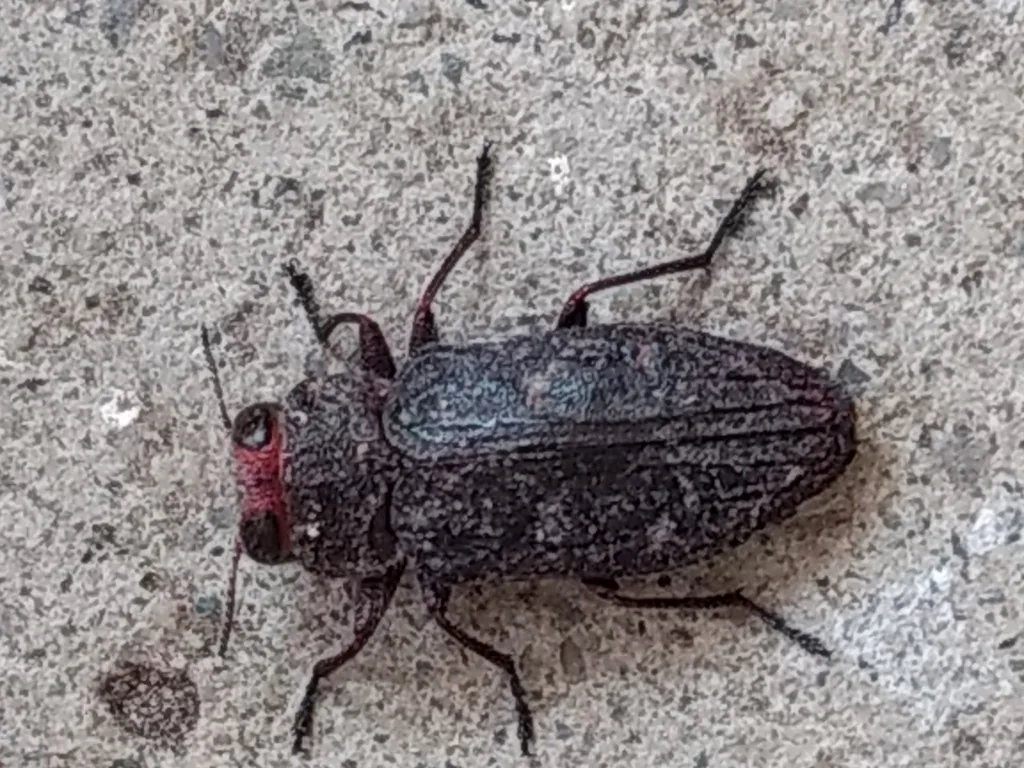
- Adults are flattened, bullet-shaped beetles, dark bronze to coppery or gray with pale mottling or reddish spots, and Oregon State notes a shiny metallic blue or turquoise underside. Size figures differ: UC IPM gives 1/2 to 3/4 inch, Washington State 1/4 to 1/2 inch, and Oregon State 6 to 12 mm, with females larger than males.[1][4][2]
- Larvae are pale yellow to whitish and legless, with a greatly enlarged, flattened segment just behind the head, and they curl into a hook when disturbed. Mature larvae measure 3/5 to 3/4 inch by UC IPM's count, up to 1 inch by Washington State's, and 19 to 32 mm by Oregon State's.[1][4][2]
- Early signs are wet or water-soaked spots and cracking bark, then bark roughened in a winding pattern over the tunnels, and round to D-shaped exit holes about 1/10 inch across. Brown sap may appear near fresh exit holes.[1][2]
Look-alikes
| Look-alike | How to tell them apart |
|---|---|
| American plum borer | Shares hosts with flatheaded borers; check which borer is present before acting.[5] |
| Flatheaded appletree borer | A close relative that is hard to tell apart in the field. It is typically larger (7 to 15 mm), greenish bronze above and below with lighter zigzag markings, and more common in the eastern, central and southeastern United States. Larvae of the two can't be told apart reliably.[2] |
Where it lives
Oregon State and a 2023 study of museum specimens place it west of the Rocky Mountains. In California, UC IPM calls it the most common of at least 69 Chrysobothris species; it can infest at least 70 tree species in 21 plant families, including fruit and nut trees, shade trees and woody ornamentals.[2][3][1]
Biology and life cycle
Each female lays about 100 eggs singly in bark cracks and wounds such as pruning cuts, stake and tie injuries, sunburned bark and graft unions. Eggs hatch in two to three weeks, and the larvae bore straight into the bark to feed in the cambium.[1][2]
Sources differ on where it spends the winter. UC IPM says mature larvae overwinter under the bark, while Oregon State says the larvae move deeper into the heartwood in fall to build pupal chambers. Either way, they pupate in spring.[1][2]
Adults fly mostly April through August in California, especially June and July, and may be active year-round in mild-winter areas. In western Oregon, emergence runs from late May through August, peaking in June and July, and adults fly for about three to five weeks.[1][2]
There is commonly one generation a year, but development can take more than a year in cooler places; Oregon State says some larvae need up to three years.[1][2]
Adults are active, sun-loving beetles that buzz in flight and hide or fly off quickly when disturbed. They prefer to lay eggs on sun-exposed bark of weakened trees.[2][4]
Damage and signs
- Larvae tunnel under the bark in winding galleries packed with powdery frass, killing the cambium. In small trees they can girdle the whole trunk, and damaged limbs may break years later in wind or under heavy crops.[1][2]
- Heavy adult feeding can partly defoliate young trees.[1]
- Stress invites attack: drought, transplanting, sunburn, mechanical injury and diseases such as fire blight all raise the risk. In California, a 2026 study calls it a reemerging walnut pest as walnut acreage has grown and severe droughts have stressed orchards.[2][1][6]
Health risk
It feeds on trees, and none of the extension sources here describe a risk to people.[1][2][4]
Control
Prevention
Plant well-adapted species, avoid trunk and root injuries, and water properly, since drought stress makes trees more attractive to borers. Oregon State adds that late plantings are especially susceptible, so set out new trees early in the dormant season.[1][2]
Whitewash young trunks with indoor white latex paint diluted with an equal amount of water, or wrap them, to prevent the sunburn that attracts egg-laying females. Oregon State warns against oil-based or acrylic paints and notes that borers often attack the sunlit rim of trunk wraps.[1][2]
Sanitation
Prune out limited infestations and remove dying trees. Don't stack freshly cut wood near trees; solarize it under clear plastic, or burn or remove infested wood promptly so adults can't emerge from it.[1][2]
Traps and physical control
In a small infestation, larvae can sometimes be killed by probing their tunnels with a sharp wire, though it is hard to know whether the wire reached the larva.[1]
Biological control
In California the wasp Trigonura californica is the most common parasite of the larvae, and a predatory mite and woodpeckers also feed on them, though woodpeckers flake off bark and add to the injury.[1]
Pesticides
Home sprays are of little use. Washington State says borers can't be controlled once they are inside the bark and recommends no chemical for home trees; UC IPM says products available to homeowners are not effective and a professional applicator is needed to protect especially valuable trees.[4][1]
Scouting orchards and young trees
Check the sunny sides of trunks in summer, especially June and July, for feeding wounds and fresh D-shaped exit holes. Scraping suspect bark with a blade reveals frass-filled galleries.[2]
Late summer to early fall is the time to judge the full extent of larval damage, and winter pruning is a chance to remove and replace damaged trees.[2]
For monitoring in walnut orchards, a 2026 study found that yellow or red triangular sticky traps caught more adults than other colors, and the yellow trap caught them most consistently and earliest in the season.[6]
Common questions
Sources
- University of California Statewide IPM Program, “Pacific Flatheaded Borer (Pests in Gardens and Landscapes).” ipm.ucanr.edu/PMG/GARDEN/FRUIT/PESTS/pacfltheadbor.html (accessed 2026-11-13)
- Oregon State University Extension Service, “Flatheaded borers in nurseries and orchards (EM 9681, January 2026).” extension.oregonstate.edu/sites/extd8/files/catalog/auto/EM9681.pdf (accessed 2026-11-13)
- Ann Entomol Soc Am 2023;116(4):195-206, via PubMed, “Insights from specimen data for two economic Chrysobothris species (Coleoptera: Buprestidae) in the western United States (2023).” pubmed.ncbi.nlm.nih.gov/37465725/ (accessed 2026-11-13)
- Washington State University Extension, “Plum, Prune (Fresh): Pacific flatheaded borer (Hortsense).” hortsense.cahnrs.wsu.edu/fact-sheet/plum-prune-fresh-pacific-flatheaded-borer/ (accessed 2026-11-13)
- University of California Statewide IPM Program, “American Plum Borer (Pests in Gardens and Landscapes).” ipm.ucanr.edu/PMG/GARDEN/FRUIT/PESTS/amerplumbor.html (accessed 2026-11-13)
- Environ Entomol 2026;55(2):nvag033, via PubMed, “Optimizing trap design, lure, and color for monitoring Chrysobothris mali (Coleoptera: Buprestidae) in California walnut orchards (2026).” pubmed.ncbi.nlm.nih.gov/41992977/ (accessed 2026-11-13)
- Global Biodiversity Information Facility (GBIF), “Chrysobothris mali Horn, 1886 (GBIF Backbone Taxonomy).” api.gbif.org/v1/species/6003083 (accessed 2026-11-13)
- iNaturalist, “Chrysobothris mali taxon page (order and family).” www.inaturalist.org/taxa/455233 (accessed 2026-10-06)