On this page
How to identify it
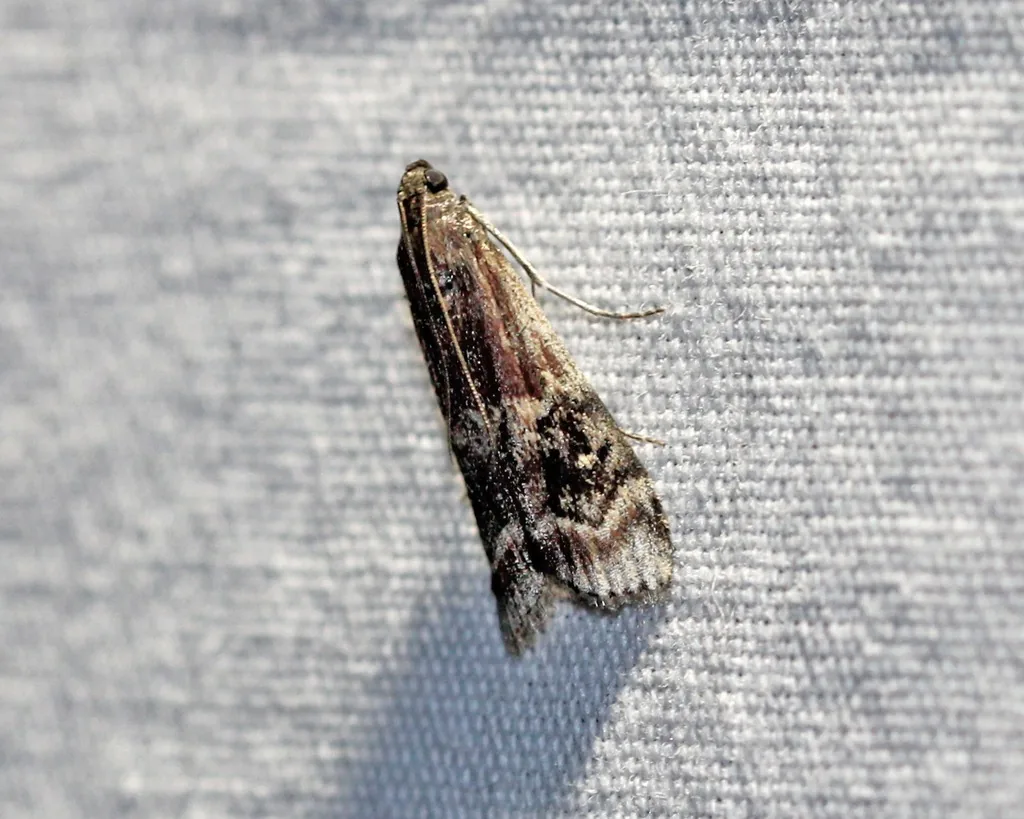
- UC IPM describes the moths as gray with brown and black wing markings and the caterpillars as dull green, pinkish or white, both up to about 1 inch long. NC State describes grayish to reddish-brown moths with two dark spots near the wing tip that can merge into a band, and greenish to pink or almost purple caterpillars with a dark brown head.[1][2]
- Look for heavy gumming, reddish-orange frass and webbing at crotches, on the lower trunk and at the root crown.[1]
- On young trees, early infestations show up as wet spots where sap oozes from feeding sites. Under the bark you'll find galleries packed with frass and white silk cocoons.[2][3]
Look-alikes
| Look-alike | How to tell them apart |
|---|---|
| Clearwing borers | Clearwing moth borers, Pacific flatheaded borers and shothole borers attack some of the same trees but need different controls. UC IPM suggests checking the pattern of tiny hooks on the larva's prolegs with a hand lens before acting.[1] |
| Dogwood borer | Dogwood borer, a clearwing moth, also tunnels between bark and sapwood. In New York apple orchards both borers attack burrknots on dwarfing rootstocks, but American plum borer turned up only in western New York orchards near infested stone fruit.[2][5] |
Where it lives
It's native to North America (the U.S., Canada and Mexico) and has also turned up in Turkey. UC IPM lists fruit and nut trees, mountain ash, olive and sycamore, mostly young trees; NC State calls it a sporadic pest of ornamental plums, cherries and maples, and EFSA counts host plants in 22 genera.[3][1][2]
Biology and life cycle
Moths start flying in April. Females lay eggs in bark wounds, and the newly hatched larvae go straight into the wound to feed. EFSA's review adds that larvae can't attack trees with undamaged bark.[1][3]
Mature larvae spend the winter in cocoons inside the tree. Sources differ on generations: UC IPM says three to four a year, while EFSA's review gives one in parts of Canada and up to three in the southern U.S. and Mexico.[1][2][3]
Egg-laying sites include pruning wounds, fresh grafts, frost cracks and cankers. On apple, larvae also enter through burrknots, the lumpy root bumps that form on the trunk of dwarfing rootstocks.[3][5]
Damage and signs
- Feeding weakens limbs, which often break in wind, and sometimes kills young trees.[1][3]
- In New York surveys it was the most important wood borer in tart cherries and an important pest of peaches with canker disease, but not common in plums or healthy peaches.[4]
- Its tunnels let canker and rot fungi in, and it's known to carry Ceratocystis fimbriata, a fungus that causes cankers.[3]
Health risk
It lives under tree bark; neither UC IPM nor NC State mentions any risk to people.[1][2]
Control
Prevention
Prevent bark wounds from pruning, sunburn and string trimmers; bacterial galls and canker fungi also make trees easy targets. UC IPM suggests whitewashing young trunks with white interior latex paint thinned with water to prevent sunburn.[1]
Biological control
Parasitic wasps and woodpeckers help keep numbers down. EFSA's review lists birds, spiders, beetles, ants, ichneumonid wasps and a Hirsutella fungus among its natural enemies. In New York trials, commercial insect-killing nematodes gave no meaningful control.[2][3][4]
When to call a professional
Where borers are already present, UC IPM says an effective trunk treatment usually needs a licensed professional applicator, timed to peak egg-laying of the first generation; pheromone traps show when that peak flight happens.[1]
Common questions
- What is the orange sawdust and gum at my tree's crotch?
- Probably American plum borer larvae, which cause gumming and reddish-orange frass at crotches and the lower trunk. Rule out clearwing and flatheaded borers before treating.[1]
- How do I prevent it?
- Protect the bark from wounds, since larvae can enter only through fresh injuries, and shade or whitewash young trunks against sunburn.[1][3]
- How many generations are there each year?
- It depends on climate. UC IPM says three to four in California; EFSA's review says one in parts of Canada and up to three farther south.[1][3]
Sources
- University of California Statewide IPM Program, “American Plum Borer (Pests in Gardens and Landscapes).” ipm.ucanr.edu/PMG/GARDEN/FRUIT/PESTS/amerplumbor.html (accessed 2026-11-13)
- NC State Extension, “American Plum Borer in Ornamentals.” content.ces.ncsu.edu/american-plum-borer-in-ornamentals (accessed 2026-11-13)
- European Food Safety Authority (EFSA Journal, via PubMed Central), “Pest categorisation of Euzophera semifuneralis (EFSA Panel on Plant Health, EFSA Journal 21(7):e08120, 2023) (full text).” pmc.ncbi.nlm.nih.gov/articles/PMC10366935/ (accessed 2026-11-13)
- Journal of Economic Entomology, 1999 (via PubMed), “Pest status of American plum borer (Lepidoptera: Pyralidae) and fruit tree borer control with synthetic insecticides and entomopathogenic nematodes in New York State (abstract).” pubmed.ncbi.nlm.nih.gov/10036985/ (accessed 2026-11-13)
- Journal of Economic Entomology, 2004 (via PubMed), “Incidence and control of dogwood borer (Lepidoptera: Sesiidae) and American plum borer (Lepidoptera: Pyralidae) infesting burrknots on clonal apple rootstocks in New York (abstract).” pubmed.ncbi.nlm.nih.gov/15154480/ (accessed 2026-11-13)
- Global Biodiversity Information Facility (GBIF), “Euzophera semifuneralis (Walker, 1863) (GBIF Backbone Taxonomy).” api.gbif.org/v1/species/1875407 (accessed 2026-11-13)