On this page
How to identify it
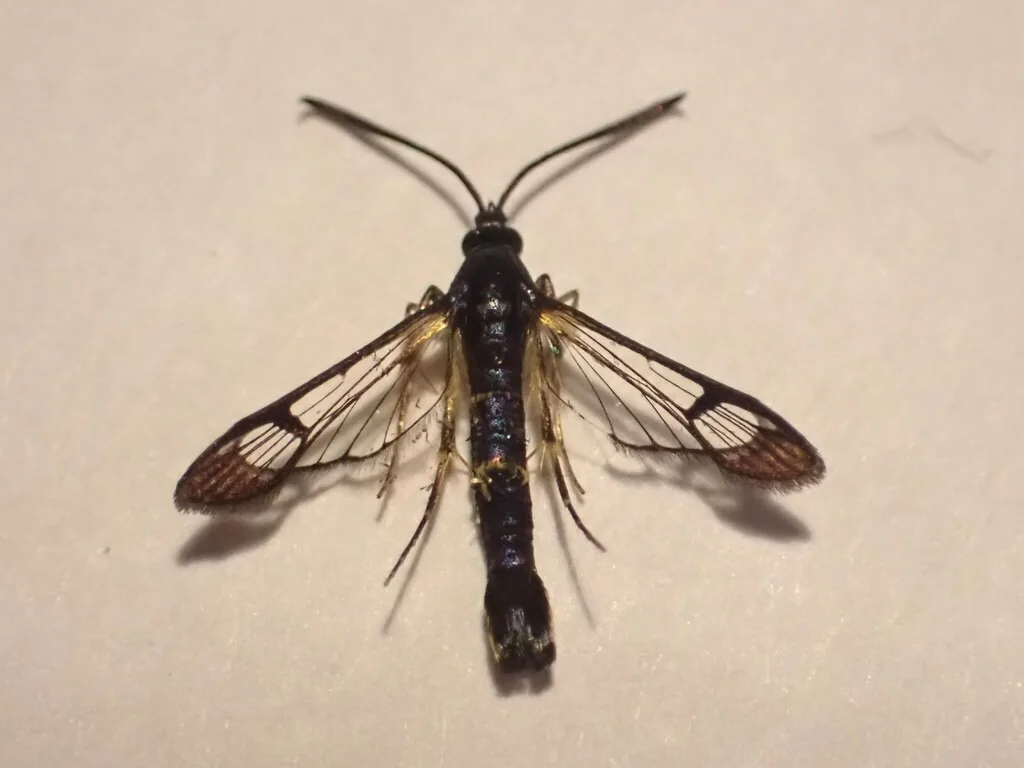
- Adults are small, day-flying clearwing moths with a wingspan of about 1 inch and a black-and-yellow pattern that makes them look like small wasps. The yellow band on the fourth abdominal segment is much wider on females than on males. UF/IFAS gives a body about 1/2 inch (1 to 2 cm) long, bluish-black with a yellow band on the second and fourth abdominal segments.[1][4][10]
- Full-grown larvae are about 1/2 to 5/8 inch long, off-white to light pink (sometimes with an orange tinge), with a reddish-brown to dark brown head. UF/IFAS describes larvae as cream-colored with reddish-brown heads and two reddish-brown spots on the shield just behind the head, growing to over 15 mm (0.6 inch).[1][2][4][10]
- Signs on dogwood include leaves that turn red and drop early, bark sloughing off around holes, brown sawdust-like frass near or below the holes in late summer, and rough, knotty areas on the trunk and large branches.[2]
- On apple, the first sign is reddish-brown, crumbly frass on burr knots. Golden pupal skins sticking out of the feeding site mean adults have emerged, though old skins can stay on the tree for up to a year.[1]
- Eggs are tiny (0.6 x 0.4 mm), oval and marked with a pattern of slightly raised hexagonal lines; they start pale yellow and darken as they develop. The light brown pupae are about 10 mm (2/5 inch) long, inside a cocoon of silk and bits of frass.[10]
Look-alikes
| Look-alike | How to tell them apart |
|---|---|
| Ash/lilac borer | Another clearwing moth borer, whose larvae mine the wood of ash, lilac, olive and privet.[8] |
Where it lives
Native to eastern North America, it occurs throughout the midwestern and eastern United States and southeastern Canada. UF/IFAS describes it as widely distributed east of the Mississippi and in eastern Canada, and notes that cultivated trees are usually more heavily infested than trees in woodlots.[1][3][10]
Biology and life cycle
It overwinters as a nearly mature larva inside its feeding tunnels. In spring the larva feeds again, then pupates in a silk cocoon covered with frass; adults emerge about 25 days later and mate soon after. UF/IFAS says larvae resume feeding once temperatures rise above 7 to 10°C (45 to 50°F), and empty pupal cases stay visibly protruding from the bark after adults leave.[1][4][10]
Females lay eggs singly in bark crevices, especially around healed wounds and burr knots, and seem to prefer trees that are already infested. Eggs hatch after 8 or 9 days.[1][4]
In a 2005 and 2006 pheromone-trap study in New York, West Virginia, Virginia, North Carolina and Tennessee, the first moths were caught around early to mid-May in the southern states and around early June in New York, and catches continued into October in every state. Orchard and urban catches tended to peak twice, from late May through mid-July and from late August through mid-September.[5]
Catches in apple orchards were 13 to 16 times those at urban sites, which in turn caught 13 to 16 times more than woodland sites.[5]
UF/IFAS says larvae pass through seven instars over about a year, that adults are swift fliers, and that borers in various stages of development can be found throughout the year.[10]
Damage and signs
- Larvae feed just under the bark on the inner bark and cambium. If the cambium is destroyed, a branch or the whole tree dies, and infested young dogwoods can be killed in one to two seasons.[2]
- Feeding inside apple burr knots usually does not harm the tree by itself, but larvae that move under the bark can girdle and kill it. Persistent infestations over several years slowly reduce vigor and yield.[1][3]
- Hosts include dogwood, oak, mountain ash, chestnut, willow, hickory, birch, pecan, elm, apple, Prunus species and hazel. Apples on dwarf and semi-dwarf rootstocks that form burr knots are especially prone, and the borer became a bigger orchard pest as growers moved to those rootstocks. UF/IFAS adds American beech, black willow, blueberries, loquat and pines to the host list.[3][1][4][10]
- In apple, feeding stays mostly in the burr knot until that tissue is used up, then moves to the bark next to it. UF/IFAS calls sloughing bark an early symptom, and infested areas turn swollen, knotty, calloused or gall-like.[10]
Health risk
It feeds inside trees; none of the sources describes any harm to people.[1][2]
Control
Prevention
Keep dogwoods healthy with appropriate water, fertilizer and mulch, and protect trunks and branches from wounds, especially from lawn mowers and string trimmers. UF/IFAS adds bracing newly planted trees against wind and removing dead or cankered branches.[2][8][10]
In apple orchard research, plastic spiral-wrap tree guards seemed to increase burr knot tissue and led to significantly more infestation. New Hampshire Extension likewise advises against opaque wrap-around mouse guards, since shade and humidity at the trunk promote burr knots. UF/IFAS reports that vinyl tree wraps around the trunks of young dogwoods actually increased dogwood borer infestation in some cases.[6][4][10]
For apple trees, avoid rootstocks prone to burr knots and plant with the graft union no more than one to two inches above the ground. Mounding soil over existing burr knots up to the graft union keeps moths from laying eggs there, though researchers found it also makes the scion root, which can undo a dwarfing rootstock's size control.[4][3][6]
Keep them out
In New York orchard trials, a trunk barrier of non-woven ethylene vinyl acetate prevented borer infestation but needed reapplying after 2 years; pheromone mating disruption reduced infestation, though less than trunk sprays.[7]
Traps and physical control
Painting the lower trunk with white latex paint before egg-laying begins can significantly reduce infestation.[1]
Biological control
Woodpeckers and nuthatches eat the larvae and pupae, and birds, bats and spiders eat the adults, but UF/IFAS says this natural control may not be enough on its own.[10]
Pesticides
Permethrin is labeled for homeowner use against dogwood borer. Clemson suggests starting in early May and repeating four times at three-week intervals, thoroughly wetting the trunk, major branches and any bark wounds. Follow the label. UF/IFAS notes that longer-lasting insecticides are applied to the lower trunk and burr knots, and refers readers to their local Extension office for specific products.[2][10]
Where sources disagree
Generations: New Hampshire Extension says there is one generation a year; NC State says it is still unclear how many generations occur in the southeastern US. UF/IFAS says one generation a year is typical, some larvae in cooler climates may take two years, and more than one generation a year may occur in Georgia.[4][1][10]
Flight season: Clemson gives late April through July for adults in South Carolina; NC State says adults may be found from May through September; New Hampshire sees a few in June and most in July and August; the five-state trap study caught moths into October.[2][1][4][5]
Pupal stage: NC State and New Hampshire Extension say adults emerge about 25 days after pupation begins; UF/IFAS says the pupal stage generally lasts a month.[1][4][10]
Time of activity: NC State and New Hampshire Extension describe day-flying moths, while UF/IFAS says adults are most active at dawn and twilight.[1][4][10]
Common questions
- Why is the base of my dogwood swollen with sawdust?
- Dogwood borer larvae feeding under the bark at a wound leave rough, knotty bark and brown sawdust-like frass near their holes.[2]
- How do I prevent it?
- Keep mowers and string trimmers away from the trunk and keep the tree healthy; the borers can only get in through wounds or openings in the bark.[2][8]
- What eats dogwood borers?
- Woodpeckers and nuthatches eat the larvae and pupae; birds, bats and spiders eat the adults. UF/IFAS says this natural control may not be enough, so preventing bark wounds still matters most.[10]
Sources
- NC State Extension, “Dogwood Borer (Walgenbach).” content.ces.ncsu.edu/dogwood-borer (accessed 2026-11-11)
- Clemson Cooperative Extension Home & Garden Information Center, “Dogwood Diseases and Insect Pests in South Carolina.” hgic.clemson.edu/factsheet/dogwood-diseases-insect-pests/ (accessed 2026-11-11)
- University of Missouri Extension, “Insect Borers of Fruit Trees (G7190).” extension.missouri.edu/publications/g7190 (accessed 2026-11-11)
- University of New Hampshire Cooperative Extension, “Borers in New Hampshire Apple Trees (fact sheet).” extension.unh.edu/resource/borers-new-hampshire-apple-trees-fact-sheet-0 (accessed 2026-11-11)
- Environmental Entomology, via PubMed, “Dogwood borer abundance and seasonal flight activity in apple orchards, urban landscapes, and woodlands in five eastern states (Bergh et al. 2009).” pubmed.ncbi.nlm.nih.gov/19508761/ (accessed 2026-11-11)
- Journal of Economic Entomology, via PubMed, “Factors promoting infestation of newly planted, nonbearing apple orchards by dogwood borer (Leskey and Bergh 2005).” pubmed.ncbi.nlm.nih.gov/16539141/ (accessed 2026-11-11)
- Journal of Economic Entomology, via PubMed, “Novel barriers to prevent dogwood borer and rodent damage in apple plantings (Agnello et al. 2014).” pubmed.ncbi.nlm.nih.gov/25026680/ (accessed 2026-11-11)
- University of California Statewide IPM Program, “Pest Notes: Clearwing Moths (Publication 7477).” ipm.ucanr.edu/PMG/PESTNOTES/pn7477.html (accessed 2026-11-11)
- iNaturalist, “Synanthedon scitula taxon page (order and family).” www.inaturalist.org/taxa/232126 (accessed 2026-11-11)
- University of Florida IFAS Extension, EDIS (Featured Creatures), “Dogwood Borer, Synanthedon scitula (Harris), EENY-374/IN671 (Featured Creatures).” ask.ifas.ufl.edu/publication/IN671 (accessed 2026-11-14)