On this page
How to identify it
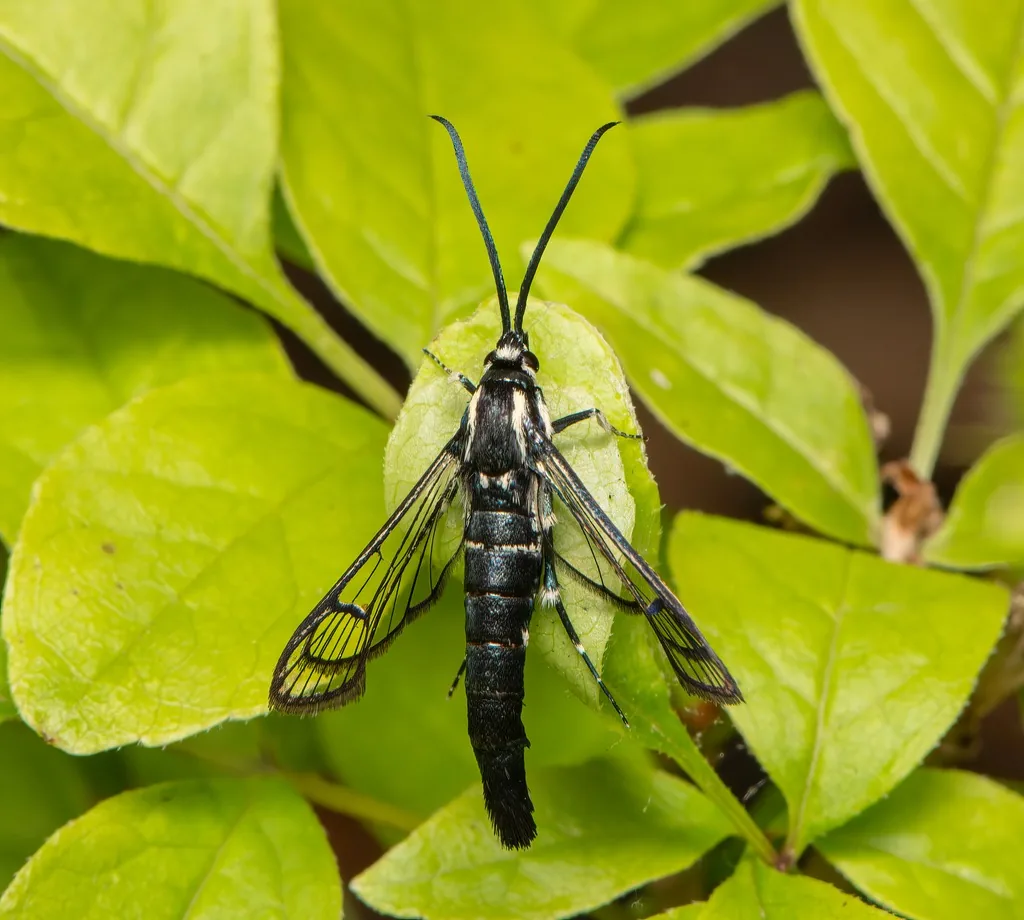
- Adults are slender, wasp-like, dark blue moths with narrow pale yellow bands on the second and fourth abdominal segments and clear wings edged in blue-black scales. Virginia Tech gives a body length of about 1/2 inch; NC State gives a wingspan of 3/4 to 1 1/4 inches and Virginia Tech 6/10 to 1 inch.[1][2][4]
- Gum oozing from the bark, mixed with reddish-brown frass and bits of wood, marks where larvae are feeding. Penn State and Virginia Tech say clear gum without these particles is not borer injury.[1][2][3][4]
- Empty brown pupal skins are often left sticking out of the bark where moths emerged.[1][2][3]
- Grown larvae are about 1 inch long, creamy white (sometimes pinkish) with a light or yellowish-brown head.[1][2][3]
Look-alikes
| Look-alike | How to tell them apart |
|---|---|
| Peachtree borer | The peachtree borer mainly hits young or unmanaged trees at or below the soil line; the lesser borer attacks older trees higher up. Male peachtree borers have 3 to 4 narrow yellow abdominal bands, and Penn State notes the head scales are reversed: yellow between the eyes and black between the antennae in the lesser borer, the opposite in the peachtree borer.[1][3] |
Where it lives
It's native to North America, was first reported in Pennsylvania in 1868 and is now widespread in the East. Virginia Tech calls it the most important indirect pest of peach and nectarine in the mid-Atlantic, and Penn State an important pest of peach and cherry orchards in Pennsylvania.[1][2][4][3]
Biology and life cycle
Moths fly by day, most actively from 10 a.m. to 2 p.m. Kentucky and NC State describe two generations a year, while Penn State says two and possibly a partial third. Flights run roughly May to June and again August to September.[1][2][3]
Kentucky and NC State put egg counts around 400 per female; Penn State says several hundred. Eggs go in cracks, under bark scales and in cankered or wounded spots, and females are drawn to injured or previously infested trees.[1][2][3][4]
Eggs hatch in about 7 to 10 days and larvae bore straight into the inner bark, feeding there for 40 to 60 days. They overwinter at various sizes under the bark, finish feeding in spring and pupate for 3 to 4 weeks.[4][1][2][3]
Peach and nectarine are preferred, but all stone fruits can be attacked, and Virginia Tech says it may be common in black knot galls on plum.[4][1]
Damage and signs
- Most injury is in the upper trunk and scaffold limbs, up to about 8 feet. Bark peels from damaged areas, inviting other pests and diseases; girdled limbs lose production and may break under a fruit load, and trunk girdling can kill trees.[4][1][2]
- Penn State ties problems mostly to widespread Cytospora canker, and to a lesser degree to pruning wounds, winter injury and mechanical damage.[3][4]
Health risk
It feeds on trees. None of the cited extension sources mentions any risk to people.[1][2][3]
Control
Prevention
Prevention is key: once larvae are under the bark, chemical control is usually ineffective. Penn State says any practice that prevents canker and keeps trees growing well helps prevent borer damage.[1][3]
Count empty pupal skins and fresh frass-filled gum on wounds. Penn State and Virginia Tech both treat more than two borers or pupal skins per tree as the point to act.[3][4]
Traps and physical control
Backyard growers can still dig larvae out in spring around bud break with a knife or wire. Cut vertically and remove as little sound bark as possible, since careless digging can hurt the tree more than the borers.[1]
Biological control
Virginia Tech calls pheromone mating disruption the preferred control; in Virginia and Pennsylvania research it beat the old standard trunk spray. Penn State says dispensers must go out before moths emerge in spring and be spread evenly through the block.[4][3]
Pesticides
Sprays only work against larvae hatching on the bark. Kentucky and NC State time them 7 to 14 days after pheromone traps catch the first moths; Penn State treats at peak flight, usually late June, and again in late summer. Kentucky says air-blast sprays do little, so sprays are directed to wet the trunk and scaffold limbs.[1][2][3]
Sources differ on chlorpyrifos, long the most effective trunk spray. Virginia Tech says it is no longer available and that the remaining products may need repeated sprays during moth flight. EPA lists peach among the crops on which chlorpyrifos food use was kept on amended labels in certain states, and use on the crops that were cancelled has been illegal since July 1, 2025.[4][5]
Common questions
- Why is gum oozing from my peach tree?
- Gum mixed with reddish-brown frass often marks lesser peachtree borer feeding.[1]
- Can I spray borers already under the bark?
- Usually not effectively; control focuses on preventing larvae from getting in.[1]
- Is clear gum on my peach tree a borer sign?
- Probably not. Penn State and Virginia Tech say borer gum contains sawdust-like frass and wood chips; clear gum without them has another cause.[3][4]
Sources
- University of Kentucky Entomology (ENTFACT), “Lesser Peachtree Borer (ENTFACT-213).” entomology.mgcafe.uky.edu/ef213 (accessed 2026-11-13)
- NC State Extension, “Lesser Peachtree Borer.” content.ces.ncsu.edu/lesser-peachtree-borer (accessed 2026-11-13)
- Penn State Extension, “Tree Fruit Insect Pest - Lesser Peachtree Borer.” extension.psu.edu/tree-fruit-insect-pest-lesser-peachtree-borer (accessed 2026-11-13)
- Virginia Tech, Virginia Fruit (Department of Entomology), “Lesser Peachtree Borer, Synanthedon pictipes (Grote & Robinson).” www.virginiafruit.ento.vt.edu/lptb.html (accessed 2026-11-13)
- U.S. Environmental Protection Agency, “Chlorpyrifos.” www.epa.gov/ingredients-used-pesticide-products/chlorpyrifos (accessed 2026-11-13)
- Global Biodiversity Information Facility (GBIF), “Synanthedon pictipes (Grote & Robinson, 1868) (GBIF Backbone Taxonomy).” api.gbif.org/v1/species/1940604 (accessed 2026-11-13)