On this page
How to identify it
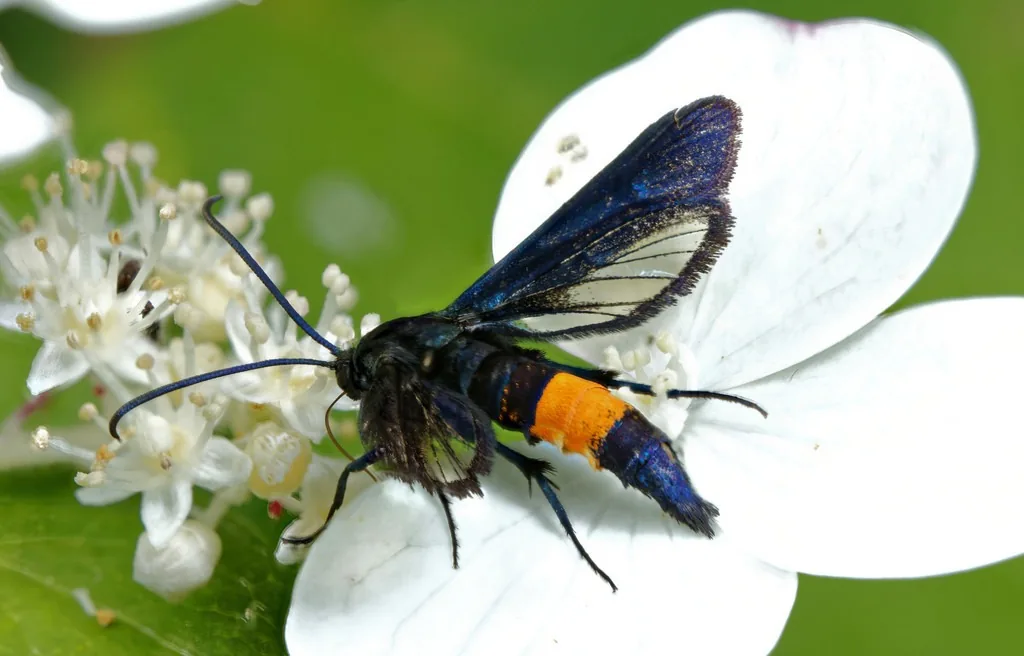
- Adult females are dark metallic or steel blue with opaque front wings and clear hind wings. Penn State and New Hampshire describe one broad reddish-orange band around the abdomen, NC State says two, and Kentucky, Colorado State and Cornell one or two.[1][8][2][5][7][6]
- Males are smaller and slimmer and look like small wasps, with both pairs of wings clear and several narrow yellow bands on the abdomen.[2][5][6][1]
- Mature larvae are about 1 1/4 to 1 1/2 inches long, white to cream, with a dark brown head.[1][2][5]
- Empty light brown pupal skins are often seen sticking out of the trunk or lying around the base of damaged trees.[1][2][7]
Look-alikes
| Look-alike | How to tell them apart |
|---|---|
| Lesser peachtree borer | A related borer that may feed on any part of the tree, while the peachtree borer feeds mainly in the lower trunk and roots.[2] |
| Wasps | In flight the adults look like wasps and are often mistaken for them, but they are day-flying moths.[1][6][8] |
| Cytospora canker | This fungal disease of stone fruits also makes sap ooze from wounds, but borer gum contains wood fragments and frass, and pupal skins turn up near the base of the trunk.[7] |
Where it lives
Native to North America, mainly east of the Rocky Mountains; in California it is found mostly in coastal areas and the northern San Joaquin Valley.[1][3]
Biology and life cycle
Larvae of different sizes spend the winter under the bark, close to or below ground level, and resume feeding in spring. Penn State, NC State, Kentucky and Colorado State describe one generation a year, while Cornell says some larvae take two years to develop.[1][2][8][5][7][6][3]
Mature larvae pupate in a cocoon of silk with chewed bark, frass or soil, usually at or just below the soil line, for about 18 to 30 days.[2][5][6]
Adults fly during the day, mostly from late morning to early afternoon. Flight dates vary by region: late June to early September in Pennsylvania, June 10 to August 30 in New Hampshire (peak about July 10 to 15), early July into October in New York, and May to September in California.[1][5][8][6][3]
Each female lays 200 to 800 eggs, according to Penn State and NC State; Kentucky and Colorado State give an average of 500 to 600, and Cornell about 400. Eggs go on the lower trunk, in bark crevices or on nearby soil and weeds, and hatch in about 7 to 10 days.[1][2][5][7][6][8]
Young larvae crawl down the trunk and enter the bark at or below the soil line, often through cracks or wounds, then feed on the growing layer beneath it. Females are drawn to trees that already have borer damage or mechanical injury.[2][5][7][6][8]
Damage and signs
- Gum oozes from the trunk near the soil line, often mixed with sawdust, frass and soil. Penn State puts the zone from about 3 inches below to 12 inches above the soil; Cornell says larvae usually attack from 3 inches below to 10 inches above ground.[1][6][2][5]
- Heavy feeding in the trunk can girdle and kill a tree; root feeding reduces vigor and fruit production, and young trees are especially vulnerable. Colorado State says most infested trees die if left untreated.[2][3][5][6][7]
- Stressed trees, such as new transplants, drought-stressed trees and trunks nicked by mowers or trimmers, are more likely to be attacked. Penn State says attacks usually occur on trees more than two inches in diameter, while Cornell says trees of all ages are injured.[1][6]
Health risk
It is a tree pest only; the wasp-like adults are clearwing moths, and the adult stage doesn't feed.[1]
Control
Prevention
Don't pile mulch around the base of Prunus trunks, which attracts egg-laying females, and avoid wounding the bark at the base of the tree. Healthy, well-watered and fertilized trees withstand borers better than stressed ones.[1][7]
Traps and physical control
Home gardeners can dig larvae out in the fall: pull the soil back 4 to 5 inches from the trunk base, cut vertically and as little as possible into sound bark to find and remove the larvae with a knife or wire, then put the soil back to its original level.[5][7]
Remove and destroy severely infested trees.[1]
Biological control
An egg parasitoid, several larval parasitoids, a pupal parasitoid and some small mammal and arthropod predators attack the peachtree borer. In orchard trials, the insect-killing nematode Steinernema carpocapsae applied to infested trees gave more than 80% control of larvae already in the tree, where a standard trunk insecticide failed.[1][10][11]
In orchards, mating disruption dispensers flood the air with synthetic sex attractant so males can't find females. Kentucky says it works best in blocks of at least 5 acres with low starting populations, and a West Virginia trial found infestation similar to insecticide-treated plots.[5][7][9]
Pesticides
Pheromone traps baited with the female sex attractant catch males and show when moths are flying. Identify catches carefully, because other clearwing moths such as lilac and dogwood borers also turn up in the traps.[1][5][7]
Trunk sprays work only in the window around egg hatch, before larvae get under the bark. Timing advice differs: Penn State says 7 to 10 days after the first male is trapped, Kentucky 7 to 14 days and NC State 8 to 16 days, while UC IPM times sprays to adult emergence in May and again 6 weeks later. Wet the lower trunk thoroughly and follow the label.[1][5][2][3][7]
Trunk sprays are unlikely to kill larvae already inside the tree but protect against new egg-laying, so results may not show until the next season.[3][5][7]
Common questions
- Why is gum oozing from the base of my peach tree?
- Gum mixed with sawdust near the soil line is one of the first signs of peachtree borer larvae tunneling under the bark; Colorado State notes that Cytospora canker also causes oozing, but without frass and pupal skins.[1][2][7]
- When should I treat for peachtree borer?
- Time any treatment to the brief period after adults emerge and before eggs hatch; pheromone traps tell you when the moths are flying. Sprays don't reach larvae already under the bark.[2][1][5]
- Can I get rid of peachtree borers without spraying?
- Yes, on a few backyard trees: dig the larvae out in the fall after pulling back 4 to 5 inches of soil, keep mulch away from the trunk and avoid bark wounds.[5][7][1]
Sources
- Penn State Extension, “Peachtree Borer (updated April 10, 2026).” extension.psu.edu/peachtree-borer (accessed 2026-11-11)
- NC State Extension, “Peachtree Borer (published February 23, 2015).” content.ces.ncsu.edu/peachtree-borer (accessed 2026-11-11)
- University of California Statewide IPM Program, “Peachtree Borer, UC IPM Pest Management Guidelines: Peach (UC ANR Publication 3454).” ipm.ucanr.edu/agriculture/peach/peachtree-borer/ (accessed 2026-11-11)
- iNaturalist, “Synanthedon exitiosa taxon page (order and family).” www.inaturalist.org/taxa/143277 (accessed 2026-11-11)
- University of Kentucky Entomology, “Peachtree Borer, ENTFACT-200 (R. Bessin).” entomology.ca.uky.edu/ef200 (accessed 2026-11-11)
- Cornell University, New York State Integrated Pest Management, “Peachtree borer (Synanthedon exitiosa) Fruit Fact Sheet.” cals.cornell.edu/integrated-pest-management/outreach-education/fact-sheets/peachtree-borer-synanthedon-exitiosa-fruit-fact-sheet (accessed 2026-11-11)
- Colorado State University, Department of Agricultural Biology, “Peachtree Borer, Synanthedon exitiosa.” agsci.colostate.edu/agbio/ipm-pests/peachtree-borer (accessed 2026-11-11)
- University of New Hampshire Cooperative Extension, “Peach Tree Borers in New Hampshire [fact sheet].” extension.unh.edu/resource/peach-tree-borers-new-hampshire-fact-sheet (accessed 2026-11-11)
- Insects, via PubMed, “Comparison of mating disruption and insecticide application for control of peachtree borer and lesser peachtree borer (Lepidoptera: Sesiidae) in peach (2020), Insects.” pubmed.ncbi.nlm.nih.gov/32992791/ (accessed 2026-11-11). Cited from the PubMed abstract.
- Journal of Nematology, via PubMed, “Shapiro-Ilan DI, Cottrell TE, Mizell RF, Horton DL (2016), Curative control of the peachtree borer using entomopathogenic nematodes, Journal of Nematology 48(3):170-176.” pubmed.ncbi.nlm.nih.gov/27765990/ (accessed 2026-11-11). Cited from the PubMed abstract.
- Journal of Invertebrate Pathology, via PubMed, “Susceptibility of the peachtree borer, Synanthedon exitiosa, to Steinernema carpocapsae and Steinernema riobrave in laboratory and field trials (2006), Journal of Invertebrate Pathology.” pubmed.ncbi.nlm.nih.gov/16707138/ (accessed 2026-11-11). Cited from the PubMed abstract.