On this page
How to identify it
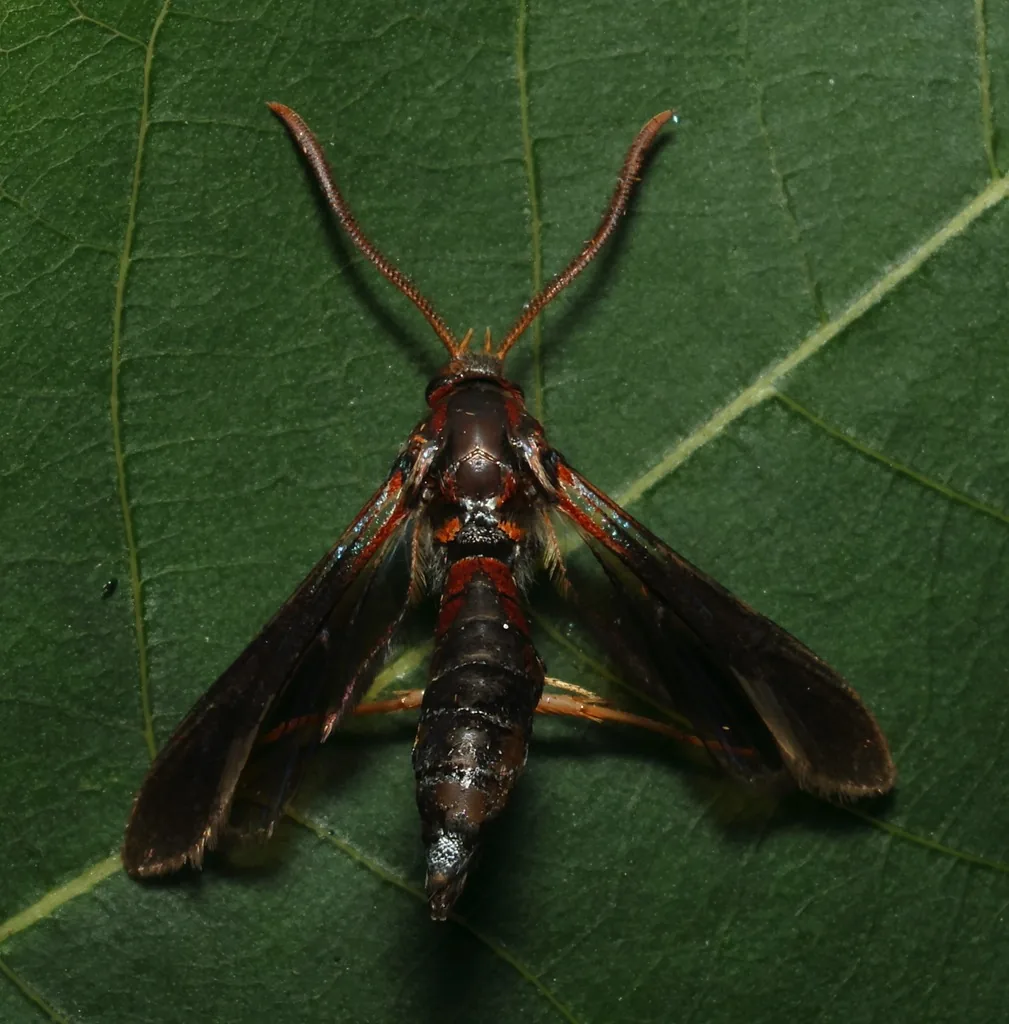
- Adults mimic paper wasps in size, color and flight, with narrow dark front wings and clear hind wings, and fly by day. Colorado State gives a wingspan of about 28 to 35 mm (about 1 inch); Utah State says 1 to 1 1/2 inches, with females somewhat larger than males.[1][2][3]
- In the West, the male has long brownish legs and a black body with narrow yellow bands.[1]
- Larvae are whitish caterpillars with a dark head: UC IPM says 1 to 1 1/2 inches long and whitish to pink, and Utah State says about 1 inch and white with a brown head. Colorado State says the small prolegs with rings of hooks separate them from the beetle larvae that also bore in ash.[1][3][2]
- Signs are sawdust-like frass pushed from tunnels, roughly 1/4-inch round exit holes, and empty brownish pupal skins left sticking out of the bark after adults emerge.[1][2][3]
Look-alikes
| Look-alike | How to tell them apart |
|---|---|
| Emerald ash borer | The emerald ash borer is an introduced beetle, not a moth, and is far more deadly to ash. Colorado State says emerald ash borer leaves D-shaped exit holes about 1/8 inch across and attacks the upper crown first, while lilac/ash borer leaves irregular round holes about 1/4 inch across, mostly in the lower trunk.[1][2] |
| Paper wasps | Clearwing moths mimic wasps in color and behavior, running about while fluttering their wings.[1] |
Where it lives
UC IPM says it occurs throughout the United States, and Utah State says throughout the US and Canada; UC IPM says it varies in look and behavior by region. Sources differ on how high it attacks: UC IPM says mostly within 5 to 10 feet of the ground in California's Central Valley, Colorado State about 10 feet up the trunk, and Utah State says it starts low but may be found 25 feet up.[1][3][2]
Biology and life cycle
Adults live about a week. Females lay eggs in bark cracks, crevices and wounds, singly or in small groups. Sources describe the eggs differently: UC IPM says reddish to pale pink, Utah State says tan.[1][2][3]
Sources differ on hatch time: Colorado State says 9 to 13 days, Utah State within 14 days, and UC IPM one to four weeks for clearwing moths in general. Larvae feed under the bark first, then tunnel upward into the wood, and pupate just under the bark.[2][3][1]
There is one generation a year. It overwinters as a larva in its tunnel: Colorado State says partly grown, Utah State says mature. Adults fly in spring: UC IPM says April through July in California, Colorado State says first emergence early April to early May, lasting 4 to 6 weeks, and Utah State late April (sometimes late March) to mid-July.[1][2][3]
Damage and signs
- Tunnels damage the food- and water-conducting tissue, roughen and gnarl the bark and can weaken or kill branches; Utah State says heavy infestations increase wind breakage and can kill whole plants. Colorado State says killing a tree is rare and damage to well-established, well-watered trees is usually insignificant.[1][3][2]
- Attacks are most common on stressed trees: bark injured by pruning, staking or earlier borers (UC IPM), recently transplanted, street and parking-lot ash (Colorado State), and fresh pruning wounds (Utah State). On lilac and privet, Colorado State says larvae can girdle and kill smaller stems.[1][2][3]
Health risk
The larvae feed inside trees, and no cited source describes any risk to people or pets.[1][2][3]
Control
Prevention
Keep trees vigorous: water deeply at the drip line, avoid trunk and root wounds, and in hot areas whitewash young trunks with diluted white interior latex paint (UC IPM). Colorado State says relieving the stress, for example with extra water, should come first. Utah State suggests renewal pruning of lilac, removing older stems at the base, since borers prefer older branches.[1][2][3]
Traps and physical control
Prune out infested branches outside the flight season, since fresh wounds attract egg-laying moths, and kill larvae by probing tunnels with a stiff wire.[1][3]
Biological control
UC IPM says commercially sold Steinernema nematodes injected into tunnels kill at least some clearwing larvae, and says these nematodes kill only insects.[1]
Pesticides
Insecticides only prevent attack: they are sprayed on the trunk and lower limbs to kill newly hatched larvae before they bore in, timed with clearwing pheromone traps, and won't save trees already infested. Colorado State and Utah State name permethrin and bifenthrin, and both say imidacloprid doesn't work on this borer. Sources differ on who can buy effective products: UC IPM says effective wood-borer insecticides are available only to licensed applicators, while Colorado State says some permethrin products for this borer are sold at nurseries and hardware stores. Follow the label.[1][2][3]
When to call a professional
Colorado State says chlorantraniliprole is available to commercial applicators, and that emamectin benzoate trunk injections by a certified applicator, used against emerald ash borer, may also work on lilac/ash borer larvae. It says mature ash usually don't need treatment.[2]
More from Colorado State Extension
Colorado State University Extension notes most feeding is in the lower trunk around the soil line and up to about 10 feet, with roughly 1/4-inch round exit holes that often hold an empty pupal skin; serious problems almost always involve stressed, recently planted or street and parking-lot ash, and it should not be confused with the far more damaging emerald ash borer.[2]
Common questions
- Is the ash borer the same as the emerald ash borer?
- No. The ash borer is a clearwing moth; the emerald ash borer is a beetle.[1]
- Why is sawdust coming out of my lilac?
- Sawdust-like frass at tunnel openings is a classic sign of clearwing borer larvae such as the lilac borer.[1]
- Can insecticides save a heavily infested tree?
- No. UC IPM and Utah State say insecticides have little or no effect on borers already inside; they only help protect trees before larvae bore in.[1][3]
- When should trunk sprays go on for lilac/ash borer?
- Around egg hatch. Colorado State says hatch comes about 10 to 14 days after adults start emerging, usually mid-April to mid-May there; Utah State uses pheromone traps and degree-days and says the first spray goes on within 10 to 20 days of adult emergence, depending on location.[2][3]
Sources
- University of California Statewide IPM Program, “Pest Notes: Clearwing Moths (Publication 7477).” ipm.ucanr.edu/PMG/PESTNOTES/pn7477.html (accessed 2026-11-13)
- Colorado State University Extension, “Lilac/Ash Borer: A Common Wood Borer of Colorado's Street Trees.” extension.colostate.edu/resource/lilac-ash-borer-a-common-wood-borer-of-colorados-street-trees/ (accessed 2026-11-13)
- Utah State University Extension and Utah Plant Pest Diagnostic Laboratory, “Lilac-Ash Borer (Utah Pests Fact Sheet ENT-135-10).” extension.usu.edu/planthealth/uppdl/files/factsheet/lilac-ash-borer10.pdf (accessed 2026-11-13)
- Global Biodiversity Information Facility (GBIF), “Podosesia syringae (Harris, 1839) (GBIF Backbone Taxonomy).” api.gbif.org/v1/species/1941310 (accessed 2026-11-13)